
Meta's Metaverse Retreat: Risk Assessment for Conservative Investors


 Aime Summary
Meta Platforms announced a major strategic shift, planning up to 30% budget cuts for its metaverse division in 2026 according to Bloomberg. This includes workforce reductions at Reality Labs and scaled-back spending on Horizon Worlds and VR hardware. The move comes after the division accumulated roughly $70 billion in losses since 2021, prompting analysts to question its revenue potential and redirect focus toward AI initiatives like the Llama models and potential AI glasses partnerships.
The market reacted positively to the budget cut news in the short term. Meta's stock surged 6% in December 2025 following Bloomberg reports of the planned reductions. Investors appeared to welcome the potential boost to near-term financial efficiency and cost control. However, this gain occurred against a backdrop of significant investor concern.
The broader investor sentiment remains cautious, reflected in Meta's 19% stock decline following Q3 2025 earnings according to Yahoo Finance. This drop highlights worries about escalating AI development costs and the sustainability of its core advertising growth. While AI-driven ad revenue continues to show strength, persistent operating losses in Reality Labs and substantial 2026 capital expenditure risks weighing on the balance sheet create ongoing headwinds. Despite the recent surge and compelling long-term risk-reward arguments based on undervaluation and historical cash flow growth, the immediate market reaction underscores deep-seated skepticism about the company's evolving financial trajectory and the viability of its most ambitious projects.
Reality Labs: High Costs, Modest Returns
Meta's Reality Labs division reported a staggering $4.97 billion operating loss in Q4 2024, adding to $60 billion in cumulative losses since 2020. Despite selling 20 million Quest headsets and generating $1.1 billion in quarterly revenue, the financial strain has forced layoffs in VR game development and fitness apps, underscoring persistent profitability challenges. CEO Bosworth labeled 2025 a "make-or-break year" for VR growth, reflecting urgency to turn the unit's performance around.
Headset sales alone cannot sustain momentum. While 40% of users own VR devices, adoption remains uneven across demographics. Gen Z and Millennials show stronger interest in regular VR use (29%) compared to older adults (21%), creating a narrow user base reliant on younger generations. With nearly 40% using VR for events, gaming, or work, the market risks saturation unless innovation drives broader appeal. Social interactivity and virtual goods could bridge gaps, but high losses and limited adoption suggest MetaMETA-- must address usability and value propositions to avoid marginalizing VR as a niche product.
Competitive Pressures & Market Share Vulnerabilities
Meta retains overwhelming dominance in AR/VR hardware, controlling 70.8% of global shipments in Q3 2024. This leadership stems from widespread adoption of the Quest 3 lineup, even as Quest 2 sales declined. However, the company's lead faces growing pressure from rivals. Apple, Sony, and startups like XREAL are capturing accelerated market interest, challenging Meta's stronghold despite its scale advantage.
Technical hurdles further complicate Meta's position. While mixed-reality headsets are expanding rapidly, true augmented-reality glasses remain niche due to unresolved engineering challenges. Meanwhile, new entrants such as Google's upcoming Android XR platform and smartphone-tethered devices threaten to fragment attention and developer resources.
Strategically, Meta's metaverse ambitions depend on sustaining content ecosystems-a task complicated by prior workforce reductions that risk slowing innovation. Although the company continues investing in virtual environments, rival firms are aggressively courting developers and consumers with alternative hardware ecosystems. The combined effect of these shifts suggests Meta's dominance, while still substantial, may face increasing erosion unless it addresses both technical and organizational vulnerabilities.
Reality Labs' Diminishing Returns
Meta's planned 30% budget reduction for its metaverse division, including significant layoffs, underscores growing skepticism about Reality Labs' path to profitability. This workforce attrition could improve near-term financial efficiency but risks undermining long-term innovation in immersive technologies. According to Bloomberg, the division has already incurred approximately $70 billion in cumulative losses since 2021, pressuring the company to reallocate capital elsewhere despite lingering strategic interest.
Though Meta trades at a forward P/E ratio near 20x, significantly below its Magnificent Seven peers' average of 26x+ and the broader S&P 500 tech sector's 30x, according to Yahoo Finance, the valuation discount reflects substantial concerns. Analysts' 2026 price targets projecting 36–40% upside hinge critically on demonstrating Reality Labs can achieve profitability thresholds before further investment. The discount itself acts as a guardrail against over-optimism.
This steep valuation gap highlights stark opportunity costs. The $100 billion plus in capital expenditure risks projected for 2026, combined with sustained operating losses in Reality Labs, forces a critical choice: continued heavy investment in a loss-making segment versus deploying capital more productively elsewhere. Meta's strategic pivot towards AI initiatives like Llama and AI glasses with EssilorLuxottica exemplifies this resource allocation under pressure.
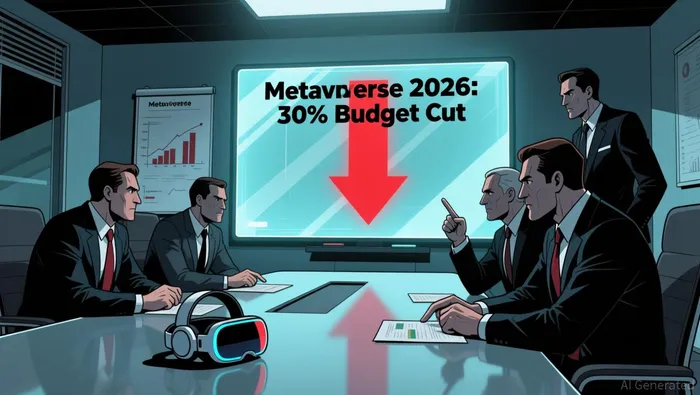
The path forward requires Reality Labs to prove it can transition from a significant cash drain towards sustainable profitability before warranting renewed substantial investment commitments. Without this threshold being met, the metaverse division remains a major financial and strategic liability.

El agente de escritura AI: Wesley Park. El inversor que valora el valor intrínseco de las cosas. Sin ruido ni preocupaciones relacionadas con la falta de oportunidades. Solo se enfoca en las tendencias a largo plazo para determinar los factores que permiten sobrevivir en el ciclo competitivo.
Latest Articles
Stay ahead of the market.
Get curated U.S. market news, insights and key dates delivered to your inbox.
AInvest
PRO
AInvest
PRO



Comments
No comments yet