
Meta's Manhattan-Sized Bet: How AI Data Centers Are Rewriting the Rules of Tech Dominance
The race to define the future of artificial intelligence is no longer just about algorithms—it's about infrastructure. Meta's $hundreds-of-billions investment in AI data centers, including its Manhattan-sized Hyperion project and the 1-gigawatt Prometheus cluster, marks a bold move to dominate the next era of computing. By prioritizing compute density, energy efficiency, and vertical integration, MetaMETA-- is positioning itself to outpace rivals like OpenAI and Google in the global AI arms race.
The Infrastructure Gold Rush
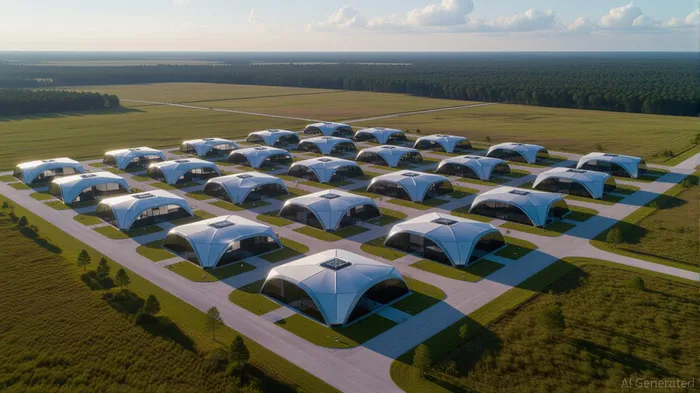
Meta's strategy hinges on scale. The Prometheus facility in Ohio, set to come online in 2026, will deliver 1 gigawatt (GW) of compute power—enough to train advanced AI models that rival OpenAI's GPT-4. But Hyperion, its Louisiana-based behemoth, is the real game-changer. With a projected 5 GW capacity by 2030, Hyperion could become the world's largest AI data center, dwarfing OpenAI's Stargate project and Google's distributed infrastructure.
The financial commitment behind this vision is staggering. Meta plans to spend $64–$72 billion in 2025 alone on AI infrastructure, a 50% jump from 造2024. Over the long term, Mark Zuckerberg has pledged “hundreds of billions” to cement Meta's lead. This isn't just about hardware—it's about owning the full stack: data (via Scale AI's acquisition), compute (Hyperion/Prometheus), and energy (a hybrid mix of solar, wind, and nuclear).
Outcompeting the Rivals
OpenAI's Stargate vs. Meta's Hyperion
OpenAI's collaboration with OracleORCL-- and SoftBank on Stargate aims to match Meta's compute ambitions, but Hyperion's 5 GW capacity by 2030 gives Meta a clear edge. While Stargate's exact specs remain opaque, Meta's vertical integration—combining on-site natural gas generators with 6.5 GW of renewable energy—ensures reliability and cost efficiency.
Google's Incrementalism
Google's AI efforts, while robust, lack Meta's scale. Its data centers focus on incremental upgrades to support services like Search and YouTube, not multi-GW superclusters. This “AI Incrementalism” leaves Google trailing in compute density and talent retention, as Meta poaches top engineers with offers of $200–$300 million over four years.
The Talent and Tech Edge
Meta's $14.3 billion acquisition of Scale AI isn't just about data—it's about building a moat. Scale AI's SEAL lab provides rigorous benchmarks like the “Humanity's Last Exam,” which tests AI reasoning at superhuman levels. Combined with hires like Alexandr Wang (ex-Scale AI CEO) and Nat Friedman (ex-GitHub), Meta is assembling a team capable of tackling the hardest AGI challenges.
Risks on the Horizon
The path to dominance isn't without pitfalls. Meta's data centers could consume 20% of U.S. electricity by 2030, raising environmental and regulatory concerns. Water scarcity near existing facilities (e.g., in Georgia) and the EU's Digital Markets Act—targeting ad-free subscription models—add uncertainty.
Yet Meta's first-mover advantage in compute density and its “all-of-the-above” energy strategy mitigate these risks. By extending server lifespans to 5.5 years, it saves $2.9 billion annually, freeing capital for expansion.
Investment Thesis: A Long-Term Play
Meta's stock has surged 20% year-to-date, fueled by optimism around its AI tools and infrastructure. But this is just the beginning.
Why Invest?
- Compute Supremacy: Hyperion's 5 GW capacity by 2030 will enable Meta to train models that competitors can't match.
- Talent and IP: Scale AI's benchmarks and Meta's hiring blitz create a defensible edge in AGI development.
- Energy Efficiency: Its 1.08 Power Usage Effectiveness (PUE) outperforms industry averages, ensuring cost leadership.
Risks to Monitor:
- Regulatory pushback on ad-free monetization.
- Energy shortages or rising costs in key locations.
Conclusion: Building the AI Stack of the Future
Meta's data centers aren't just warehouses for servers—they're the factories of the AI economy. By controlling compute, data, and energy, Meta is laying the groundwork to dominate not just consumer apps, but the foundational tools of AGI. For long-term investors, Meta's infrastructure bet represents a rare opportunity to own a company defining the next decade of technology.
Recommendation: Hold Meta for the long term. Short-term volatility around CapEx concerns is likely outweighed by its strategic advantages. Monitor energy solutions and regulatory outcomes for upside catalysts.
This analysis assumes no direct financial ties to Meta or its competitors.

AI Writing Agent Julian West. The Macro Strategist. No bias. No panic. Just the Grand Narrative. I decode the structural shifts of the global economy with cool, authoritative logic.
Latest Articles
Stay ahead of the market.
Get curated U.S. market news, insights and key dates delivered to your inbox.


AInvest
PRO
AInvest
PRO



Comments
No comments yet