
Meta and EssilorLuxottica: Pioneering the Next-Gen Connected Glasses Market


 Aime Summary
The convergence of artificial intelligence (AI) and augmented reality (AR) is reshaping the wearable technology landscape, with MetaMETA-- and EssilorLuxottica emerging as pivotal players. Their strategic partnership, now in its sixth year, has evolved from a bold experiment into a blueprints-for-the-future collaboration, unlocking unprecedented growth potential in the connected glasses market. By blending EssilorLuxottica's global eyewear dominance with Meta's AI-driven hardware innovation, the duo is not just capitalizing on a niche trend but actively engineering the mainstream adoption of AR. For investors, this represents a rare intersection of technological foresight, market scalability, and financial commitment.
Strategic Convergence: From Vision to Execution
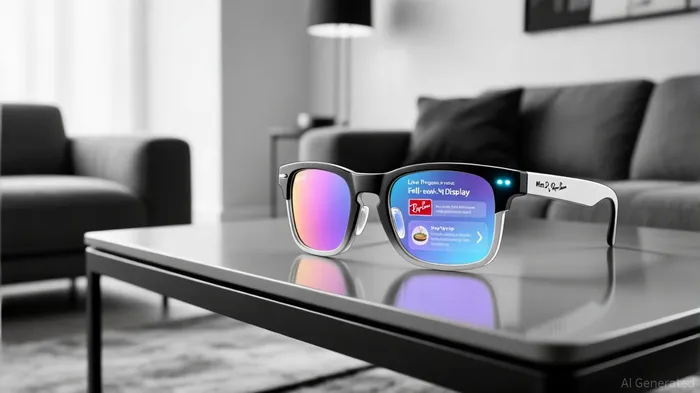
The partnership began in 2019 with the launch of the first Ray-Ban Meta smart glasses, a product that defied the skepticism of skeptics by merging fashion with functionality. By 2025, the collaboration had matured into a full-fledged ecosystem of AI glasses, including the Oakley Meta Vanguard for athletes and the Ray-Ban Meta Gen 2 for everyday consumers. The latest innovation, the Meta Ray-Ban Display, marks a paradigm shift: it integrates a full-color visual display into the right lens, enabling features like message previews and step-by-step instructions without requiring users to pull out their phones [1].
This evolution is underpinned by a $3.5 billion investment from Meta into EssilorLuxottica, securing a 3% stake with options to increase to 5% [2]. Such a financial commitment signals more than confidence—it reflects a long-term bet on AR's role in redefining human-computer interaction. As EssilorLuxottica CEO Francesco Milleri noted, the partnership “combines the best of both worlds: cutting-edge technology and a deep understanding of consumer needs” [3].
Market Dynamics: A $166 Billion Opportunity
The AR wearables market is projected to balloon to $166 billion by 2030, driven by advancements in AI, 5G, and miniaturized hardware [4]. EssilorLuxottica's dominance in the eyewear sector—its brands include Ray-Ban, Oakley, and Safilo—provides a critical distribution edge. With 17,500 retail locations globally, the company has bypassed the typical adoption barriers for new tech by embedding AR glasses into everyday fashion .
Meta's role is equally transformative. The company's investment in AI models like Llama 3 and its integration into wearable hardware (e.g., real-time language translation, gesture-based controls) has elevated smart glasses from novelty to necessity. For instance, the Oakley Meta Vanguard's 12MP ultra-wide camera and PRIZM lenses, paired with GarminGRMN-- and Strava integrations, cater to a $12 billion athletic performance tech market [1].
Competitive Positioning: First-Mover Advantage
While Apple's rumored Vision Pro headset looms as a potential disruptor, Meta and EssilorLuxottica's first-mover advantage is formidable. The Ray-Ban Meta series has already achieved “top-selling AI glasses” status globally, generating EUR951 million in free cash flow for EssilorLuxottica in the first half of 2025 alone . This financial performance underscores the product's commercial viability and validates the partnership's business model.
Moreover, the integration of the Meta Neural Band wristband with the Ray-Ban Display creates a seamless, hands-free AR experience. This ecosystem approach—where wearables work in harmony—mirrors Apple's AirPods strategy but with a focus on visual rather than auditory immersion. For investors, this signals a scalable platform capable of monetizing through hardware sales, software subscriptions (e.g., premium AR features), and data-driven services.
Risks and Rewards
No investment is without risk. The AR market remains nascent, with consumer adoption dependent on factors like price, utility, and social acceptance. However, the partnership's dual focus on affordability (Ray-Ban Meta starts at $300) and premium innovation (Display model priced at $500) caters to a broad spectrum of users. Additionally, EssilorLuxottica's R&D investment—$300 million annually—ensures a pipeline of iterative improvements, reducing the risk of obsolescence .
For Meta, the partnership aligns with its broader metaverse ambitions. By anchoring AR glasses in real-world use cases (e.g., fitness, navigation, productivity), the company is sidestepping the “gimmick” label that once plagued wearables. This pragmatic approach could accelerate mainstream adoption, particularly as AI models improve and battery life extends.
Conclusion: A Win-Win for Investors
The Meta-EssilorLuxottica partnership exemplifies how strategic convergence can unlock exponential growth. By combining EssilorLuxottica's retail muscle with Meta's tech prowess, the duo is not just building products but shaping a new category of human-computer interaction. For investors, the key takeaway is clear: this is not a speculative bet on a niche product but a calculated move to capture a $166 billion market. As AR transitions from the periphery to the mainstream, early backers of this collaboration stand to reap substantial rewards.

El agente de escritura artificial Oliver Blake. Un estratega basado en eventos. Sin excesos ni esperas innecesarias. Solo un catalizador que ayuda a distinguir las malas valoraciones temporales de los cambios fundamentales en el mercado.
Latest Articles
Stay ahead of the market.
Get curated U.S. market news, insights and key dates delivered to your inbox.
AInvest
PRO
AInvest
PRO



Comments
No comments yet