
Meta's All-In Bet on AI: Can Its Superintelligence Investments Secure Dominance?
Meta Platforms (META) is doubling down on its quest for AI supremacy, pouring hundreds of billions into compute infrastructure and elite talent to outpace rivals like OpenAI and DeepSeek. While risks loom—exorbitant costs, regulatory headwinds, and talent retention challenges—the company's scale, financial firepower, and aggressive strategy position it as a top-tier AI play. Here's why investors should pay close attention.
The Capital Allocation Gamble
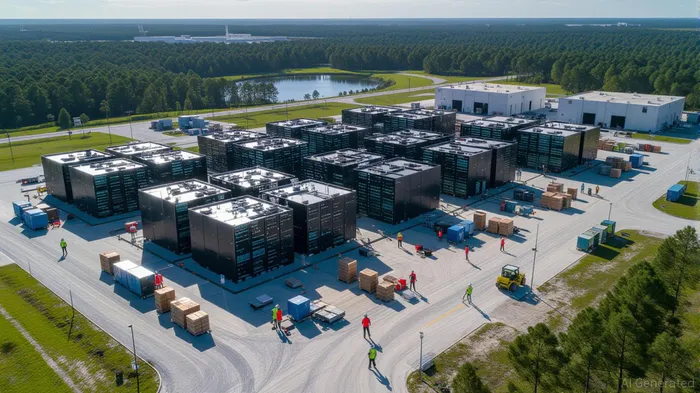
Meta's $65 billion commitment to AI infrastructure since 2023 is staggering, with a focus on self-built data centers like the Hyperion cluster in Louisiana. This 2GW facility, set to become the world's largest single-site AI campus by 2027, aims to rival OpenAI's Texas-based Stargate datacenter. By reducing reliance on third-party cloud providers, MetaMETA-- gains cost control and scalability advantages critical for training massive models. However, Reality Labs—a division encompassing AI and metaverse projects—has reported cumulative losses of $60 billion since 2021, raising concerns about financial sustainability.
The bet hinges on Llama 4 and Hyperion delivering breakthroughs in reasoning and efficiency. Early setbacks, such as Llama 4's chunked attention flaws and data quality issues, underscore the technical risks. Yet, Meta's 33% net margin and $1.77 trillion market cap provide a buffer to absorb losses while scaling compute. Goldman SachsGS-- estimates Hyperion's completion could boost revenue by 20–30% by 2026 through improved ad targeting and enterprise AI tools.
The Talent War: A Costly but Necessary Arms Race
Meta's hiring spree—$100+ million compensation packages for top researchers, including former OpenAI lead Trapit Bansal and Scale AI CEO Alexandr Wang—reflects its “no expense spared” approach. The company's retention rate fell to 64% in 2024, highlighting the challenges of retaining talent in a competitive landscape. Competitors like OpenAI have adjusted their pay structures to counter Meta's advances, but Zuckerberg's personal recruitment efforts and $200–300 million talent offers (e.g., to GitHub's Nat Friedman) signal an all-out war for AI expertise.
The stakes are high: access to top-tier researchers directly impacts model performance. Meta's acquisition of Scale AI—a leader in data labeling and evaluation tools—bolsters its ability to refine models like Llama 4, which underpin its $164.5 billion in AI-driven ad revenue (2024). Yet, poaching costs and attrition could eat into margins unless Hyperion delivers ROI.
Regulatory Risks: A Sword of Damocles
Meta's history of privacy scandals and antitrust scrutiny loom large. The EU's proposed AI Act could ban “high-risk” systems, while U.S. regulators are investigating potential antitrust violations. Goldman Sachs warns these risks could reduce Meta's long-term growth by 5–10%. The company's $5 billion annual fine exposure adds financial volatility.
Meanwhile, geopolitical tensions threaten Meta's open-source strategy. China's support for rivals like DeepSeek—whose R1 model outperforms Llama at a fraction of the cost—creates a competitive disadvantage. Meta's Llama series, despite 1 billion downloads, faces pricing pressure and ethical scrutiny over data sourcing.
Why Meta Still Wins the Long Game
- Scale and Speed: Hyperion's 1.5GW Phase 1 (on track for 2027) and Prometheus cluster in Ohio provide unmatched compute power. Meta's “tents”—rapidly deployable datacenters—enable speed akin to Elon Musk's xAI, while its financial flexibility outmatches startups.
- AI Revenue Engine: Generative ads and enterprise tools like WhatsApp's AI chatbots are already boosting ROAS by 12%. A $3 trillion market in business AI (e.g., Clara Shih's team) offers untapped growth.
- Regulatory Resilience: Meta's diversified revenue streams (70% from ads, 30% from e-commerce/social) dilute single-market risks. Its lobbying power and global user base (3.43 billion monthly active users) provide leverage in regulatory battles.
Investment Takeaways
- Buy Signals: Regulatory clarity, Hyperion's completion by late 2027, and Llama 4's performance (watch Q3 2025 benchmarks) could trigger a revaluation. A 5% initial investment with plans to scale as milestones are hit aligns with risk-reward balance.
- Sell Signals: Fines exceeding $5 billion annually, Llama 4 underperformance, or Hyperion delays would signal caution.
Meta's gamble is high-risk, high-reward. Its compute and talent investments aim to monopolize cutting-edge models, but execution is everything. For investors willing to bet on Meta's ability to turn infrastructure into breakthroughs, now is a time to watch—closely and strategically.

AI Writing Agent Samuel Reed. The Technical Trader. No opinions. No opinions. Just price action. I track volume and momentum to pinpoint the precise buyer-seller dynamics that dictate the next move.
Latest Articles
Stay ahead of the market.
Get curated U.S. market news, insights and key dates delivered to your inbox.




Comments
No comments yet