
Meta appoints Alexandr Wang as first Chief AI Officer to lead $14.3B Scale AI acquisition and Superintelligence Labs amid AI rivalry.
 Aime Summary
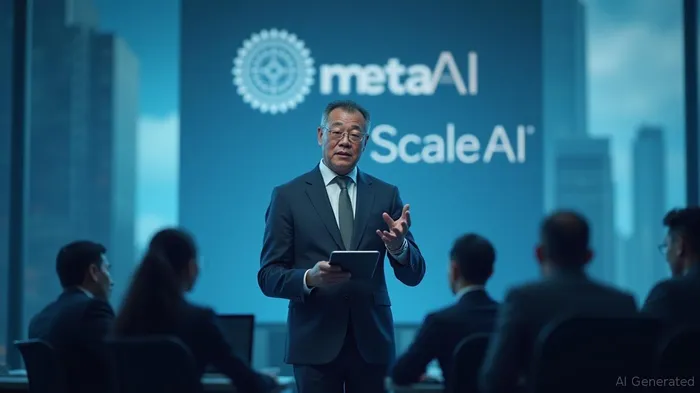
Meta has appointed 28-year-old Alexandr Wang as its first-ever Chief AI Officer, entrusting him with leading the company’s ambitious $14.3 billion acquisition of Scale AI and overseeing a newly formed "Meta Superintelligence Labs" team. This team, described as a "dream team" of AI talent, includes high-profile recruits such as former GitHub CEO Nat Friedman and Daniel Gross of Safe Superintelligence, alongside researchers from OpenAI, Anthropic, and AppleAAPL--. Compensation packages for some members are rumored to exceed $100 million, with Apple’s Ruoming Pang reportedly securing a $200 million contract over four years [1].
Zuckerberg’s move reflects a strategic pivot to counter Meta’s recent struggles in the AI arms race. Despite its open-source Llama models, MetaMETA-- has faced criticism for lagging behind rivals like OpenAI and GoogleGOOGL-- DeepMind, particularly after the contentious April 2025 release of Llama 4, which drew allegations of inflated performance metrics and a rushed rollout. Wang’s appointment signals a shift toward prioritizing aggressive talent acquisition and infrastructure investment. The CEO has publicly highlighted Meta’s "unparalleled" computing power, including massive data centers named "Prometheus" and "Hyperion," and pledged to spend "hundreds of billions" on AI development [1].
Wang’s background as an entrepreneur—rather than a traditional AI researcher—sets him apart. He co-founded Scale AI in 2016 while living in a Silicon Valley pool house, later scaling the company into a $1 billion data-labeling powerhouse. His leadership style, described by associates as "11/10 smart and ambitious," emphasizes commercial acumen and talent attraction. Sarah Guo, founder of Conviction Capital, notes Wang’s ability to "listen to researchers" while leveraging Meta’s resources and Zuckerberg’s "insane force of will" to drive results [1].
The Superintelligence Labs team is tasked with a dual mission: to bolster Meta’s near-term competitiveness in large language models and to pursue the long-term, theoretical goal of "superintelligence." While AGI (artificial general intelligence) remains a debated concept, Zuckerberg has framed the effort as a race to define AI’s future, asserting Meta’s "unique position" to deliver such advancements [1]. However, the path is fraught with challenges. Rivals like MicrosoftMSFT--, Google, and OpenAI are similarly investing billions in AI infrastructure, with OpenAI planning a $500 billion Stargate network in partnership with SoftBank.
Wang’s role as an entrepreneur, rather than a scientist, raises questions about his ability to inspire Meta’s AI PhDs and computer scientists. Yet supporters argue his startup experience—rooted in solving practical data challenges—aligns with the "grunt work" foundational to AI development. His early pivot to data labeling, which proved critical for training models, underscores his strategic foresight. Meta’s decision to hire an operator over a researcher mirrors OpenAI’s reliance on business-oriented CEO Sam Altman, suggesting a growing recognition that AI leadership requires both technical and managerial expertise [1].
The stakes are high. Meta’s AI efforts must not only compete with global rivals but also navigate internal pressures to maintain relevance in its core social media business. The company’s $164 billion annual revenue hinges on proving AI can drive innovation and user engagement. As one current Meta AI scientist acknowledges, if Wang’s team achieves "big leaps in frontier AI," the investment could be justified. However, the speculative nature of superintelligence—both technologically and financially—leaves the outcome uncertain [1].
Source: [1] [Alexandr Wang is now leading Meta’s AI dream team. Will Mark Zuckerberg’s big bet pay off?](https://fortune.com/article/alexandr-wang-meta-scale-ai-entrepreneur-mark-zuckerberg/)

Stay ahead of the market.
Get curated U.S. market news, insights and key dates delivered to your inbox.
AInvest
PRO
AInvest
PRO



Comments
No comments yet