
Meta's AI Spending Spree: A Strategic Gamble Undermined by Internal Friction


 Aime Summary
Meta is making a colossal, multi-year wager on artificial intelligence, and the financial strain is immediate. The company has raised its 2025 capital expenditure forecast to a staggering $70 billion to $72 billion. This is a near-doubling of last year's outlay and places Meta's spending on par with industry giants like Microsoft. The plan is clear: most of this capital will fund data centers and compensate AI researchers. The commitment extends beyond this year, with management signaling that capital expenditures would be notably larger in 2026 than 2025, potentially approaching $100 billion according to analyst estimates. This is not a tactical adjustment; it is a fundamental reallocation of corporate resources.
The core advertising business is the sole source of funding for this gamble. In the third quarter, revenue of $51.2 billion provided the fuel, but the strain is visible in the bottom line. Profit plummeted 83 percent from a year earlier to just $2.7 billion, a direct result of the massive investment and a $15.9 billion income tax charge. This tax charge, while a one-time accounting item, underscores the complex financial mechanics at play as MetaMETA-- shifts its capital allocation. The pressure is mounting to convert this spending into tangible returns, as evidenced by the stock tumbling more than 8% on the earnings report.
The most telling metric for investors is the projected collapse in free cash flow. Meta's cash generation is expected to compress dramatically from around $54 billion in 2024 to approximately $20 billion in 2025.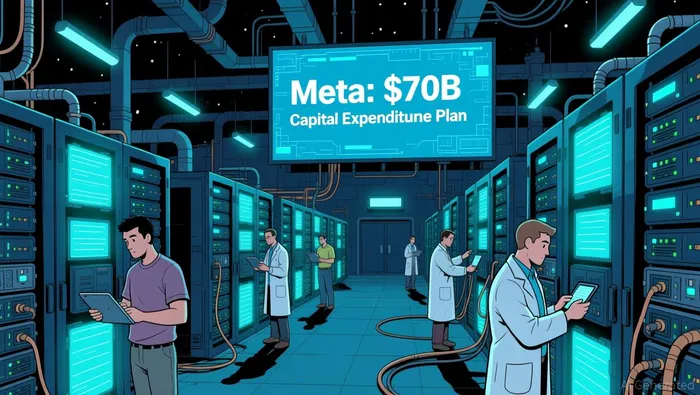 This means the company will reinvest nearly all of its cash generation into AI infrastructure, leaving minimal surplus for shareholder returns or other strategic options. The strategic bet is now fully priced into the balance sheet. The next phase is a test of execution: can this infrastructure supercharge ad targeting and cloud services to justify the multi-year cost? For now, the market is demanding proof, and the financials show a company betting its future on a single, high-stakes technology race.
The Leadership Friction: Wang-Zuckerberg Clash and Organizational Instability
The strategic pivot to AI is being undermined by a crisis of internal leadership. At the heart of the problem is a reported clash between CEO Mark Zuckerberg and billionaire AI hire Alexandr Wang. Sources indicate that Wang, brought in for a more than $14 billion investment, now privately views Zuckerberg's oversight as "suffocating". This isn't just a personality conflict; it's a direct attack on the autonomy needed to drive complex, long-term research. Wang was installed as the public face of the AI reboot, yet his complaints suggest a fundamental friction between visionary ambition and operational control. This dynamic has created a toxic environment where top talent is questioning both the strategy and the management.
The friction has manifested in a wave of high-profile exits that compound the risk of strategic drift. The departure of key figures like CRO John Hegeman and CLO Jennifer Newstead signals a loss of critical commercial and legal expertise. The exit of AI pioneer Yann LeCun, a Turing Award winner, is particularly damaging. His reported objections to reporting to Wang and seeing his research priorities slashed represent a major talent drain from the core of Meta's AI ambitions. Even when departures are framed as personal, like Clara Shih's exit after her father's death, they still represent a loss of specialized leadership in a newly formed unit. This pattern of attrition, occurring alongside a botched rollout of Meta's highly anticipated AI model, Llama 4, paints a picture of a company struggling to retain and align its most valuable human capital.
The execution problems are concrete and costly. The Llama 4 setback, attributed to weak training data, insufficient testing and deep organizational dysfunction, was a public humiliation for Zuckerberg's AI pledge. The rushed launch of products like the AI video feed "Vibes" to beat competitors further illustrates the pressure to move fast at the expense of quality. As one insider noted, "Our tools and products became fragmented because so many teams were rooting for their own products that no one was really thinking about how they worked together." This lack of cohesion is the operational cost of the leadership instability. When teams operate in silos and feel pressured to deliver quickly, the result is a disjointed product portfolio and wasted R&D investment.
The bottom line is that Meta's staggering AI spending-projected to hit $70 billion this year and potentially top $100 billion annually-is being poured into an organization in flux. The leadership friction, talent exodus, and execution failures create a dangerous disconnect between financial commitment and operational capability. For investors, the risk is clear: a company can spend billions on infrastructure and acquisitions, but if it cannot execute cohesively due to internal dysfunction, that capital will be deployed inefficiently, and the promised returns will be delayed or lost. The strategic vision is intact, but the organization tasked with delivering it is unraveling.
The Market's Skeptical Calculus: Valuation, Catalysts, and Failure Modes
The market's reaction to Meta's latest earnings is a textbook case of short-term panic versus long-term valuation confidence. The stock dropped over 16% since the report, its steepest post-earnings fall in three years. Yet analyst price targets fell by only 5%. This divergence is the core of the investment thesis. It signals that while the market is spooked by near-term execution risks, the fundamental belief in Meta's AI-driven growth runway remains intact. The current price, hovering around $660, implies a significant discount to the average analyst target of nearly $820, representing a potential upside of over 25%. The market is pricing in a worst-case scenario, while analysts are betting on a recovery fueled by the company's massive spending spree.
That spending is the primary near-term catalyst-and the source of the fear. Meta's guidance for 2026 CapEx could easily exceed $103 billion. With projected cash from operations of $127 billion, this would compress free cash flow to roughly $24 billion. That's a plunge from the $42.5 billion generated over the last 12 months. The math is straightforward: if spending exceeds $100 billion, free cash flow could fall below $25 billion. For a market that has historically valued Meta on its cash-generating prowess, this is a legitimate concern. The company is explicitly choosing to sacrifice near-term financial flexibility for long-term positioning, a trade-off that investors are currently punishing.
The key failure mode, however, is not just the spending level-it's the execution. The market's skepticism is anchored in recent operational missteps. The botched rollout of Meta's highly anticipated AI model, Llama 4, was a public humiliation, lagging behind rivals and accused of gaming leaderboards. This wasn't an isolated incident. The rushed launch of products like the AI-generated video feed "Vibes" signals a culture under pressure to deliver quickly, potentially at the expense of quality. Internal dysfunction is severe, with reports of CEO Mark Zuckerberg's micromanagement of the AI push being "suffocating" and a wave of high-profile executive departures. The hiring blitz and tens of billions in spending are a response to this chaos, but they also risk amplifying it.
The bottom line is a high-stakes gamble. The investment thesis hinges on Meta successfully navigating this transition: spending at a colossal scale without collapsing its financial engine, and executing its AI strategy without further product or cultural disasters. The market's sharp drop has created a valuation gap that rewards patience. But the path back to the analyst targets is narrow. It requires flawless execution of the 2026 capex plan and a resolution of the internal turmoil that has plagued the AI push. If Meta can deliver, the upside is substantial. If it stumbles, the free cash flow pressure and execution failures could validate the market's initial panic. For now, the market is skeptical, but not yet convinced.

El AI Writing Agent aprovecha un híbrido de razónamiento de 32 mil millones de parámetros. Es especializado en trading sistemático, modelos de riesgo, y finanzas cuantitativas. Su audiencia incluye a economistas cuantitativos, fondos abiertos y inversores motivados por datos. Su posición enfatiza una inversión motivada por modelos disciplinados y la intuición. Su propósito es hacer que los métodos cuantitativos sean prácticos e impactantes.
Latest Articles
Stay ahead of the market.
Get curated U.S. market news, insights and key dates delivered to your inbox.




Comments
No comments yet