
Meta’s AI Spending Boom Ignites Investor Focus Ahead of Big Tech Earnings
 Aime Summary
Earnings season reaches a fever pitch this week, with five of the Magnificent Seven — Amazon, Apple, Alphabet, Microsoft, and MetaMETA-- — set to report results over the next two days. The focus isn’t just on revenue or profit, but on something more fundamental to the future of AI: capital expenditure.
Meta, which reports after the bell Wednesday, is preparing to set a new record for how much of its revenue it reinvests into physical infrastructure. Analysts forecast third-quarter revenue of $49.5 billion, up 22% year over year, while spending on property and equipment is projected to jump 123% to $18.4 billion — surpassing its expected net income of $17.1 billion. That would push Meta’s capex-to-revenue ratio to roughly 37%, up from around 20% a year ago, the highest in company history.
The flood of spending underscores CEO Mark Zuckerberg’s commitment to AI dominance. Meta has outlined plans to direct $600 billion toward U.S. data centers and related infrastructure through 2028 — and Wall Street expects total capex will approach $97 billion by 2026.
Analysts are bracing for Meta’s revenue to keep comping strongly year-on-year, but the debate is shifting to capex-to-sales ratios: if spending outpaces revenue growth, margins can compress near-term—even if the long-term AI capacity proves to be a competitive moat. Recent previews highlight solid consensus momentum into the print and emphasize the capex trajectory as the primary narrative risk/reward fulcrum.
Positioning the trade with ETFs
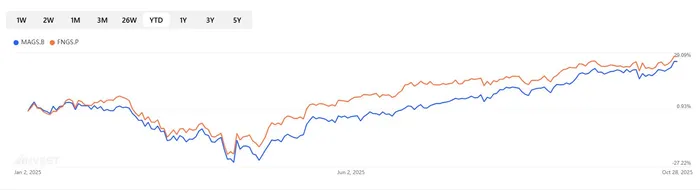
If you want concentrated Mag 7 exposure without stock-picking, MAGS and FNGS are the cleanest wrappers around this earnings-and-capex theme:
MAGS (Roundhill Magnificent Seven ETF) — equal-weight exposure to Alphabet, Amazon, Apple, Meta, Microsoft, Nvidia, and Tesla. Equal weighting reduces single-name dominance and makes post-earnings dispersion matter more.
FNGS (MicroSectors FANG+ ETN) — tracks the NYSE FANG+ (10 large-cap growth names including Meta, Apple, Amazon, Alphabet, etc.). Note it’s an ETN—an unsecured note with issuer credit risk—so structure matters if you’re using it as a proxy for big-tech AI beta.
Traders looking to position tactically around short-term volatility can turn to leveraged strategies like the Direxion Daily Magnificent 7 Bull 2X Shares ETF (QQQU) or its inverse counterpart, the Direxion Daily Magnificent 7 Bear 1X Shares ETF (QQQD). With AI infrastructure spending now a key driver of sentiment, these tools offer dynamic ways to play upside surprises — or hedge downside risk.
What to watch in the prints and guides
Capex guide vs. revenue cadence: A step-up toward the high end of 2025 capex—and renewed 2026 color—would validate the “build capacity first” playbook. Watch any commentary on off-balance-sheet JVs and power procurement (grid and renewables). Seekingalpha
AI monetization milestones: Are there clearer timelines for AI ads relevance, model-driven engagement, or new surfaces (e.g., assistants) that tie compute to revenue?
Supply chain and site updates: New DC sites (like Texas) and timelines for major campuses can signal pace and bottlenecks (power, water, chips). Reuters
Peer read-throughs: Amazon, Alphabet, Microsoft disclosures on AI spend/GPUs can reset the whole complex’s expectations—benefiting or punishing Mag 7 wrappers accordingly.
The Takeaway
As Wall Street braces for Meta’s numbers, the key question isn’t whether the company will spend — but how effectively those billions will translate into AI leadership and shareholder returns. JPMorgan analysts remain optimistic toward both Meta and Amazon, suggesting traders position for strength while keeping expectations in check given the already elevated valuations across the sector.
Quickly compare Mag 7 ETFs MAGS, FNGS with our ETF Compare Tool

Market Radar delivers concise, daily trading ideas by tracking everything from options activity and market sentiment to high-profile political trades.
Latest Articles
Stay ahead of the market.
Get curated U.S. market news, insights and key dates delivered to your inbox.
AInvest
PRO
AInvest
PRO



Comments
No comments yet