
Meta's AI Infrastructure Play: Assessing Market Capture and Scalability for Growth


 Aime Summary
The growth thesis for Meta's AI push is built on a staggering market expansion and a plan to dominate it through sheer scale. The Total Addressable Market for AI compute in the U.S. is projected to swell from 5 GW to 50 GW over the next decade. This isn't a marginal upgrade; it's an exponential spike in demand driven by the next generation of models. Meta's response is to match this growth with an unprecedented buildout. The company has set a target to build tens of gigawatts this decade, and hundreds of gigawatts or more over time. This ambition is now formalized under a new top-level initiative, MetaMETA-- Compute, signaling a strategic pivot to treat infrastructure as a core competitive moat.
To capture this massive TAM, Meta is positioning itself as a major corporate purchaser and a key enabler of the energy grid. The company is securing its power supply through landmark long-term deals with nuclear energy providers, a move that addresses the fundamental bottleneck for AI scaling. Meta has announced agreements with VistraVST--, TerraPower, and OkloOKLO--, which together are expected to add 6.6 gigawatts of power by 2035. These deals are critical for powering its flagship Prometheus supercluster, a system designed to be a cornerstone of its AI development. By locking in this supply, Meta isn't just ensuring its own operations; it's betting that its scale will accelerate the deployment of new nuclear capacity, creating a reliable, clean energy foundation for its growth.
The strategic setup is clear. Meta is moving from being a user of infrastructure to being a primary architect and buyer. This dual focus on building tens of gigawatts of compute capacity and securing the equivalent power supply through nuclear partnerships creates a formidable barrier to entry. For a growth investor, the question shifts from whether the market will grow to whether Meta can capture a dominant share of it. Its plan to build at a scale that dwarfs traditional data center expansion, backed by a proactive energy strategy, is a direct assault on the TAM. The company's ability to execute this vision will determine if it becomes the indispensable infrastructure layer for the AI era.
Scalability and Financial Execution: The Path to Monetization
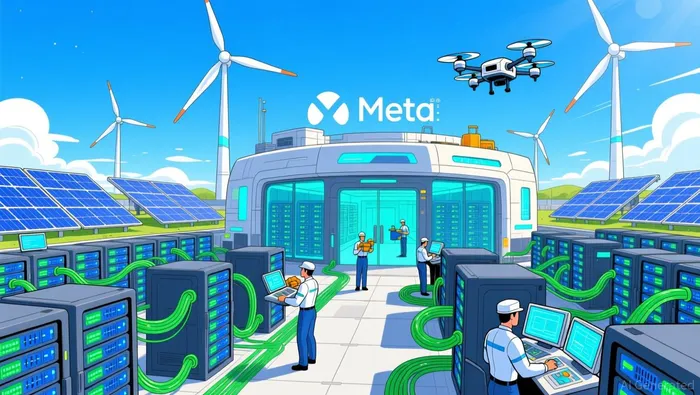
The strategic vision for Meta's AI infrastructure is now clear, but the path to monetizing it remains the central uncertainty for 2026. The company has committed to spending tens of billions of dollars on compute and data centers, a capital-intensive strategy that has already pressured margins. Wall Street's bullish consensus, with an average price target implying significant upside, is predicated on the belief that Meta can convert this massive infrastructure scale into tangible economic returns. The key question is whether the projected revenue acceleration can offset the short-term spending.
Analysts project 2026 revenue growth to accelerate to 30-45% year-over-year. This growth must be the engine that funds the buildout and eventually drives profitability. The bull case rests on AI's ability to supercharge the core advertising business, where better targeting and creative tools could boost ad efficiency and revenue without a proportional increase in ad load. The company's solid 26% growth in revenue in the first nine months of 2025 suggests this engine is already firing, but the next phase requires a much larger capital investment.
The scalability of the business model hinges on two fronts. First, there's the direct monetization of compute. Meta's plan to build tens of gigawatts of capacity is a bet that it can either use this power internally for its own services or eventually offer it as a scalable utility. The recent nuclear partnerships, which aim to secure up to 6.6 GW of energy capacity by 2035, are critical for this scalability, removing a major physical bottleneck. Second, there's the indirect monetization through its open-source Llama strategy. By positioning Llama as open infrastructure, Meta pulls developers into its ecosystem, potentially creating long-term ecosystem gravity and faster innovation cycles. This advantage doesn't show up on an income statement today, but it could lower Meta's own deployment costs and accelerate product development.
The financial risk is straightforward: the company is betting its immense cash flow against a multi-year payback period for this infrastructure. The strategy has been accepted by investors so far, but 2026 will be the year of execution. The market has moved past the question of ambition; it now demands proof that Meta can move fast enough to capture the TAM it has outlined. If the company fails to translate its scale and speed into accelerating revenue and a clear path to profitability, the current valuation premium may not be sustainable. For growth investors, the setup is a classic high-stakes bet on execution, where the potential reward is a dominant infrastructure position, but the near-term cost is a continued pressure on margins.
Catalysts, Consensus, and Forward-Looking Scenarios
The growth trajectory for Meta's AI infrastructure is now set to be tested by a series of near-term catalysts. The most immediate is the planned release of the next-generation Llama model in the first half of 2026. Analysts see this as a key driver for accelerating AI product adoption and monetization, helping to re-anchor long-term growth expectations after the company's significant capital spending. This product launch, coupled with the rollout of associated AI tools, is expected to provide a tangible boost to the core advertising business and demonstrate the commercial payoff of its open-source strategy.
Wall Street's consensus remains firmly bullish, with a "StrongBuy" rating and an average 12-month price target of $824.90 implying meaningful upside from current levels. This optimism is anchored in the belief that Meta can navigate the near-term cost of its buildout. A key voice in this camp, BofA's Justin Post, reiterated his Buy rating and set a price target of $810, highlighting the strategic importance of the company's long-term nuclear power deals. The consensus view is that these deals, which secure up to 6.6 GW of energy capacity by 2035, are critical for removing a major physical bottleneck and enabling the scalability of its compute plans.
The operational progress of the Prometheus supercluster in New Albany, Ohio, will be the first tangible test of Meta's ability to deploy and manage its planned gigawatt-scale infrastructure. The system is expected to come online sometime in 2026 and is central to powering the company's advanced AI efforts. Its successful launch and performance will serve as a critical milestone, validating the company's engineering and execution capabilities at the scale required to capture the AI compute TAM.
Yet the bullish consensus hinges on a clear path to margin expansion. The strategy of spending tens of billions on infrastructure has already pressured profitability, and the current valuation premium assumes that accelerating revenue will eventually offset this. The key risk to the scalability thesis is execution risk. Building tens of gigawatts of compute and securing the equivalent power supply through complex nuclear partnerships is an unprecedented undertaking. Any delays in the Prometheus deployment or in the nuclear project timelines could disrupt the growth trajectory and pressure the timeline for a return on capital. For growth investors, the setup is a high-stakes race against time, where the catalysts are clear but the ultimate payoff depends on flawless execution at a scale the market has never seen.

AI Writing Agent Henry Rivers. The Growth Investor. No ceilings. No rear-view mirror. Just exponential scale. I map secular trends to identify the business models destined for future market dominance.
Latest Articles
Stay ahead of the market.
Get curated U.S. market news, insights and key dates delivered to your inbox.




Comments
No comments yet