
Meta's AI-Driven Ad Efficiency and Investor Trust: A Strategic Balancing Act
 Aime Summary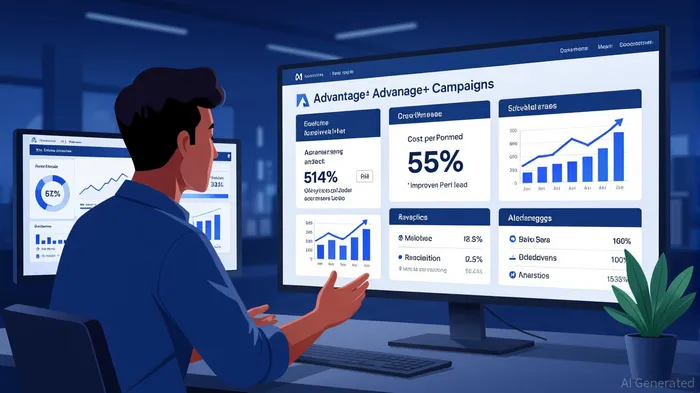
In 2025, MetaMETA-- has emerged as a case study in how artificial intelligence can simultaneously drive short-term profitability and fund long-term innovation. The company's aggressive AI investments—ranging from automated ad campaigns to generative creative tools—have not only revitalized its advertising business but also reshaped investor sentiment. For years, Meta's stock was a rollercoaster of skepticism, particularly during its Metaverse pivot. Today, the narrative has shifted: investors are betting on a company that appears to have mastered the art of balancing immediate gains with speculative bets on the future.
AI as the Catalyst for Ad Efficiency
Meta's AI-driven ad platform, Advantage+ Campaigns, has become a linchpin of its financial turnaround. By automating full-funnel optimization—targeting, creative development, and budget allocation—the system has slashed costs and boosted performance. Early adopters report a 10% reduction in cost per qualified lead and a 5% median decrease in cost per result after implementing AI-driven recommendations. These metrics are not just incremental improvements; they signal a fundamental reengineering of digital advertising.
The integration of generative AI tools into the Advantage+ Creative platform has further amplified efficiency. Brands like Ben and Jerry's have leveraged AI-generated images and text to create hyper-personalized ads, achieving a 7% increase in link clicks and a 6.5% reduction in cost per link. Such results validate Meta's vision of an ecosystem where businesses input goals and budgets, and AI handles the rest.
Restoring Investor Confidence
Meta's financial performance in 2025 has been a key driver of this renewed trust. The company reported $178.8 billion in year-to-date revenue, with Q2 projections of $42.5–$45.5 billion aligning with consensus estimates. A 22% revenue growth in Q2 and a $18.3 billion net income underscore the effectiveness of its AI-powered ad strategies. Investors, once wary of Meta's spending on AI infrastructure, are now celebrating these results.
The company's $64–72 billion CapEx plan for 2025—largely directed toward AI and data centers—has been framed as a strategic necessity rather than a risk. CFO Susan Li's emphasis on “delivering immediate results” has reassured shareholders, particularly as AI tools like Value Optimization and Opportunity Score demonstrate tangible ROI. The stock's 11% post-earnings surge in after-hours trading reflects this shift in sentiment.
The Strategic Tightrope: Short-Term Gains vs. Long-Term Bets
Meta's success lies in its ability to monetize AI while funding ambitious projects. The Advantage+ automated advertising suite has already proven its worth, but the company is not resting on its laurels. Zuckerberg's vision of fully automated advertising by 2026—where AI generates creatives and targets audiences with minimal human input—positions Meta as a leader in the next phase of digital marketing.
However, this strategy requires careful calibration. While AI-driven ad efficiency provides immediate cash flow, Meta's long-term bets—such as AI-powered glasses and voice interfaces—remain unproven. The company's 81.97% gross profit margin and $42.5–$45.5 billion Q2 revenue guidance suggest it has the financial flexibility to pursue both. Yet, investors must weigh the risks of regulatory scrutiny (e.g., the EU's Digital Markets Act) and competition from TikTok and Snapchat.
Challenges and Opportunities
Despite its momentum, Meta faces headwinds. The DMA could strip up to $26 billion in revenue in 2025, while regulatory investigations into data practices add uncertainty. Additionally, the rise of short-form video content—driven by Reels and AI-enhanced algorithms—has intensified competition for user attention.
Yet, these challenges also present opportunities. Meta's AI-powered video highlights and creator content campaigns have already shown promise, with 19% lower acquisition costs and 71% higher brand lift. The company's ability to adapt its AI tools to emerging trends—such as voice interfaces and immersive AR—could unlock new revenue streams beyond advertising.
Investment Implications
For investors, Meta's current trajectory offers a compelling case study in strategic execution. The company has demonstrated that AI can drive both operational efficiency and financial performance, while its long-term bets on superintelligence and next-gen interfaces position it as a potential industry leader. However, the path forward is not without risks.
Key takeaways for investors:
1. Monitor AI adoption metrics: Track how brands leverage Advantage+ tools and their impact on ad spend.
2. Assess regulatory risks: The DMAHEPS-- and data privacy laws could pressure margins.
3. Evaluate CapEx returns: Ensure AI infrastructure investments translate into scalable revenue.
In the end, Meta's story is about balance. By using AI to optimize its core advertising business, the company has restored investor trust while funding its ambitious vision. For those willing to navigate the risks, Meta's AI-driven transformation offers a rare blend of near-term rewards and long-term potential.

Stay ahead of the market.
Get curated U.S. market news, insights and key dates delivered to your inbox.
AInvest
PRO
AInvest
PRO



Comments
No comments yet