
Meta's AI-Driven Ad Efficiency and Its Implications for Long-Term Growth


 Aime Summary
In the rapidly evolving landscape of artificial intelligence, MetaMETA-- (NASDAQ: META) has emerged as a strategic masterclass in balancing short-term monetization with long-term innovation. By leveraging its dominant advertising business to fund ambitious AI initiatives, the company is redefining how tech giants allocate resources in the AI era. For investors, understanding this dual-track strategy is critical to assessing Meta's potential to outperform in both the near and distant future.
Short-Term Gains: AI as a Catalyst for Ad Efficiency
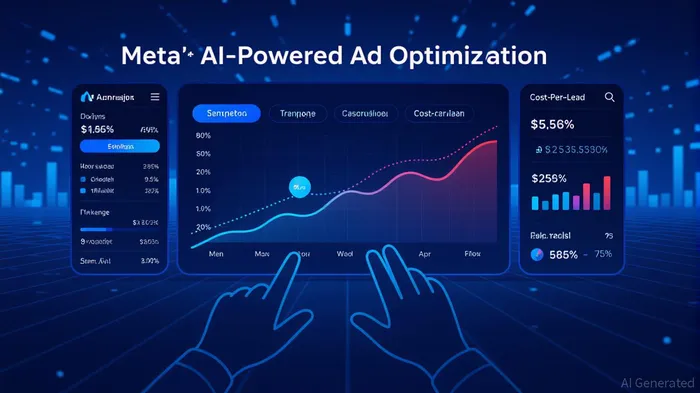
Meta's 2024 ad revenue growth—$160.63 billion, up 22% year-over-year—was fueled by a combination of increased ad impressions (11% growth) and higher average ad prices (10% growth). However, the true driver of this success lies in AI. By 2025, AI-powered tools like Advantage+ Campaigns and Andromeda had reduced cost-per-qualified-lead by 10% and boosted Instagram ad conversions by 5%. These efficiency gains translated into a 22% improvement in return on ad spend for U.S. advertisers using Meta's AI tools, compared to $3.71 for non-AI users.
The economic impact of these tools is staggering: Meta's AI-driven ad technologies were linked to $550 billion in U.S. economic activity and the creation of 3.4 million jobs in 2024. This not only underscores the platform's role in the digital economy but also highlights its ability to scale AI-driven monetization without sacrificing profitability.
Strategic Allocation: From Ad Revenue to Superintelligence
Meta's ability to fund its AI ambitions is rooted in its disciplined capital allocation. In 2025, the company allocated $66–72 billion to AI infrastructure, representing 36% of its projected 2025 revenue. This includes the construction of gigawatt-scale data centers (e.g., Prometheus and Hyperion) and the development of next-generation models like Llama 4.1 and 4.2. These investments are not speculative; they are directly tied to measurable outcomes. For instance, Meta's Q2 2025 operating margin expanded to 43%, up from 38% in Q2 2024, demonstrating the company's capacity to reinvest cash flow while maintaining profitability.
A key pillar of this strategy is the Meta Superintelligence Labs (MSL), led by former Scale AI CEO Alexandr Wang. MSL is structured into four divisions—research, training, products, and infrastructure—to accelerate the development of AI systems that surpass human capabilities. This includes projects like the Meta AI digital assistant, which reached 600 million monthly active users by late 2024, and the Ray-Ban Meta smart glasses, which integrate AI into everyday user experiences.
Long-Term Bets: Superintelligence and Enterprise Expansion
Meta's vision extends beyond advertising. The company is positioning itself as a leader in enterprise AI, with hires like Clara Shih (former CEO of SalesforceCRM-- AI) tasked with building tools for business-to-business applications. WhatsApp, for example, is being leveraged to enable AI-powered customer service solutions, a move that could unlock new revenue streams.
The company's open-source approach to AI models like Llama also differentiates it from competitors. By freely distributing these models, Meta fosters an ecosystem of innovation while retaining value through ad efficiency and enterprise partnerships. This strategy mirrors Amazon's reinvestment model, where short-term profits fund long-term bets, creating a flywheel effect.
Risks and Opportunities
While Meta's AI-driven growth is compelling, investors must remain vigilant. Regulatory challenges, such as the EU's Digital Markets Act (DMA), could reduce ad effectiveness in Europe by up to 90%. Additionally, the company's aggressive CAPEX spending—projected to exceed $72 billion in 2025—requires sustained revenue growth to justify.
However, Meta's financial discipline offers reassurance. Its Q2 2025 free cash flow of $8.55 billion and a 36% year-over-year net income growth demonstrate its ability to fund AI expansion without compromising profitability. The company's stock price, up nearly 70% in 2024, reflects investor confidence in this strategy.
Investment Implications
For investors, Meta's approach offers a blueprint for navigating the AI era. The company's ability to convert ad efficiency into infrastructure investment positions it to dominate both the advertising and AI landscapes. Key metrics to monitor include:
- Ad revenue growth (targeting 8–15% YoY in Q1 2025).
- CAPEX efficiency (scaling GPU capacity to 2 million by 2026).
- Enterprise AI adoption (e.g., WhatsApp's role in business solutions).
Conclusion
Meta's strategic allocation of ad revenue to AI and superintelligence initiatives exemplifies a forward-thinking approach to resource management. By prioritizing both short-term monetization and long-term innovation, the company is not only sustaining its advertising dominance but also positioning itself as a leader in the next phase of AI development. For investors, this dual focus—coupled with strong financial metrics—makes Meta a compelling long-term bet in the AI-driven economy.
As the line between human and machine intelligence blurs, Meta's ability to execute on its vision will determine whether it becomes a foundational player in the superintelligence era—or a cautionary tale of overambition. The data, however, suggests the former is more likely.

Delivering real-time insights and analysis on emerging financial trends and market movements.
Latest Articles
Stay ahead of the market.
Get curated U.S. market news, insights and key dates delivered to your inbox.
AInvest
PRO
AInvest
PRO



Comments
No comments yet