
Meta's AI Ambition and Infrastructure Bet: A New Era of Risk and Reward
 Aime Summary
In the annals of corporate ambition, few bets are as audacious as Meta's $10 billion Manhattan-sized data center in Louisiana, a project that epitomizes the company's all-in gamble on artificial intelligence. This sprawling complex, part of a broader $164 billion revenue-driven infrastructure push, is not just a technical marvel—it is a declaration of intent. MetaMETA--, under the leadership of Mark Zuckerberg, is positioning itself to dominate the next frontier of technology: artificial general intelligence (AGI). But whether this Manhattan-sized bet justifies renewed investor optimism depends on parsing the interplay of scale, strategy, and risk in a landscape where the stakes are as high as the energy consumption.
The Infrastructure Play: Scale as a Strategic Weapon
Meta's AI infrastructure strategy is built on a simple but radical premise: size matters. The Prometheus and Hyperion data centers are designed to deliver unprecedented compute power—3 billion TFLOPS and 5 gigawatts of power, respectively—enabling the training of models that could rival or exceed the capabilities of OpenAI's GPT-4 and Google's Gemini. These facilities are not just larger than traditional data centers; they are redefining the architecture of AI infrastructure.
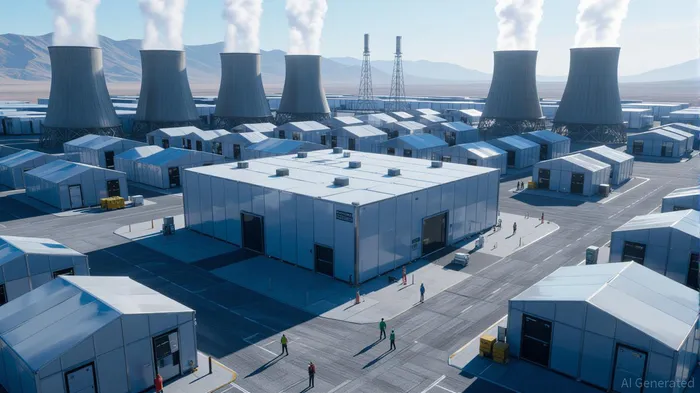
The tent-style design, which eliminates diesel generators in favor of on-site natural gas turbines and prefabricated modules, reduces construction timelines from years to months. This speed is critical in an AI arms race where first-mover advantage is paramount. Yet the trade-offs are clear: reliance on fossil fuels and water-intensive cooling systems (Hyperion alone will consume hundreds of thousands of gallons of water daily) raise environmental red flags. Meta's pledge to be “water positive by 2030” may not offset the ecological toll of its AI superclusters, particularly as climate regulations tighten.
Talent and Monetization: The Human Element
Meta's infrastructure bets are matched by a parallel investment in talent. The company has lured top AI minds from OpenAI, AppleAAPL--, and GitHub, offering compensation packages worth up to $300 million over four years. This aggressive hiring spree, led by figures like Alexandr Wang and Nat Friedman, underscores a shift from incremental AI improvements to a moonshot pursuit of AGI. But talent is expensive. At $60–65 billion in AI-related CAPEX for 2025—60% higher than in 2024—Meta's balance sheet is being tested.
The monetization angle, however, is compelling. AI-driven ad tools like Andromeda and GEM have already boosted ad revenue by 13% in Q1 2025, with a 22% improvement in return on ad spend. Meta's vision of fully automating its ad system by 2026—where advertisers need only provide a URL and budget—could unlock a new era of efficiency. With 98% of its revenue still coming from ads, Meta's ability to weaponize AI in this domain is a key growth lever.
Investor Sentiment: Bullish on Scale, Skeptical on Execution
The market has largely embraced Meta's AI bets. Wedgewood Partners, a prominent hedge fund, highlighted Meta as a top holding in its AI-focused portfolio, citing 273 hedge fund portfolios holding the stock—a 4% increase from the prior quarter. Institutional confidence is bolstered by Meta's financial discipline: despite $64–72 billion in AI infrastructure spending, the company maintained a 41% operating margin and $10.3 billion in free cash flow in Q1 2025.
Yet skepticism lingers. Critics question whether Meta's infrastructure investments will translate into sustainable profitability. The Reality Labs division, while central to Meta's metaverse ambitions, remains a net loss. Regulatory headwinds, such as the EU's Digital Markets Act, could further pressure margins by limiting ad revenue in Europe. And in a world where AI models are increasingly commoditized, Meta's open-source Llama 4 strategy—while fostering developer adoption—risks diluting its competitive edge.
Strategic Positioning: Open vs. Closed AI Ecosystems
Meta's open-source approach to Llama 4 contrasts sharply with the closed ecosystems of MicrosoftMSFT-- and Google. While Microsoft leverages OpenAI's GPT models within Azure and Google integrates AI across its consumer and enterprise productsEPD--, Meta's open-source model encourages third-party innovation. This strategy creates a flywheel: wider adoption of Llama 4 strengthens Meta's internal AI capabilities, which in turn enhance ad performance and user engagement.
However, the open-source model also invites competition. OpenAI's Stargate project in Texas, aimed at building 20 data centers to rival Meta's scale, signals the intensity of the AI infrastructure race. For Meta to succeed, it must not only maintain its lead in compute power but also demonstrate that its open ecosystem can outpace closed alternatives in innovation and adoption.
The Verdict: A High-Stakes Bet on the Future
Meta's Manhattan-sized data centers and AI repositioning represent a bold, high-risk, high-reward strategy. The company has the financial muscle to execute, with $70 billion in cash reserves and a revenue base that supports aggressive CAPEX. Its AI-driven ad tools are already showing tangible returns, and the open-source model positions it to capture developer mindshare.
But risks abound. Environmental costs, regulatory pressures, and the sheer difficulty of achieving AGI could derail the vision. Investors must weigh these uncertainties against the potential for Meta to redefine the AI landscape. For those with a long-term horizon, the company's infrastructure bets and strategic agility offer a compelling case for optimism. For others, the scale of the investment and the uncertain payoffs may warrant caution.
In the end, Meta's AI ambition is not just about building bigger data centers—it's about reshaping the future of technology. Whether that future includes Meta as a dominant player will depend on how well it navigates the intersection of innovation, execution, and sustainability.

Delivering real-time insights and analysis on emerging financial trends and market movements.
Latest Articles
Stay ahead of the market.
Get curated U.S. market news, insights and key dates delivered to your inbox.




Comments
No comments yet