
Meta Acquires 49% Stake in Scale for $14.3 Billion, Securing AI Leadership
In November 2023, a select group of AI executives, venture capitalists, government officials, and policy experts gathered in Utah’s Wasatch Mountains for a secretive, three-day retreat focused on the national securitySNFCA-- implications of artificial intelligence. The event was presided over by Alexandr Wang, the young CEO of data labeling AI startup Scale. Wang, who co-founded Scale AI in 2016 with Lucy Guo, had transformed the company into a generative AI powerhouse, valued at $13 billion at the time. The retreat was co-hosted with longtime Scale angel investor Nat Friedman and aimed to showcase Wang’s status as more than just a Silicon Valley wunderkind.
Wang, who dropped out of MIT at 19 to pursue his startup dream, had already made a significant impact in the AI industry. By hiring tens of thousands of workers to manually label massive datasets, Scale had become a key player in training AI models for companies like OpenAI, SAPSAP--, and ToyotaTM--. Wang’s leadership and strategic vision had positioned Scale as a leader in the AI data labeling space, and his company was valued at over $7 billion in 2021, making him briefly the youngest self-made billionaire.
In a surprising turn of events, just days after the Utah retreat, OpenAI CEO Sam Altman was abruptly fired. Within 48 hours, Wang and Friedman were approached to serve as interim CEO, but both declined. This incident highlighted Wang’s growing influence and connections in the AI and national security communities. Wang’s rise from a MIT dropout to a key figure in the AI industry was a testament to his ambition and strategic acumenABOS--.
Meta’s relationship with Scale dates back to 2019, when the social media company began using Scale as a data provider for its AI efforts. In 2024, MetaMETA-- invested in Scale’s Series F funding round, acquiring half-a-million shares of the startup’s stock. The relationship between Meta CEO Mark Zuckerberg and Wang deepened in April 2024, when Zuckerberg began inviting Wang to his homes in Lake Tahoe and Palo Alto for discussions. Zuckerberg, frustrated with Meta’s struggles to keep up with rival AI labs, saw Wang as a potential solution to regain the edge in the AI race.
Meta’s latest AI model, Llama 4, released in April 2025, faced criticism for allegedly inflated performance metrics and a lack of transparency. This crisis prompted Meta to move aggressively to amass AI talent and realign its efforts. Meta was reportedly in talks to acquire several AI firms, including Perplexity and Safe Superintelligence, and was also considering acquiring the AI venture capital fund managed by Friedman and Safe Superintelligence executive Daniel Gross. Wang resisted Zuckerberg’s initial proposal to join Meta, insisting on a deal that would benefit Scale’s investors and employees. After months of negotiations, Meta agreed to invest $14.3 billion for a 49% stake in Scale, with the potential for future conversion. The deal also included a poison pill provision, incentivizing Wang to make a long-term commitment to Meta.
Wang’s decision to leave Scale came as a surprise to many, but his commitment to doing right by his investors and employees was evident in the deal he struck with Zuckerberg. Wang addressed Scale employees at the company’s San Francisco office, receiving a standing ovation as he spoke about his time at Scale and his vision for the future. Wang’s upbringing, as the son of immigrant parents who were nuclear physicists at Los Alamos National Laboratory, had instilled in him a sense of purpose and ambition that drove his success at Scale.
Scale’s success was built on Wang’s ability to recruit top talent and create an intense culture focused on data labeling. The company’s early focus on self-driving vehicles provided a perfect customer base, and Wang’s hands-on approach to customer engagements helped Scale win key accounts. However, tensions between Wang and co-founder Lucy Guo led to Guo’s departure in 2018. Despite these challenges, Scale continued to grow and expand its services, becoming a key player in the generative AI ecosystem.
Scale’s labor practices have come under scrutiny, with concerns about fair pay and worker classification. A Department of Labor investigation was opened in 2024 and closed in May, and there are currently two labor lawsuits against Scale. Despite these challenges, Scale has continued to operate as an independent company, serving a wide range of customers in the AI ecosystem. Under the terms of the Meta deal, Meta will spend a minimum of $500 million a year for Scale data over the next five years, but the perception of neutrality now looks all but dead. Following the announcement, news reports said that both Google and OpenAI were planning to end their relationship with Scale, raising questions about Meta’s real strategy.
Several industry insiders speculated that Meta’s real strategy was a data landgrab, aimed at securing a major source of one of the vital components for building AI models and depriving others of it. However, others were skeptical of this theory, pointing out the benefits of having diversity in data vendors. The key thing Zuckerberg is getting for his $14.3 billion investment is Wang’s leadership and strategic vision, which could help Meta navigate the unpredictable landscape of AI and national security.
Wang’s versatility and ability to open doors and navigate challenges will be crucial for Meta’s success in the AI era. As the landscape changes, Wang’s unique blend of technical capability, business acumen, and strategic vision will be invaluable to Meta. Wang’s fans see him as a main character in Silicon Valley at the highest levels for the next 30 years, and his impact on the AI industry is likely to be felt for decades to come. 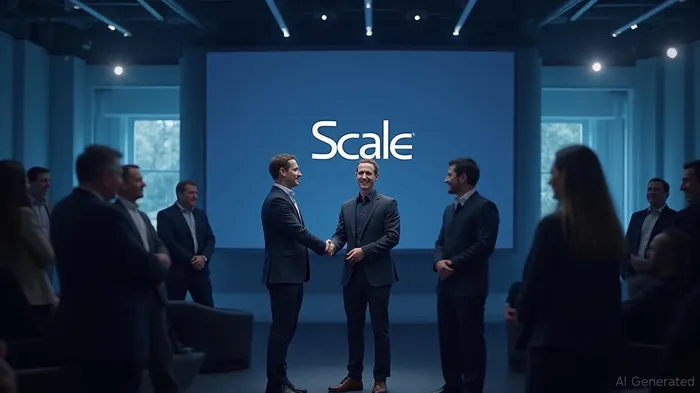

Stay ahead of the market.
Get curated U.S. market news, insights and key dates delivered to your inbox.
AInvest
PRO
AInvest
PRO



Comments
No comments yet