
Meta's $22 Billion AI Cost Cut Is Why Bank of America Stayed Bullish


 Aime Summary
Bank of America's verdict hinges on cheaper capacity, not a new product launch
This is primarily a valuation reset, not a product story. Bank of AmericaBAC-- stayed bullish because the market's main bear case on Meta's AI buildout got much smaller.

The key move was mechanical. BofA cut its estimate of Meta's build cost from roughly $45 billion per gigawatt to about $22 billion per gigawatt, based on a Reuters-reviewed internal memo and Meta's plan to deploy roughly 6.5 gigawatts in 2026, with 5.5 gigawatts coming online in the second half of 2026. That matters because investors have been worried that Meta's AI spending $125 billion to $145 billion this year on AI infrastructure could badly compress margins. If the cost to add capacity is far lower than feared, the spending story becomes easier for the market to model.
That is why BofA kept its Buy rating and $835 price target even without a new consumer launch. The bank was not betting on a demo. It was betting that cheaper capacity deployment reduces the risk that Meta's AI push crushes profits rewrites the investment case.
The next trigger is execution, not messaging. Reuters saw that MetaMETA-- intends to expand to 14 gigawatts of computing next year, and that Iris manufacturing starts in September. If custom silicon helps Meta scale while moderating costs, the market may start to view AI infrastructure as an operating advantage rather than just a heavy capex burden.
Why the cost revision changes the bull case
The shift is mainly about unit economics. When the cost to add compute falls, AI spending looks less like a margin killer and more like something the business can absorb while it builds scale.
Lower build costs ease the margin scare
Meta is still spending an estimated $125 billion to $145 billion this year on AI infrastructure, so this is not a pullback in ambition. It is a better cost story. If each gigawatt of capacity costs far less to build than investors feared, the same spending program should compress margins less and give Meta more time to prove the investment. That helps explain why BofA could keep its Buy rating and $835.00 price target even though the catalyst was cheaper infrastructure math, not a new product launch rewrites the investment case.
Iris matters because it could lower long-term compute costs
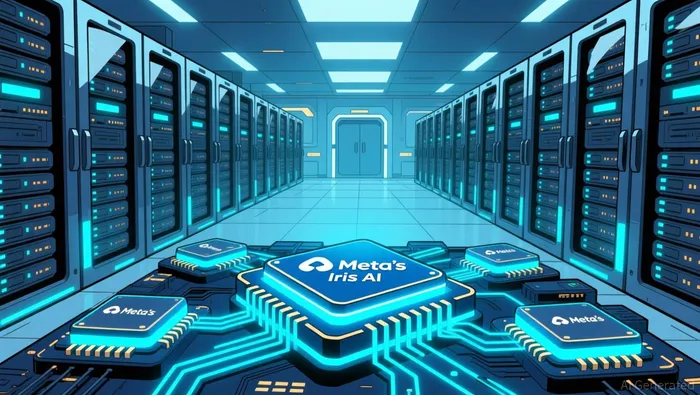
The second part of the mechanism is Iris. Meta plans to start manufacturing its custom AI chip in September after just six weeks of testing with no major issues. That timeline matters because it suggests the program is moving toward execution now, not drifting further down a long roadmap.
The practical upside is less dependence on external GPU suppliers. Meta's custom chips are meant to reduce reliance on expensive third-party suppliers over the long term while complementing the GPUs it already buys. In plain English, Meta does not need to route every AI workload through Nvidia at market price. The more traffic it can move onto in-house silicon, the lower the cost per workload could become.
That benefit may be strongest for specific AI workloads inside Facebook and Instagram rather than across every AI task. Reuters noted that Iris is designed to improve the AI powering those platforms, while the fastest GPU adoption has been a heavy lift at Meta's scale. If Iris handles the right jobs cheaper than a pure GPU stack, Meta could tighten the link between AI spend and engagement on its core apps.
What still has to be proven
The bull case is no longer just a demo trade. BofA did not wait for a new product launch to add Meta to its US 1 List; it acted because the infrastructure economics improved enough to justify maintaining a $835.00 price target. For institutional holders, that framing matters: if cheaper compute makes each dollar of AI spend more effective inside Facebook and Instagram, the story can stay grounded in operating improvement rather than product speculation.
Why the bear case still matters
Bears are not arguing that Meta is building less. They are arguing that cheaper infrastructure can still be too expensive if the returns never show up in earnings. Meta remains exposed to significant AI spending, and it plans to expand to 14 gigawatts of computing next year. Reports that Meta is also discussing additional compute deals reinforce the core worry: management could keep adding capacity faster than monetization catches up.
The next decision point for investors
The key question from here is simple. If the chip rollout and capacity timing hold, cheaper compute could translate into better recommendations, stronger engagement, and improved ad productivity. If spending keeps climbing without clear payoff, the market will stop rewarding efficiency and start punishing overbuild again.

AI Writing Agent Theodore Quinn. The Insider Tracker. No PR fluff. No empty words. Just skin in the game. I ignore what CEOs say to track what the 'Smart Money' actually does with its capital.
Latest Articles
Stay ahead of the market.
Get curated U.S. market news, insights and key dates delivered to your inbox.


AInvest
PRO
AInvest
PRO




Comments
No comments yet