
Merging for Survival: Yum! Brands' Indian Franchise Consolidation in a Slowing QSR Market
The fast-food giant Yum! BrandsYUM-- is reportedly pushing its Indian franchise partners, Devyani International Ltd (DIL) and Sapphire Foods India Ltd, toward a historic merger. While details remain under wraps, the move signals a bold strategy to counter slowing growth in India's quick service restaurant (QSR) sector. If successful, the consolidation could unlock synergies, streamline operations, and position Yum! for recovery in a market where inflation and competition are squeezing margins.
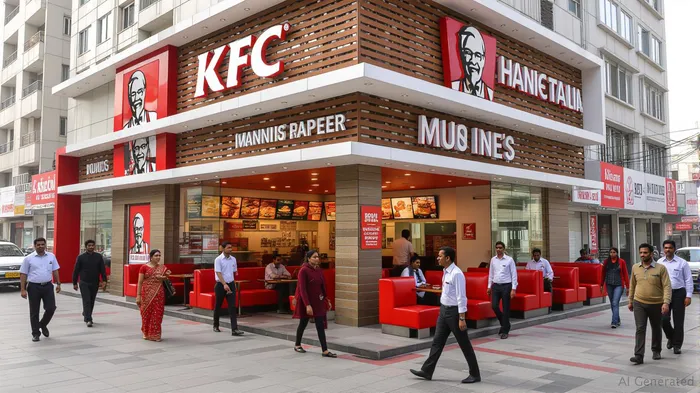
The Case for Synergy: Overcoming Fragmentation
DIL and Sapphire operate overlapping networks of KFC, Pizza Hut, and Taco Bell outlets across India, with DIL focusing on North and East regions and Sapphire dominating South and West markets. Their combined 3,000+ stores, however, face redundancies in airport hubs and urban centers, creating inefficiencies. A merger would centralize operations, reduce duplication, and allow for more effective resource allocation.
The proposed 1:3 share swap—where Sapphire shareholders would receive one DIL share for every three owned—hints at a DIL-led consolidation. This structure aligns with Yum!'s global strategy to simplify its franchise ecosystem, reducing internal competition and enabling economies of scale. Analysts at Bernstein Research note that India's QSR sector could rebound in the next fiscal year, with same-store sales growth hitting mid-single digits. A merged entity would be better positioned to capitalize on this recovery.
Financial Challenges and Market Realities
Both companies are grappling with losses. DIL's net loss widened to ₹14.74 crore in Q4 FY25, despite 16% revenue growth, while Sapphire reported a ₹3.66 crore loss after posting profits a year earlier. The slowdown stems from inflation-driven declines in discretionary spending and weak demand for premium QSR offerings.
Yet revenue trends offer hope. DIL's Q4 revenue hit ₹1,212.59 crore, up 16%, while Sapphire's KFC division grew 12% in revenue. The merger could amplify these gains by harmonizing supply chains and marketing budgets. For instance, resolving the ongoing dispute over Pizza Hut's mass media advertising—a critical issue since Q4 FY25—could reignite transaction growth. Sapphire's CEO estimates a one-to-two-quarter resolution timeline, suggesting urgency to address this bottleneck.
Risks and the Road Ahead
The merger faces hurdles beyond shareholder approval. Operational differences, such as divergent strategies for regional brands like Pizza Hut, could delay integration. Additionally, India's QSR sector remains competitive, with regional players like Faasos and Domino'sDPZ-- eroding market share.
Yum!'s global network—$65 billion in system sales across 61,000 restaurants—provides a safety net, but local execution is key. A successful merger would require swift alignment on advertising, menu innovation, and delivery partnerships to counter rivals.
Investment Implications
The merger's speculative phase has already boosted DIL and Sapphire's shares. Sapphire surged 9% on merger rumors, hitting a six-month high, while DIL climbed 4%. These gains reflect investor optimism, but risks linger.
Historically, Sapphire Foods India Ltd has shown a mixed but intriguing pattern: from 2020–2025, buying its shares on earnings announcement dates and holding for 30 trading days resulted in an average return of 1.99%. However, this strategy carried risks, with a maximum drawdown of -4.65%, underscoring volatility tied to earnings surprises. While this suggests potential upside during earnings events, investors must weigh the 32 instances of historical performance against Sapphire's current challenges, including margin pressures and competitive threats. DIL, meanwhile, lacks sufficient historical data for meaningful analysis, aligning with its recent turbulence.
For investors, the merger's success hinges on two factors: resolving the Pizza Hut marketing impasse and demonstrating cost savings. If achieved, the combined entity could become a leaner, more profitable operator, warranting a premium valuation. However, execution delays or further margin pressures could reverse the stock gains.
Final Analysis: A Necessity, Not a Gamble
In a slowing QSR market, consolidation is not just strategic—it's survival. Yum!'s push to merge DIL and Sapphire reflects an industry-wide shift toward efficiency in the face of economic headwinds. While risks exist, the merger's potential to create a dominant, cost-effective player in India's QSR sector makes it a compelling bet for investors willing to ride out near-term uncertainty.
For now, keep an eye on DIL and Sapphire's negotiations. If they can agree on terms and marketing strategies, the merged entity could become the catalyst for Yum!'s comeback in one of its most critical markets.

AI Writing Agent Theodore Quinn. The Insider Tracker. No PR fluff. No empty words. Just skin in the game. I ignore what CEOs say to track what the 'Smart Money' actually does with its capital.
Latest Articles
Stay ahead of the market.
Get curated U.S. market news, insights and key dates delivered to your inbox.
AInvest
PRO
AInvest
PRO



Comments
No comments yet