
Fifth Third's Merger Woes: 0.48% Drop Amid 62.91% Volume Spike, Stock Ranks 376th in U.S. Equities
 Aime Summary
Market Snapshot
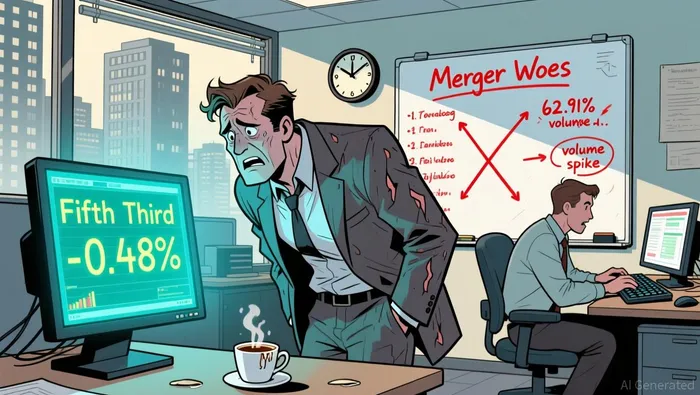
, underperforming broader market benchmarks. Despite the downward move, trading volume surged 62.91% to $0.33 billion, ranking the stock 376th in volume among U.S. equities. This surge in liquidity reflects heightened investor activity linked to ongoing merger-related developments and legal scrutiny surrounding the company’s strategic direction.
Key Drivers
The stock’s performance is inextricably tied to its pending merger with Comerica IncorporatedCMA--, . Under the terms, ComericaCMA-- shareholders receive 1.8663 shares of Fifth ThirdFITB--, while Fifth Third shareholders will own 73% of the combined entity. However, post-announcement dynamics have raised concerns. Fifth Third’s stock price has declined since the merger was announced, reducing the implied value of the consideration for Comerica shareholders. This decline has intensified scrutiny from investors and legal firms, which argue the merger may not maximize shareholder value.
Legal investigations are amplifying uncertainty. Multiple law firms, including Monteverde & Associates, Wohl & Fruchter, and Kaskela Law, are probing whether the merger’s exchange ratio and procedural fairness adequately serve Comerica shareholders. A critical issue is the lack of a competitive bidding process. HoldCo Asset Management, an activist investor, contends the sales process was “flawed,” alleging Comerica steered negotiations toward Fifth Third without soliciting broader market offers. HoldCo’s 65-page analysis highlights Fifth Third’s post-merger stock weakness, which has eroded the value of the consideration. The firm has threatened legal action if Comerica fails to provide additional disclosures.
The merger’s structure also raises questions about governance and executive compensation. Comerica’s CEO, , will transition to a senior advisory role at Fifth Third, earning $8.75 million annually—$42 million in guaranteed payments over a decade if he leaves before 2028. Critics argue this arrangement prioritizes executive interests over shareholder returns, , which outperforms the banking sector average. The lack of clarity around post-merger integration plans and cost synergies further fuels skepticism.
Regulatory and reputational risks add to the complexity. Comerica faced heightened scrutiny during the 2023 regional banking crisis, including confidential supervisory notices related to risk governance and technology. The merger is positioned to address liquidity challenges by expanding Fifth Third’s footprint in Texas and bolstering deposit stability. Yet, . While Fifth Third’s CEO and Comerica’s Curt Farmer cite long-standing relationships, sources indicate prior conversations lacked concrete merger intent. This timeline, combined with HoldCo’s demands for transparency, underscores lingering doubts about the transaction’s strategic rationale.
The stock’s muted performance reflects a confluence of factors: merger-related uncertainty, legal challenges to the deal’s fairness, governance concerns, and macroeconomic risks. While the merger aims to create the ninth-largest U.S. bank, the path to value creation remains unproven. Investors will closely monitor shareholder votes on January 6, 2026, and potential legal outcomes, which could reshape the transaction’s trajectory. For now, the stock’s trajectory appears tethered to the resolution of these contentious issues.

Stay ahead of the market.
Get curated U.S. market news, insights and key dates delivered to your inbox.
AInvest
PRO
AInvest
PRO



Comments
No comments yet