
Meredith Whitney Predicts a "Bifurcated" US Economy Driven by High-End Consumer
ByAinvest
Thursday, Aug 21, 2025 5:30 pm ET1min read
HD--
Whitney's concerns extend to stagflation—a scenario where joblessness and inflation rise simultaneously. She notes that the weakest segment of the U.S. economy, which includes hospitality and leisure jobs, is particularly vulnerable. Additionally, she points out that the resumption of student debt payments and the difficulty of college graduates finding first jobs are further straining the economic situation [1].
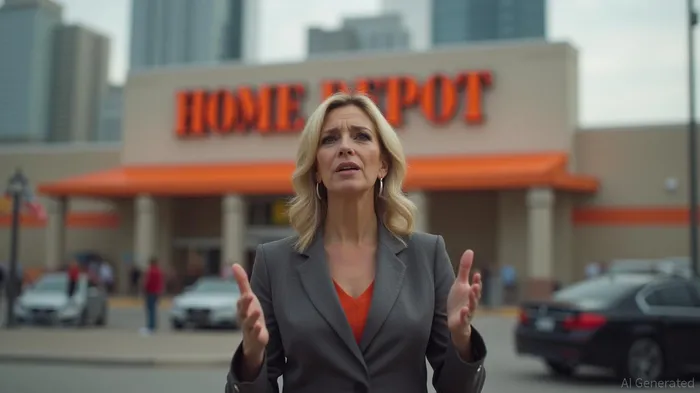
In response to these challenges, Whitney has shifted her investment preferences. She previously favored dollar stores like Dollar General (DG) and Dollar Tree (DLTR), but now she is more bullish on higher-end retailers such as Home Depot (HD), Lowe's (LOW), and Walmart (WMT). Whitney argues that these retailers benefit from a customer base that includes homeowners, who possess a financial safety net [1].
The housing market, according to Whitney, is headed for its worst activity in decades. Existing-home sales are tracking under 4 million on an annualized basis, the lowest in over 25 years. This slowdown is attributed to an aging homeowner demographic that is reluctant to sell due to limited downsizing options and the high costs associated with moving [1].
Home Depot and Lowe's, two leading home improvement retailers, reported mixed but encouraging second-quarter financial results. Home Depot missed analyst forecasts, while Lowe's beat expectations and announced a significant acquisition of Foundation Building Materials for $8.8 billion [2]. Despite the mixed performance, both companies remain cautious about the immediate future, projecting continued momentum rather than a near-term boom in the marketplace [2].
The economic outlook, as outlined by Whitney, suggests a cautious approach for investors. While the housing market may not be in immediate peril, the bifurcated nature of the economy poses significant risks to lower-income households. Investors should monitor the job market and inflation rates closely, as well as the performance of higher-end retailers that cater to homeowners with financial safety nets.
References:
[1] https://www.marketwatch.com/story/meredith-whitney-famously-called-the-2008-financial-crisis-heres-the-new-problem-with-the-u-s-economy-she-says-7b0aa8f9
[2] https://businessofhome.com/articles/home-depot-and-lowe-s-report-solid-numbers-but-remain-cautious
WMT--
Meredith Whitney, a financial analyst known for predicting the 2008 financial crisis, warns of a "bifurcated" US economy driven by high-end consumers. She expects over 50% of households to face job loss and predicts stagflation. Whitney now prefers "higher-end retailers" like Home Depot, Lowe's, and Walmart, citing their customer base of homeowners with a financial safety net.
Financial analyst Meredith Whitney, renowned for her prescient predictions during the 2008 financial crisis, has sounded the alarm on a potential economic bifurcation in the United States. In a recent interview with MarketWatch, Whitney cautioned that over 50% of U.S. households, many of whom are living paycheck to paycheck, are at risk of losing jobs in the near future [1]. She attributes this to the hospitality and leisure sector, which employs a significant portion of low-wage workers.Whitney's concerns extend to stagflation—a scenario where joblessness and inflation rise simultaneously. She notes that the weakest segment of the U.S. economy, which includes hospitality and leisure jobs, is particularly vulnerable. Additionally, she points out that the resumption of student debt payments and the difficulty of college graduates finding first jobs are further straining the economic situation [1].
In response to these challenges, Whitney has shifted her investment preferences. She previously favored dollar stores like Dollar General (DG) and Dollar Tree (DLTR), but now she is more bullish on higher-end retailers such as Home Depot (HD), Lowe's (LOW), and Walmart (WMT). Whitney argues that these retailers benefit from a customer base that includes homeowners, who possess a financial safety net [1].
The housing market, according to Whitney, is headed for its worst activity in decades. Existing-home sales are tracking under 4 million on an annualized basis, the lowest in over 25 years. This slowdown is attributed to an aging homeowner demographic that is reluctant to sell due to limited downsizing options and the high costs associated with moving [1].
Home Depot and Lowe's, two leading home improvement retailers, reported mixed but encouraging second-quarter financial results. Home Depot missed analyst forecasts, while Lowe's beat expectations and announced a significant acquisition of Foundation Building Materials for $8.8 billion [2]. Despite the mixed performance, both companies remain cautious about the immediate future, projecting continued momentum rather than a near-term boom in the marketplace [2].
The economic outlook, as outlined by Whitney, suggests a cautious approach for investors. While the housing market may not be in immediate peril, the bifurcated nature of the economy poses significant risks to lower-income households. Investors should monitor the job market and inflation rates closely, as well as the performance of higher-end retailers that cater to homeowners with financial safety nets.
References:
[1] https://www.marketwatch.com/story/meredith-whitney-famously-called-the-2008-financial-crisis-heres-the-new-problem-with-the-u-s-economy-she-says-7b0aa8f9
[2] https://businessofhome.com/articles/home-depot-and-lowe-s-report-solid-numbers-but-remain-cautious
Stay ahead of the market.
Get curated U.S. market news, insights and key dates delivered to your inbox.
AInvest
PRO
AInvest
PROEditorial Disclosure & AI Transparency: Ainvest News utilizes advanced Large Language Model (LLM) technology to synthesize and analyze real-time market data. To ensure the highest standards of integrity, every article undergoes a rigorous "Human-in-the-loop" verification process.
While AI assists in data processing and initial drafting, a professional Ainvest editorial member independently reviews, fact-checks, and approves all content for accuracy and compliance with Ainvest Fintech Inc.’s editorial standards. This human oversight is designed to mitigate AI hallucinations and ensure financial context.
Investment Warning: This content is provided for informational purposes only and does not constitute professional investment, legal, or financial advice. Markets involve inherent risks. Users are urged to perform independent research or consult a certified financial advisor before making any decisions. Ainvest Fintech Inc. disclaims all liability for actions taken based on this information. Found an error?Report an Issue




Comments
No comments yet