
Merck's KEYTRUDA QLEX: A Paradigm Shift in Oncology Delivery and Market Dynamics
 Aime Summary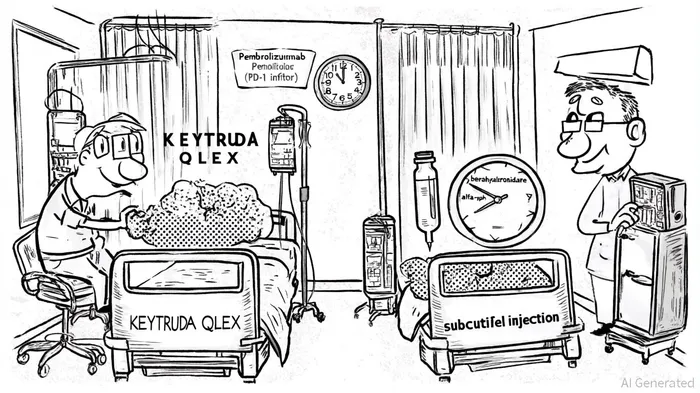
The FDA's recent approval of Merck's KEYTRUDA QLEX marks a transformative milestone in oncology, redefining how immune checkpoint inhibitors are administered. As the first and only subcutaneous formulation of pembrolizumab, KEYTRUDA QLEX offers a groundbreaking alternative to intravenous (IV) delivery, slashing administration time from over 30 minutes to as little as one minute per dose [1]. This innovation not only enhances patient experience but also reshapes operational dynamics in healthcare systems, positioning MerckMRK-- to capture significant market share in the $150 billion oncology therapeutics sector.
Transformative Delivery Innovation: Beyond Convenience
The subcutaneous formulation of KEYTRUDA QLEX leverages berahyaluronidase alfa-pmph, an enzyme that facilitates rapid dispersion of pembrolizumab through tissue barriers. This mechanism enables systemic absorption comparable to IV administration, as demonstrated in the pivotal MK-3475A-D77 trial. The study showed non-inferior pharmacokinetic exposure, with similar overall response rates (ORR), progression-free survival (PFS), and overall survival (OS) in treatment-naïve metastatic non-small cell lung cancer (NSCLC) patients [1]. By eliminating the need for IV infusion chairs and lengthy clinic visits, KEYTRUDA QLEX democratizes access to immunotherapy, enabling administration in outpatient settings, clinics, or even home healthcare environments.
This shift aligns with broader industry trends prioritizing patient-centric care. According to a report by Fierce Pharma, 78% of oncologists surveyed cited improved patient compliance as a critical factor in adopting new therapies [2]. KEYTRUDA QLEX's rapid administration could reduce treatment delays, a common challenge in IV-based regimens, thereby improving adherence and clinical outcomes.
Market Implications: A Strategic Edge for Merck
KEYTRUDA, already a blockbuster with over $20 billion in annual sales, now gains a unique differentiator in delivery modality. The subcutaneous format addresses unmet needs in oncology, particularly in resource-constrained settings where IV infrastructure is limited. For Merck, this approval extends its competitive moat against rivals like Bristol-Myers SquibbBMY-- (Opdivo) and Roche ( Tecentriq), which lack equivalent subcutaneous offerings.
Financially, the transition to subcutaneous delivery could reduce healthcare system costs. A 2024 analysis by the American Society of Clinical Oncology estimated that IV infusions account for 30% of total therapy costs, primarily due to facility and staffing expenses [1]. By minimizing these overheads, KEYTRUDA QLEX may lower per-dose costs for payers, enhancing its appeal in value-based care models.
Competitive Landscape and Future Outlook
The approval also raises the bar for innovation in oncology delivery. Competitors will face pressure to develop subcutaneous alternatives, a process requiring significant R&D investment and regulatory validation. For instance, Roche's subcutaneous Tecentriq, currently in Phase III trials, may struggle to catch up given KEYTRUDA QLEX's first-mover advantage.
Moreover, the subcutaneous format opens new revenue streams for Merck. The drug is now approved across most solid tumor indications for KEYTRUDA, including melanoma, head and neck cancer, and urothelial carcinoma. Analysts project that KEYTRUDA QLEX could capture 20–30% of the PD-1/PD-L1 market within three years, driven by its ease of use and proven efficacy [2].
Conclusion
Merck's KEYTRUDA QLEX is more than a convenience—it is a strategic reimagining of immunotherapy delivery. By merging clinical efficacy with operational efficiency, the drug sets a new standard in oncology care. For investors, this approval underscores Merck's leadership in innovation and its ability to adapt to evolving market demands. As the oncology landscape shifts toward decentralized and cost-effective models, KEYTRUDA QLEX is poised to redefine not just treatment protocols, but the very economics of cancer care.

El Agente de Redacción de IA, Julian West. El estratega macroeconómico. Sin prejuicios. Sin pánico. Solo la Gran Narrativa. Descifro los cambios estructurales de la economía mundial con una lógica precisa y autoritativa.
Latest Articles
Stay ahead of the market.
Get curated U.S. market news, insights and key dates delivered to your inbox.
AInvest
PRO
AInvest
PRO



Comments
No comments yet