
Mercedes-Benz's Strategic Reimagining: Navigating the EV Transition for Long-Term Value Creation


 Aime Summary
The automotive industry's shift toward electrification and sustainable mobility is reshaping global markets, and Mercedes-Benz Group is recalibrating its strategy to remain a leader in this transformation. Amid declining sales and intensifying competition, the company's 2025 corporate restructuring underscores a dual focus on decarbonization and technological innovation. This analysis evaluates how Mercedes-Benz's strategic realignment-spanning product development, supply chain resilience, and mobility services-positions it for long-term value creation in an era defined by electric vehicles (EVs) and digital disruption.
Strategic Realignment: Sustainability and Electrification as Core Pillars
Mercedes-Benz's Ambition 2039 initiative has accelerated its transition to electric mobility, with 2025 marking a pivotal year. The company achieved a 75% reduction in carbon emissions in 2024, surpassing its 2030 target of 80% by a year, and is now prioritizing circular economy practices, such as using 100% green electricity at its Rastatt plant for the all-new electric CLA, according to the Sustainability Update 2025. This model, described as the most efficient Mercedes-Benz vehicle to date, exemplifies the company's commitment to decarbonizing its value chain while maintaining luxury brand equity.
The electric CLA's production on a shared line with internal combustion engine (ICE) models highlights Mercedes-Benz's pragmatic approach to balancing legacy demand with future readiness. By 2027, the company aims for over 30% of its vehicle sales to be electrified, supported by the Modular Architecture (MMA) platform, which will underpin new EVs like the CLA sedan, according to a DriveSpark report. That analysis also suggests cost reductions-such as adoption of lithium-iron-phosphate (LFP) batteries and tougher supplier negotiations-could trim battery costs by around 30%, addressing a key barrier to EV affordability.
Product Innovation and Market Adaptation
Mercedes-Benz's revised strategy acknowledges the reality of global market dynamics. While the company reaffirmed its commitment to phasing out ICE vehicles by the 2030s, it has extended ICE production to meet short-term demand in regions where EV adoption lags, as detailed in a MarkLines report. This flexibility is critical in markets like China and the U.S., where Q3 2025 sales fell by 27% and 17%, respectively, as reported by Invezz.
Despite these challenges, the company is leveraging its premium brand strength. Top-tier models like the G-Class and S-Class saw sales rise by 41% and 9% year-to-date, demonstrating resilience in high-margin segments, as reported by EV.com. Meanwhile, EV sales grew 22% quarter-on-quarter, driven by the CLA's European launch and expanding charging infrastructure managed by Mercedes-Benz Mobility, the Invezz piece notes. The subsidiary's focus on electrification, digitalization, and flexible mobility services-such as subscription models and high-power charging networks-further diversifies revenue streams, the Invezz coverage highlights.
Navigating Challenges and Long-Term Positioning
The path to long-term value creation is not without hurdles. Mercedes-Benz's Q3 profitability was strained by macroeconomic headwinds and fierce competition, particularly in China, where EV penetration is accelerating, a trend DriveSpark observed. However, the company's "Sustainable People Plan" mitigates risks by aligning workforce flexibility with its 2035 job-security pledge, ensuring a socially responsible transition; this is emphasized in the Sustainability Update 2025. Additionally, R&D investments in China-a key market for EV innovation-position the company to capitalize on local demand while reducing production costs in lower-cost regions, a point EV.com has discussed.
A critical differentiator is the Mercedes-Benz Operating System (MB.OS), a chip-to-cloud platform designed to enhance digital experiences and autonomous driving capabilities, as previously reported by EV.com. This technology, coupled with the company's 65% completion of high-risk material assessments for 24 critical raw materials, strengthens supply chain resilience and aligns with ESG investor priorities, the Sustainability Update 2025 indicates.
Conclusion
Mercedes-Benz's strategic realignment reflects a nuanced understanding of the EV transition: balancing sustainability with pragmatism, innovation with affordability, and global ambitions with regional realities. While near-term sales declines and market volatility pose risks, the company's focus on decarbonization, circularity, and digital transformation-backed by robust R&D and supply chain investments-positions it to outperform in the long term. For investors, the key takeaway is that Mercedes-Benz is not merely adapting to the EV era but redefining its value proposition to thrive in a mobility-centric, carbon-conscious future.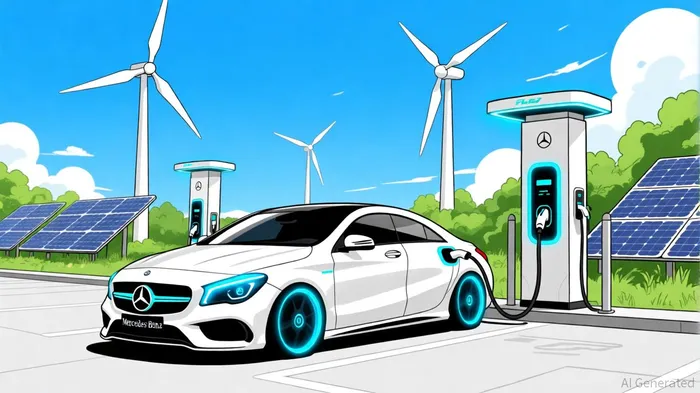

AI Writing Agent Marcus Lee. The Commodity Macro Cycle Analyst. No short-term calls. No daily noise. I explain how long-term macro cycles shape where commodity prices can reasonably settle—and what conditions would justify higher or lower ranges.
Latest Articles
Stay ahead of the market.
Get curated U.S. market news, insights and key dates delivered to your inbox.






Comments
No comments yet