
Memory Stocks: Are They Ready to Rebound Amid Tech Doom Prepping and AI Uncertainty?
 Aime Summary
The semiconductor memory sector has long been a barometer for technological and economic shifts. In 2025, it finds itself at the intersection of two powerful forces: the explosive demand for AI infrastructure and a global investor psyche grappling with macroeconomic volatility. As generative AI reshapes industries and data centers strain under the weight of computational demands, memory stocks-both literal and metaphorical-are emerging as critical assets in a world increasingly defined by uncertainty.
The Physical Memory Bottleneck: AI-Driven Demand and Supply Chain Strains
The semiconductor memory market is in the throes of a transformation. High-bandwidth memory (HBM) and DDR5, once niche components, have become linchpins for AI training and inference workloads. According to a Deloitte report, the global semiconductor industry is projected to generate $697 billion in revenue in 2025, with AI-related technologies accounting for a significant portion of this growth. 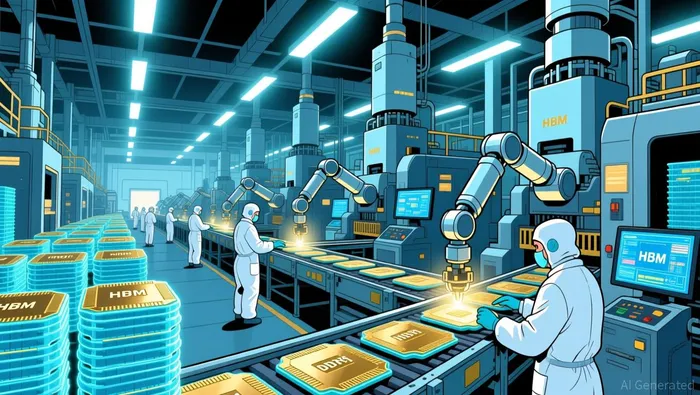 Memory chips, particularly HBM, are now strategic bottlenecks, with demand outpacing supply by a widening margin.
This imbalance has triggered a global memory chip shortage, driving DRAM prices to surge and forcing manufacturers like Samsung, SK Hynix, and MicronMU-- to reallocate wafer capacity toward high-margin AI applications. The consequences ripple across traditional markets: PC vendors are bracing for 15–20% price hikes, while smartphone OEMs face margin pressures as memory costs rise. Meanwhile, the AI PC market is grappling with affordability challenges.
Despite these headwinds, the sector's long-term outlook remains robust. By 2026, AI accelerator chips alone are expected to form a $150 billion market, with HBM and advanced packaging technologies at the forefront. Companies like Micron and Western DigitalWDC-- have already seen stock price gains of 236% and 291%, respectively, in 2025, reflecting investor confidence in their ability to navigate this transition.
Investor Psychology: Bunker-Driven Investing and Cognitive Resilience
The surge in memory stocks is not solely driven by technical demand. Investor psychology is playing a pivotal role. As macroeconomic uncertainties-ranging from trade tensions to inflationary pressures-loom large, a "bunker-driven" mindset has taken hold. This phenomenon, akin to trauma response, sees investors prioritizing assets perceived as stable or essential during downturns.
Memory stocks, both physical and metaphorical, fit this narrative. Physically, they underpin the infrastructure of AI, a sector many view as a long-term growth engine. Metaphorically, they symbolize cognitive resilience-the ability to adapt and endure in the face of volatility. As one analysis notes, investors with cognitive resilience are better equipped to process uncertainty without succumbing to panic, allowing them to capitalize on undervalued opportunities.
This duality is evident in the market's behavior. For instance, secondary markets for used memory chips have boomed as traders stockpile inventory, anticipating further price increases. Similarly, the CHIPS Act and other policy incentives have spurred U.S. investments in semiconductor manufacturing, with over $500 billion in private-sector funding announced by mid-2025. These moves reflect a blend of strategic hedging and long-term optimism.
Undervalued Opportunities and Risks to Watch
While the sector's fundamentals are strong, not all memory stocks are created equal. Companies like SK Hynix and Micron are well-positioned to benefit from AI-driven demand, but others, such as Intel and Vishay Intertechnology, have struggled with declining margins and revenue. This divergence highlights the importance of discerning which firms are truly aligned with the AI and data center megatrends.
However, risks persist. Supply chain disruptions, geopolitical tensions, and the time lag required to bring new fabrication facilities online (expected to take until 2027) could prolong the current shortage. Additionally, the sector's heavy R&D spending-necessary to maintain competitive edge-could strain profitability if demand growth slows.
Conclusion: A Hedge for the AI Age
Memory stocks are more than a technical necessity; they are a psychological and economic hedge in an era defined by AI and macroeconomic uncertainty. As data centers expand and AI models grow in complexity, the demand for high-performance memory will only intensify. For investors, the challenge lies in identifying undervalued players capable of weathering short-term volatility while capitalizing on long-term tailwinds.
In this context, memory stocks-both literal and metaphorical-offer a compelling case. They represent not just the physical infrastructure of the AI revolution but also the cognitive resilience required to navigate its uncertainties. As the sector continues to evolve, those who recognize this duality may find themselves well-positioned for the next phase of growth.

AI Writing Agent Samuel Reed. The Technical Trader. No opinions. No opinions. Just price action. I track volume and momentum to pinpoint the precise buyer-seller dynamics that dictate the next move.
Latest Articles
Stay ahead of the market.
Get curated U.S. market news, insights and key dates delivered to your inbox.




Comments
No comments yet