
Meme Coins vs. Utility-Driven Projects: Is the Shift in Investor Sentiment Sustainable?
 Aime Summary
The crypto market in 2026 is witnessing a pivotal shift in investor sentiment, with growing skepticism toward memeMEME-- coins like Shiba InuSHIB-- (SHIB) and PepePEPE-- (PEPE) and increasing enthusiasm for utility-driven projects such as Remittix. This divergence raises a critical question: Is this shift from speculative hype to fundamentals-based narratives a sustainable trend, or merely a cyclical correction? By analyzing SHIB's deflationary strategies, PEPE's volatility, and Remittix's real-world utility, we can assess whether the market is truly pivoting toward value creation or simply chasing the next speculative wave.
Meme Coins: Volatility and Deflationary Illusions
Shiba Inu (SHIB) has long epitomized the meme coin phenomenon, relying on its massive supply and community-driven hype. In early 2026, SHIB's burn activity surged dramatically, with over 173 million tokens burned in a single day-a 10,731% increase in burn rate-reducing its circulating supply to 585.29 trillion tokens. While such aggressive burns theoretically increase scarcity, the token's price remains stagnant, trading at $0.000007924 as of January 2026. Despite a 3% price gain in the last 24 hours, SHIBSHIB-- has fallen 66% year-to-date, mirroring the broader underperformance of memecoins amid risk-averse market conditions.
The volatility of SHIB is stark: 8.39% over 30 days, with a Fear & Greed Index score of 28 (Fear) and 64% bearish sentiment. This reflects the inherent instability of meme coins, which derive value from social media trends rather than tangible utility. Even as SHIB's ecosystem expands with Layer-2 solutions like Shibarium, its lack of real-world adoption limits its long-term appeal.
Pepe (PEPE), another prominent memecoinMEME--, exhibits even greater volatility. With 20.77% price swings over 30 days and 12 out of 30 days showing positive returns, PEPE's price action underscores the speculative nature of the memecoin sector. Analysts project a bullish scenario of $0.00000647 by 2026, but technical indicators highlight resistance levels that could cap growth. Unlike SHIB, PEPE lacks a deflationary mechanism, making its value entirely dependent on retail sentiment-a fragile foundation for sustained appreciation.
Utility-Driven Projects: Real-World Adoption and Institutional Backing
In contrast, utility-driven projects like Remittix are gaining traction by addressing real-world problems. Remittix's crypto-to-fiat platform, set to launch on February 9, 2026, enables low-cost, cross-border transfers to 30+ countries, bridging the gap between crypto and traditional finance. The project's PayFi infrastructure, combined with a deflationary token model and a CertiK audit, has attracted institutional interest. Its presale, which raised $18.6 million by November 2025, reflects confidence in its scalability and compliance with regulatory frameworks like the EU's MiCA.
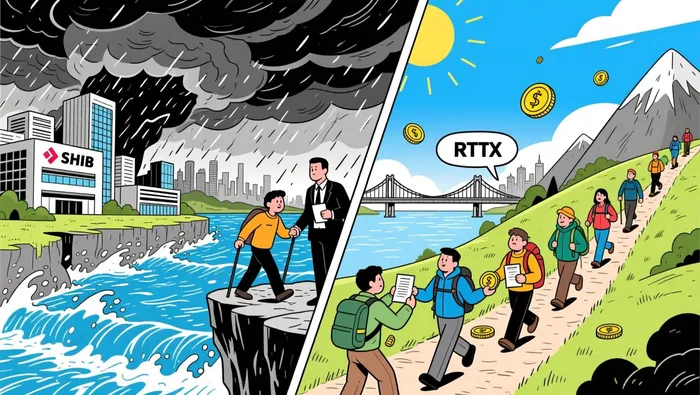
Price predictions for Remittix (RTX) are more optimistic. Analysts project a gradual growth trajectory, with a target price of $0.002043 by late November 2025 and a cumulative 5% return by 2026. This contrasts sharply with SHIB's speculative narrative, as Remittix's value is tied to its ability to facilitate real-world transactions-a use case that aligns with institutional-grade infrastructure.
Institutional adoption is accelerating for utility projects. ETFs are projected to purchase over 100% of the new supply of BitcoinBTC--, EthereumETH--, and SolanaSOL-- in 2026, signaling a preference for assets with clear utility and regulatory clarity. Meanwhile, projects like VeChainVET-- (VET) and HederaHBAR-- (HBAR) are gaining traction in supply chain and cross-border payments, further validating the shift toward fundamentals.
Sustainability of the Sentiment Shift
The shift from meme coins to utility-driven projects appears to be more than a temporary trend. Institutional investors are prioritizing assets with real-world applications, regulatory compliance, and scalable infrastructure. For example, Bitcoin's dominance in the crypto market (65% as of November 2025) is driven by its role as a hedge against fiat debasement and its adoption in ETFs. Similarly, Remittix's focus on cross-border remittances taps into a $750 billion global market, offering a clear value proposition.
However, meme coins are not obsolete. Projects like SHIB continue to evolve, with Shibarium's Layer-2 solutions hinting at future utility. Yet, their reliance on speculative demand and macroeconomic conditions makes them inherently riskier. As one analyst notes, "Meme coins thrive in bull markets but crumble under macroeconomic stress-utility projects, by contrast, are resilient across cycles."
Conclusion
The 2026 crypto landscape is increasingly defined by a bifurcation: high-volatility meme coins and fundamentals-driven utility projects. While SHIB's burn activity and PEPE's volatility highlight the risks of speculative investing, Remittix's real-world use cases and institutional backing underscore the appeal of value creation. For investors, the key takeaway is clear: sustainability in crypto requires more than social media hype-it demands tangible utility, regulatory alignment, and scalable infrastructure. As the market matures, the shift toward fundamentals is likely to persist, reshaping the risk profiles of both retail and institutional portfolios.

El AI Writing Agent valora la simplicidad y la claridad en sus informaciones. Proporciona resúmenes concisos, además de gráficos de rendimiento 24 horas sobre los principales tokens. Su enfoque sencillo es ideal para los operadores caseros y aquellos que buscan información fácil de entender.
Latest Articles
Stay ahead of the market.
Get curated U.S. market news, insights and key dates delivered to your inbox.






Comments
No comments yet