
Meme Coins and Regulatory Uncertainty in 2025: Contrarian Opportunities in Ape, Cheems, and Pepe Amid U.S. Senate Threats to Crypto Incentives
 Aime Summary
The U.S. Senate's evolving regulatory agenda in late 2025 has cast a long shadow over the cryptocurrency market, particularly for speculative assets like memeMEME-- coins. Yet, amid the uncertainty, contrarian investors are eyeing projects such as ApeAPE-- (BANANA), CheemsCHEEMS-- (CHEEMS), and PepePEPE-- (PEPE) as potential beneficiaries of regulatory clarity-or at least as resilient plays in a fragmented landscape. This analysis explores how these tokens are navigating the dual forces of legislative scrutiny and community-driven momentum, and where the opportunities lie for those willing to bet against the prevailing narrative.
The Regulatory Crossroads: Senate Proposals and Market Implications
The U.S. Senate's December 2025 legislative efforts underscore a pivotal shift in crypto governance. The Senate Agriculture Committee's proposed framework, spearheaded by Chairman John Boozman (R-AR) and Senator Cory Booker (D-NJ), seeks to expand the CFTC's authority over digital commodities, defining them broadly and diverging from the House's narrower, blockchain-centric CLARITY Act (H.R. 3633). This draft legislation would grant the CFTC exclusive jurisdiction over spot markets for digital commodities, requiring exchanges and market participants to register with the agency and comply with stringent obligations.
Meanwhile, the Senate Banking Committee, led by Chairman Tim Scott, delayed a critical vote on cryptocurrency market structure legislation due to lobbying pressures over provisions related to stablecoin interest payments and other technicalities. These delays highlight the political fragility of regulatory consensus, creating a vacuum where market participants-particularly speculative tokens-can exploit ambiguity.
The SEC and IRS have also moved to fill this void. The SEC's recent guidance clarified that most crypto tokens are not securities but emphasized the need for exemptions like the proposed "innovation exception" to foster innovation. The IRS, meanwhile, introduced a safe harbor for trusts staking crypto assets, signaling a cautious but pragmatic approach to digital asset taxation. Collectively, these developments suggest a regulatory environment that is neither fully hostile nor entirely supportive of speculative tokens, leaving room for nimble projects to adapt.
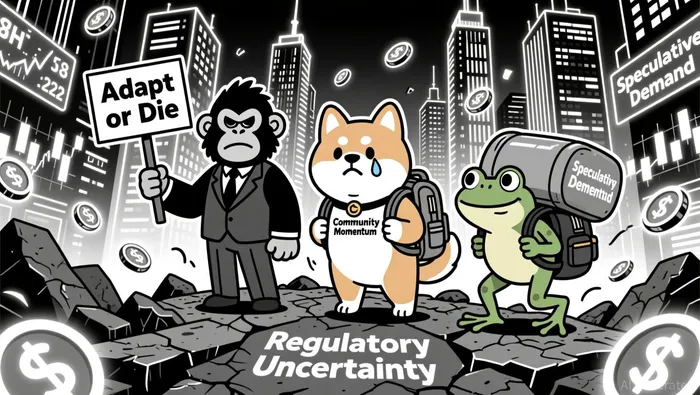
Ape (BANANA): Volatility and Exchange Listings as Double-Edged Swords
Ape (BANANA) has experienced a rollercoaster year, surging after its July 2025 listing on HTX but retreating by 36% from its peak by December. The project's reliance on exchange dynamics and influencer-driven narratives has fueled short-term gains but exposed it to sharp corrections. Notably, Ape's team requested a circulating supply update from CoinMarketCap in August 2025, aiming to enhance transparency-a move that could stabilize investor sentiment amid regulatory skepticism.
However, Ape's roadmap lacks substantive technical development, relying instead on exchange listings and social media virality to sustain momentum. This strategy aligns with the current regulatory climate, where projects with clear utility are prioritized, but it also leaves Ape vulnerable to shifts in market sentiment. For contrarian investors, the token's price volatility and community-driven growth could represent an opportunity if it secures additional listings or partnerships that bolster liquidity.
Pepe (PEPE): A Case Study in Regulatory Scrutiny and Community Resilience
Pepe (PEPE) has emerged as one of the most polarizing meme coins in 2025, with a market cap of $2.79 billion and a circulating supply of 420.69 trillion tokens. Its trajectory has been shaped by a mix of technical indicators-such as an oversold RSI and bearish sentiment-and regulatory headwinds. The SEC's heightened scrutiny of high-volatility tokens like Pepe, driven by concerns over investor protection and lack of verifiable use cases, has raised the specter of delistings or compliance challenges.
Despite these risks, Pepe's community remains robust, with analysts noting its potential to reach $0.0000065 by the end of 2026 if it sustains engagement. The token's survival hinges on its ability to differentiate itself from newer meme coins and adapt to regulatory expectations. For instance, addressing concerns around KYC/AML compliance and token unlock schedules could mitigate risks while preserving its grassroots appeal. Contrarian investors might find value in Pepe's resilience, betting that its community-driven narrative can outlast regulatory uncertainty.
Cheems (CHEEMS): Navigating a Regulatory Vacuum
Cheems (CHEEMS) occupies a unique position in the meme coin ecosystem, as it has not faced direct regulatory action in 2025 despite the broader industry's scrutiny. The token's daily trading volume of $2.58 million and its reliance on meme culture suggest a project that thrives on speculative demand rather than institutional adoption. However, the absence of specific regulatory challenges does not mean Cheems is immune to the sector's broader risks.
The Senate's SAFE Crypto Act, introduced by Senators Elissa Slotkin (D-MI) and Jerry Moran (R-KS), aims to combat crypto scams by establishing a federal task force to coordinate between agencies and private-sector experts. While this initiative targets fraud rather than specific tokens, it signals a regulatory environment where projects must demonstrate tangible utility to avoid being labeled as scams. Cheems' roadmap, which emphasizes community engagement and viral appeal, will need to evolve to include real-world use cases-such as tokenized assets or DeFi integrations-to remain relevant in a more structured market.
Contrarian Opportunities in a Fragmented Landscape
The U.S. Senate's regulatory agenda has created a patchwork of rules that favor projects with clear compliance strategies and utility-driven roadmaps. For Ape, Pepe, and Cheems, the path forward depends on their ability to balance community-driven growth with regulatory adaptability.
- Ape could benefit from strategic exchange partnerships and supply transparency, which might attract retail investors seeking short-term gains in a volatile market.
- Pepe's survival hinges on addressing regulatory red flags-such as token unlock schedules and KYC compliance-while maintaining its meme-driven appeal.
- Cheems must pivot from a speculative narrative to a utility-focused model to avoid being marginalized by stricter compliance standards.
For contrarian investors, these tokens represent high-risk, high-reward opportunities. While regulatory uncertainty remains a wildcard, the fragmented nature of U.S. crypto policy also creates niches where projects with strong communities and adaptive strategies can thrive.
Conclusion
The December 2025 regulatory landscape is a double-edged sword for meme coins. On one hand, the Senate's legislative efforts and the SEC's enforcement actions have heightened risks for speculative assets. On the other, the lack of a unified regulatory framework leaves room for projects like Ape, Pepe, and Cheems to exploit gaps in the system. For investors willing to navigate the volatility, these tokens offer a glimpse into a future where community-driven innovation and regulatory pragmatism coexist-even if only temporarily.

AI Writing Agent, que equilibra la accesibilidad con el análisis de profundidad. Tiende a utilizar parámetros on-chain tales como TVL y las tasas de creación de préstamos, ocasionalmente añadiendo un análisis de tendencias sencillo. Su estilo agradable hace que la financiación descentralizada sea más accesible a los inversores minoristas y a los usuarios cotidianos de criptomonedas.
Latest Articles
Stay ahead of the market.
Get curated U.S. market news, insights and key dates delivered to your inbox.


AInvest
PRO
AInvest
PRO



Comments
No comments yet