
Meme Coins 2.0: How BullZilla, Bonk, and Peanut Are Redefining the Meme Economy


 Aime Summary
The meme coin market has evolved from chaotic speculation to a landscape of engineered scarcity and structured incentives. In 2025, projects like BullZilla ($BZIL), Bonk ($BONK), and Peanut the Squirrel ($PNUT) are redefining the meme economy by introducing risk-rebalance mechanisms and deterministic ROI models. These innovations address the inherent volatility of meme coins while catering to both retail and institutional investors.
BullZilla: Engineered Scarcity and High-Yield Staking
BullZilla’s presale model exemplifies the new era of meme coins. Its Mutation Mechanism increases the token price every 48 hours or upon raising $100,000, whichever occurs first, creating urgency for early participation [1]. For instance, a $5,000 investment at the initial price of $0.00000575 could yield 869.57 million tokens, potentially worth $4.58 million if the token reaches its projected listing price of $0.00527141 [3].
To mitigate sell pressure, BullZilla employs the Roar Burn Mechanism, permanently removing 5% of the supply at each presale milestone. This deflationary strategy reduces circulating supply by over 70% by the final stage, amplifying scarcity [1]. Complementing this is the HODL Furnace, a staking system offering up to 70% APY for locking tokens for 1–3 months, incentivizing long-term holding [3].
BullZilla’s tokenomics are equally structured: 50% of the supply is allocated to the presale, 30% to liquidity and ecosystem growth, and 20% to staking rewards. This balanced approach ensures sustainability while aligning investor incentives [1]. Analysts project that a $7,000 investment could yield $8.05 million if the token reaches its target price [3].
Bonk: Ecosystem Anchoring and Liquidity Depth
Bonk, Solana’s flagship meme coin, leverages its integration with the SolanaSOL-- blockchain to stabilize value. With a price of $0.00002161 and a 1.47% 24-hour increase, Bonk benefits from Solana’s high transaction speed and low fees, making it a functional asset in decentralized applications (dApps) and gaming platforms [3].
Unlike BullZilla, Bonk lacks structured burn mechanisms or staking incentives. Its ROI depends on Solana’s ecosystem growth and cultural relevance. However, its strong liquidity and utility integration provide resilience during market downturns [1]. For example, Bonk’s role in Solana’s revival post-2023 challenges underscores its ecosystem anchoring [3].
Peanut the Squirrel: Humor-Driven Volatility
Peanut the Squirrel ($PNUT) relies on community-driven humor and viral engagement. At $0.2182, it has seen a 2.53% price increase, driven by social media trends and token burns to maintain scarcity [3]. However, its shallow liquidity pool exposes it to sharp volatility. A $1,000 investment could swing dramatically with market sentiment shifts [3].
Peanut’s ROI is speculative, hinging on sustained community creativity. While it lacks structured incentives like BullZilla’s HODL Furnace, its cultural appeal attracts investors seeking novelty [1].
Comparative Risk-Return Profiles
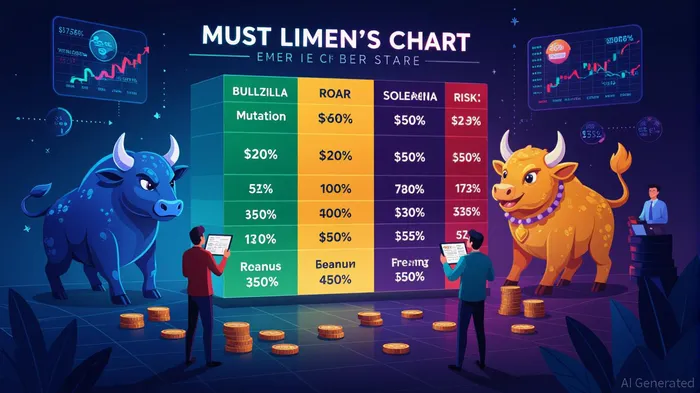
BullZilla’s structured mechanisms—engineered scarcity, staking rewards, and deflationary burns—position it as a high-conviction play with clear ROI targets. Bonk’s ecosystem anchoring offers stability but depends on Solana’s performance. Peanut’s humor-driven model is high-risk, high-reward, with ROI contingent on viral momentum.
Conclusion
Meme Coins 2.0 are redefining the market by blending cultural appeal with structured mechanics. BullZilla’s engineered scarcity and staking incentives offer a blueprint for risk-rebalance, while Bonk and Peanut highlight the enduring power of ecosystem utility and humor. For investors, the key lies in aligning risk tolerance with each project’s unique value proposition.
Source:
[1] Bonk, Peanut the Squirrel, and BullZilla [https://www.mexc.com/news/bonk-peanut-the-squirrel-and-bullzilla/79924]
[2] BullZilla Captures Market Buzz as Best Crypto Presale to Buy Now with Bonk and Peanut the Squirrel Rising [https://coinpaper.com/10778/bull-zilla-captures-market-buzz-as-best-crypto-presale-to-buy-now-with-bonk-and-peanut-the-squirrel-rising]
[3] BullZilla 2025: Why This Meme Coin's Presale Mechanics [https://www.ainvest.com/news/bullzilla-2025-meme-coin-presale-mechanics-high-conviction-short-term-play-2508/]

Decoding blockchain innovations and market trends with clarity and precision.
Latest Articles
Stay ahead of the market.
Get curated U.S. market news, insights and key dates delivered to your inbox.


AInvest
PRO
AInvest
PRO



Comments
No comments yet