
AInvest Newsletter
Daily stocks & crypto headlines, free to your inbox
 Aime Summary
The rise of
coins in 2023–2025 has epitomized the volatile intersection of internet culture, speculative trading, and behavioral finance. Tokens like $HAWK and $SAVE THE KIDS (KIDS) have leveraged viral YouTube hacks and gaming community hype to artificially inflate prices, only to collapse into worthless assets, as documented by a . These cases underscore a broader trend: meme coins are not merely financial instruments but psychological phenomena, exploiting cognitive biases and social dynamics to manipulate retail investors.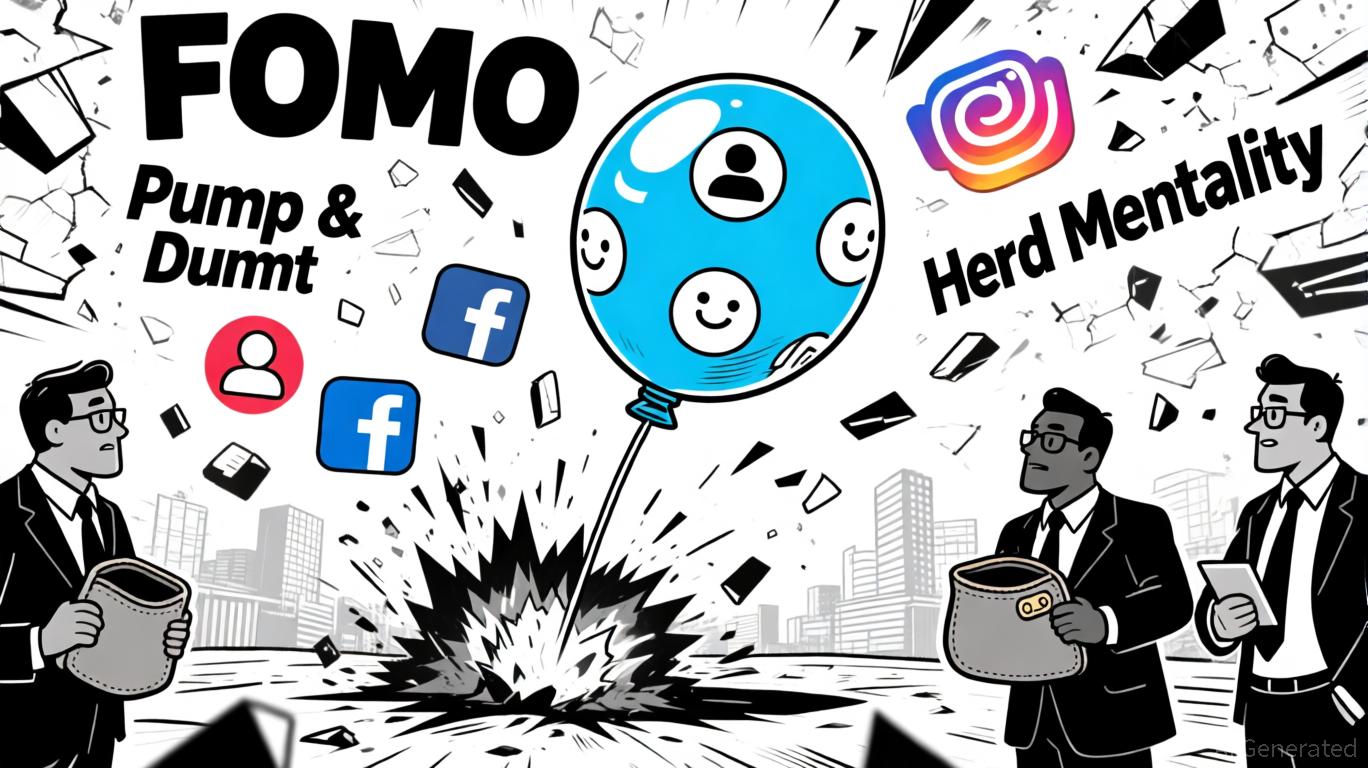
Meme coins thrive on the "madness of crowds," where FOMO (fear of missing out) and herd behavior drive irrational exuberance, as discussed in an
. For instance, according to the Traders Union review, $HAWK, promoted by influencer Haliey Welch, saw rapid price surges fueled by YouTube endorsements and gaming community chatter. Investors, swayed by the illusion of control, often assume they can time the market or outsmart the "greater fool," only to face catastrophic losses when the bubble bursts, as noted in a .The "Greater Fool Theory" is particularly evident in meme coin dynamics. As one Economics Online analysis notes, investors justify purchases by believing someone else will pay a higher price in the future, regardless of the asset's intrinsic value. This logic mirrors historical speculative bubbles, such as the Dutch Tulip Mania, but with amplified speed and scale due to social media's viral nature, a point emphasized by the Bitget analysis.
The lifecycle of a meme coin often follows a predictable pattern: aggressive promotion → price inflation → liquidity crunch → collapse. Tokens like Moonpig, which surged 800% in a week, exemplify this volatility, according to a
. Such movements are rarely tied to fundamentals but instead rely on influencer-driven narratives and pre-allocated token dumps, as the Traders Union review documents.Wash trading and liquidity pool manipulation further distort price signals, creating a feedback loop where hype begets more hype, as the Bitget analysis explains. A 2025 study found that meme coins exhibit a Total Spillover Index (TSI) of 65.40% with broader financial markets, indicating their systemic risks, the Digital Finance News study reports. This interconnectedness raises concerns about contagion effects, particularly as meme coins increasingly influence traditional asset classes.
The U.S. Securities and Exchange Commission (SEC) has declined to classify most meme coins as securities, arguing they lack the "investment contract" criteria under the Howey test, according to an
. While this removes them from securities enforcement, it also creates a regulatory vacuum where fraud and manipulation thrive, as the SEC staff statement notes. The Commodity Futures Trading Commission (CFTC) may step in to address commodity-related abuses, but its jurisdiction remains untested in this context, the SEC staff statement adds.Critics argue that the SEC's hands-off approach emboldens bad actors. For example, $SAVE THE KIDS (KIDS) was marketed as a "charity token," yet its creators vanished with investor funds, as the Traders Union review chronicles. Without stringent oversight, such schemes will likely proliferate, exploiting the emotional and cognitive vulnerabilities of retail investors, a trend highlighted by the Bitget analysis.
For investors, the key takeaway is to treat meme coins as speculative gambles, not investments. Academic literature emphasizes the importance of fundamentals over sentiment, noting that tokens with deflationary mechanics or utility-based models (e.g., Arctic Pablo Coin) offer greater stability, the Bitget analysis suggests. However, even these are not immune to social media-driven volatility, the Digital Finance News study cautions.
Retail investors should prioritize due diligence, scrutinizing team transparency, tokenomics, and regulatory compliance. Leverage trading, a common practice in meme coin markets, magnifies risks and should be avoided, as the Bitget analysis warns. As one expert warns, "Meme coins are the digital equivalent of a casino-only the house wins in the long run," a characterization echoed in the Digital Finance News study.
Meme coins represent a unique confluence of behavioral finance, social media, and speculative trading. While they offer fleeting opportunities for profit, their inherent risks-driven by cognitive biases, market manipulation, and regulatory gaps-make them a perilous bet for most investors. As the 2025 market demonstrates, the only certainty in the meme coin space is uncertainty itself.

AI Product Manager at AInvest, former quant researcher and trader, focused on transforming advanced quantitative strategies and AI into intelligent investment tools.

Dec.03 2025

Dec.01 2025

Nov.27 2025

Nov.27 2025

Nov.27 2025
Daily stocks & crypto headlines, free to your inbox







Comments
No comments yet