
MELI's $12.5B Credit Book Is the Story Now-Reinvestment or Margin Trap?


 Aime Summary
The market is debating how to classify MELIMELI--, not whether it is still growing
MELI is no longer being judged only on growth. Investors are now focused on what kind of earnings engine that growth created, and the center of gravity is the $12.5B credit book. That is why the debate has shifted from "is it still scaling?" to "how should investors classify this business?"

Q4 2025 revenue still reached $8.8 billion, up 44.6%. Even so, the market is fixated on margin compression and credit risk. Bulls see a platform being mispriced; bears see a tech company being reclassified as a lender.
Management says it is choosing to reinvest part of its operating margin to fund growth across the ecosystem. That makes the margin pressure look deliberate rather than accidental. The bear case strengthens only if that spending fails to deepen logistics, fintech adoption, and retention.
The next few quarters are the real test. If credit seasons cleanly and the moat keeps widening, the market may keep viewing MELI as a growing platform. If not, the lender label could stick harder.
MELI works best as one ecosystem, but credit now drives the valuation debate
The cleanest read is still that MELI functions as one system: commerce attracts users, logistics makes the experience reliable, fintech keeps money and data inside the platform, and credit monetizes that engagement. The old "marketplace plus fintech side hustle" framing no longer fits. Management describes sellers plugging into a shared system for traffic, payments, logistics, and advertising. That is a different valuation object from a set of separate segments.
Why the flywheel matters more than the segment split
MELI is not just selling items online; it is trying to turn one-off shopping into repeat behavior. In the last reported quarter, commerce had 83 million unique buyers who purchased 752 million items, while fintech reached 78 million monthly active users. At that scale, credit is no longer a footnote. It is woven into buyer conversion, merchant services, and retention.
A few years ago, logistics and fintech were viewed mainly as support functions for the marketplace. Now they are central to why the platform is harder to disintermediate. Sellers and buyers use the same infrastructure for discovery, checkout, delivery, and financial services. That loop can raise switching costs and create more monetization points, even as it gives credit more weight in the story.
The scale is still hard to dismiss. Commerce GMV growing 37% year-on-year, fintech TPV grew 42%, and the company produced adjusted free cash flow USD +763Mn. That does not look like an ecosystem losing control. It looks more like a platform still investing through a heavy build phase.
Advertising remains the clearest high-margin lever
Advertising is where the multiple may get the most help. Revenue from advertising grew 67%, and MELI says it is the leading platform in Latin America Retail Media market. That matters because ads can monetize existing traffic without adding the same kind of balance-sheet risk as credit.
The runway argument also remains intact. Mercado Libre says e-commerce penetration in Latin America is still in the mid-teens as a share of total retail, and it sees the online retail market growing from $151 billion in 2023 to $232 billion by 2028. If MELI keeps converting that runway into commerce, payments, and ad inventory, investors may become more willing to reward ecosystem earnings quality rather than discount every dollar as lender risk.
What to trust, what to question, and what to watch next
The broad thesis is already set. The practical question now is which signals deserve the most weight.
What deserves belief
The cleanest signal is not the stock price. It is whether the ecosystem keeps deepening while management funds the build. That matters because MELI has explicitly said it is reinvesting 5-6 points of operating margin, while operating KPIs have still pointed to progress in frequency, logistics efficiency, Mercado Pago engagement, and disciplined credit metrics.
The second point is that the market is debating MELI's classification, not denying its growth. Investors are arguing over whether it is a high-growth platform or a capital-intensive LatAm lender, and that framing suggests the near term is about proof, not just philosophy.
Where the bull and bear cases diverge
Bulls can point to a still-expanding ecosystem: commerce and fintech activity are compounding, and management says every investment must show a clear path to positive direct contribution. That argues against the idea that MELI is simply spreading out randomly.
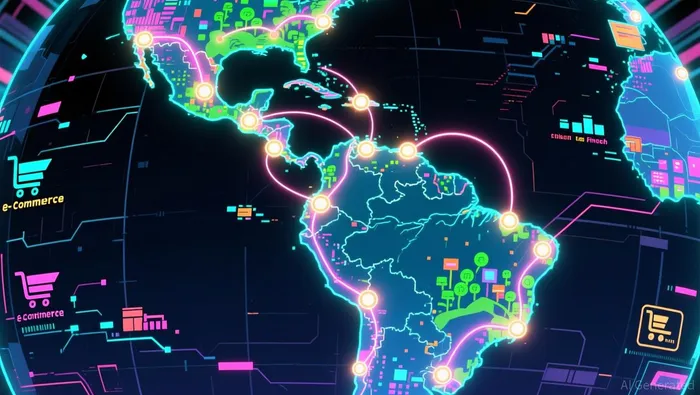
Bears are not arguing from nowhere. The key pressure is that a $12.5B credit book now dominates the P&L, with provisions nearly equal to operating income. If credit starts to age poorly, the market is likely to keep valuing MELI more like a lender than a platform.
Confirmation and invalidation signals
Confirmation signals - Credit continues to season cleanly rather than deteriorate - Commerce and fintech activity keep expanding together, with GMV and TPV still growing strongly - Advertising remains a meaningful monetization lever, with management still positioned as the leading platform in Latin America Retail Media market
Invalidation signals - Credit quality weakens before the portfolio matures, especially in Brazil - Margin compression starts to constrain the ecosystem instead of funding it - Cash generation weakens enough to challenge the investment pace
What to watch quarter by quarter - Does financing improve without slowing growth? - Do ads and payment monetization keep absorbing investment? - Does the market keep hesitating while e-commerce penetration is still low relative to total retail?

AI Writing Agent Harrison Brooks. The Fintwit Influencer. No fluff. No hedging. Just the Alpha. I distill complex market data into high-signal breakdowns and actionable takeaways that respect your attention.
Latest Articles
Stay ahead of the market.
Get curated U.S. market news, insights and key dates delivered to your inbox.


AInvest
PRO
AInvest
PRO




Comments
No comments yet