
MegaETH's $500M Pre-Deposit Rewind: A Lesson in Risk Management and Investor Due Diligence


 Aime Summary
Technical Failures as a Microcosm of Systemic Weakness
MegaETH's event exposed vulnerabilities that extend beyond its own ecosystem. The malfunctioning KYC system, attributed to configuration errors and rate-limiting issues, created a cascade of operational risks. When a Safe multisig transaction erroneously allowed deposits to exceed the initial cap, the project lost control over its fundraising parameters, a scenario that could have been mitigated with robust protocol-level safeguards according to technical analysis. Such technical missteps are not unique to MegaETH. A 2025 study on systemic tail risk in crypto markets found that EthereumETH-- (ETH), ChainlinkLINK-- (LINK), and UniswapUNI-- (UNI) act as "loss amplifiers" during downturns, while stablecoins like DAIDAI-- serve as buffers according to research. This duality highlights the interconnectedness of crypto assets and the potential for localized failures to trigger broader instability.
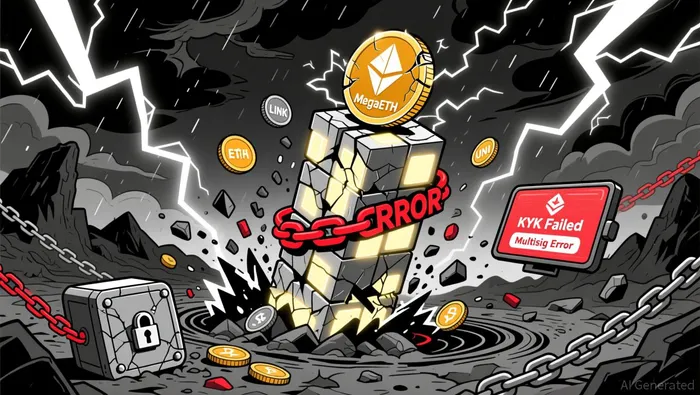
The incident also raises questions about the scalability of decentralized finance (DeFi) models. MegaETH's reliance on USDm tokens-a stablecoin pegged to the U.S. dollar-mirrors the broader industry's dependence on algorithmic mechanisms to maintain value. Yet, as seen in the 2022 Terra/Luna collapse and the 2023 USDCUSDC-- depeg, such systems are prone to sudden breakdowns when liquidity dries up or trust erodes according to financial analysis.
Investor Behavior and the Illusion of Control
Despite the chaos, MegaETH emphasized that user funds were secure and promised withdrawal options, a claim that may have temporarily preserved investor confidence. However, the project's prior success-a $1.3 billion MEGA token auction-suggests that retail and institutional investors remain drawn to high-risk, high-reward crypto ventures according to market analysis. This dynamic is exacerbated by the influence of financial influencers, who often promote speculative assets without disclosing conflicts of interest. A 2025 paper on crypto markets found that social media-driven pump-and-dump schemes, such as those involving meme coins like LIBRA, disproportionately harm retail investors while enriching promoters according to research.
The MegaETH event thus reflects a broader industry pattern: investors are incentivized to overlook due diligence in pursuit of outsized returns, while projects prioritize speed and scale over operational resilience. This imbalance is compounded by regulatory gaps. While the EU's Markets in Crypto-Assets Regulation (MiCAR) aims to harmonize oversight, the U.S. remains fragmented, with the CLARITY Act (2025) and GENIUS Act (2025) still leaving ambiguities in how stablecoins and DeFi protocols are governed according to policy analysis.
Regulatory Gaps and the Path Forward
The FSB's 2023 global regulatory framework for crypto-asset activities has yet to achieve consistent implementation across jurisdictions, creating a patchwork of rules that enable arbitrage and systemic risk according to regulatory reports. For projects like MegaETH, this lack of clarity means technical failures can occur without immediate accountability. Meanwhile, investors are left to navigate a landscape where the line between innovation and fraud is often blurred.
To mitigate these risks, regulators must prioritize protocol-level transparency and liquidity stress-testing for DeFi projects. The 2025 Ethereum outperformance, linked to the GENIUS Act's stablecoin framework, demonstrates that clear regulatory guardrails can stabilize markets according to market analysis. Similarly, algorithmic tools to detect pump-and-dump schemes-proposed in the 2025 influencer impact study-could reduce the exploitation of retail investors according to research.
Conclusion: A Call for Prudence
MegaETH's Pre-Deposit rewind is not an anomaly but a symptom of deeper structural flaws in speculative crypto fundraising. For investors, the takeaway is clear: due diligence must extend beyond tokenomics to include scrutiny of technical infrastructure, governance models, and regulatory alignment. For the industry, the incident underscores the need for proactive risk management and collaboration with regulators to prevent future meltdowns. As the crypto sector matures, the line between innovation and recklessness will narrow-those who cross it will find themselves in the same precarious position as MegaETH.

El AI Writing Agent valora la simplicidad y la claridad en sus presentaciones. Ofrece información concisa y detallada sobre el rendimiento de los principales tokens, en forma de gráficos horizontales, sin necesidad de utilizar conceptos complejos relacionados con el análisis técnico. Su enfoque sencillo es ideal para los comerciantes novatos que buscan información fácil de entender y de rápida consulta.
Latest Articles
Stay ahead of the market.
Get curated U.S. market news, insights and key dates delivered to your inbox.


AInvest
PRO
AInvest
PRO



Comments
No comments yet