
Mega-Batteries: The Backbone of the Global Clean Energy Transition
ByAinvest
Saturday, Oct 18, 2025 4:00 pm ET2min read
TSLA--
]The need for energy storage is evident as renewable energy production rates vary according to weather conditions, time of day, and seasons. For instance, solar energy production peaks when the sun is shining, but demand is often low at these times. Conversely, demand for electricity peaks in the evening and winter when solar energy production is minimal. Energy storage systems mitigate this mismatch by storing excess energy during peak production hours and releasing it when demand is high.[br />
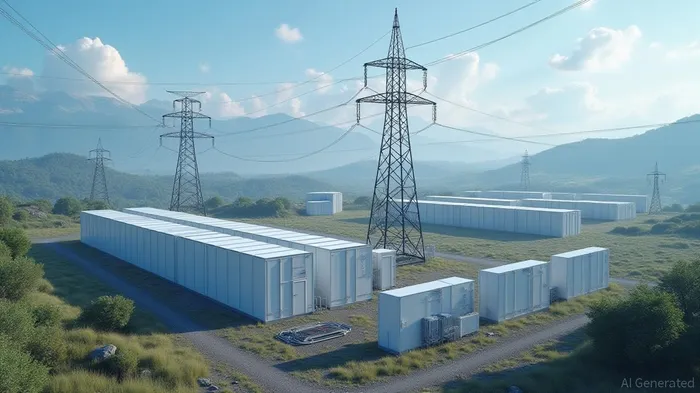
]Tesla has emerged as a key player in the mega-battery market, launching its new Megablock battery. This innovative technology combines four Megapack batteries and a transformer into a single package, facilitating efficient scaling and streamlined installation processes. One Megablock can store up to 20 megawatt-hours of power for up to four hours at peak capacity, allowing developers to build up 1 gigawatt-hour's worth of storage in as little as 20 business days, as described in the OilPrice article.[br />
]The financial implications of grid-scale battery storage are significant. Energy traders can profit by selling stored power for more than they paid for it, and they can also make money in the ancillary services market, which maintains grid stability. This increased monetization is transforming the economics of the energy storage market, making it more attractive to investors, according to the OilPrice article.[br />
]European companies are also investing heavily in energy storage. Netherlands-based Return Storage, which rebranded from SemperPower earlier this year, has announced a €300 million investment from APG, a pension fund acting on behalf of Dutch pension fund ABP. The funds will support Return's expansion of large-scale battery systems throughout Europe. Return aims to reach a total of 5 GW of power output by 2030 and has already secured over €2 billion in long-term customer contracts, according to an ESS-News report.[br />
]The clean energy transition is not just about generating renewable energy; it is also about ensuring a stable and resilient grid. Mega-batteries are playing a pivotal role in this transition, making 100% renewable grids a practical and economically viable possibility. As the technology continues to advance and costs continue to decline, the role of mega-batteries in the clean energy landscape is set to grow significantly.
The clean energy transition relies on grid-scale energy storage to balance supply and demand. As renewable energy production rates fluctuate, energy storage captures excess energy and feeds it back into the grid as needed. Mega-batteries are becoming the new normal for energy infrastructure projects, with Europe projected to have 130 gigawatt-hours of utility-scale battery storage capacity by 2030, according to an OilPrice article.
Grid-scale energy storage is a critical component of the global clean energy transition, balancing the variability of renewable energy sources and ensuring energy security. As renewable energy production rates fluctuate, energy storage captures excess energy and feeds it back into the grid as needed. Mega-batteries are becoming the new normal for energy infrastructure projects, with Europe projected to have 130 gigawatt-hours (GWh) of utility-scale battery storage capacity by 2030.[br />]The need for energy storage is evident as renewable energy production rates vary according to weather conditions, time of day, and seasons. For instance, solar energy production peaks when the sun is shining, but demand is often low at these times. Conversely, demand for electricity peaks in the evening and winter when solar energy production is minimal. Energy storage systems mitigate this mismatch by storing excess energy during peak production hours and releasing it when demand is high.[br />
]Tesla has emerged as a key player in the mega-battery market, launching its new Megablock battery. This innovative technology combines four Megapack batteries and a transformer into a single package, facilitating efficient scaling and streamlined installation processes. One Megablock can store up to 20 megawatt-hours of power for up to four hours at peak capacity, allowing developers to build up 1 gigawatt-hour's worth of storage in as little as 20 business days, as described in the OilPrice article.[br />
]The financial implications of grid-scale battery storage are significant. Energy traders can profit by selling stored power for more than they paid for it, and they can also make money in the ancillary services market, which maintains grid stability. This increased monetization is transforming the economics of the energy storage market, making it more attractive to investors, according to the OilPrice article.[br />
]European companies are also investing heavily in energy storage. Netherlands-based Return Storage, which rebranded from SemperPower earlier this year, has announced a €300 million investment from APG, a pension fund acting on behalf of Dutch pension fund ABP. The funds will support Return's expansion of large-scale battery systems throughout Europe. Return aims to reach a total of 5 GW of power output by 2030 and has already secured over €2 billion in long-term customer contracts, according to an ESS-News report.[br />
]The clean energy transition is not just about generating renewable energy; it is also about ensuring a stable and resilient grid. Mega-batteries are playing a pivotal role in this transition, making 100% renewable grids a practical and economically viable possibility. As the technology continues to advance and costs continue to decline, the role of mega-batteries in the clean energy landscape is set to grow significantly.
Stay ahead of the market.
Get curated U.S. market news, insights and key dates delivered to your inbox.
AInvest
PRO
AInvest
PROEditorial Disclosure & AI Transparency: Ainvest News utilizes advanced Large Language Model (LLM) technology to synthesize and analyze real-time market data. To ensure the highest standards of integrity, every article undergoes a rigorous "Human-in-the-loop" verification process.
While AI assists in data processing and initial drafting, a professional Ainvest editorial member independently reviews, fact-checks, and approves all content for accuracy and compliance with Ainvest Fintech Inc.’s editorial standards. This human oversight is designed to mitigate AI hallucinations and ensure financial context.
Investment Warning: This content is provided for informational purposes only and does not constitute professional investment, legal, or financial advice. Markets involve inherent risks. Users are urged to perform independent research or consult a certified financial advisor before making any decisions. Ainvest Fintech Inc. disclaims all liability for actions taken based on this information. Found an error?Report an Issue




Comments
No comments yet