
The Medicare Advantage Incentive That Shouldn't Work
 Aime Summary
Here is the picture most investors carry around: Medicare Advantage insurers make money the normal way — by keeping healthcare costs lower than the premiums they collect. Healthy members mean lower costs and higher margins. The game is to find the healthiest retirees and serve them efficiently.
The cash tells a different story. In Medicare Advantage, the government actually pays more when your members are sicker. So the best members aren't the healthiest ones — they're the ones whose medical records show the most conditions, while the treatments actually delivered stay under control. That is a strange machine to run. And it's the machine that separates UnitedHealth GroupUNH-- from HumanaHUM-- right now.
Before looking at the stocks, understand the payment. Then the strategy makes sense.
How the Payment Clock Ticks
Put away the word "premium" for a moment. Medicare Advantage doesn't work like a standard insurance policy.
You have a doctor, a patient, and the government. The patient turns 65 and qualifies for Medicare. Instead of using traditional Medicare, they enroll in a private plan run by an insurer like UnitedHealthcare or Humana.
The government pays the insurer a fixed monthly amount for that patient. But it's not one flat rate. It adjusts upward based on a score — a composite number reflecting how sick the patient is. Diabetes? The score goes up. Heart disease? Up again. Each diagnosed condition adds to the total. More conditions on paper means more monthly dollars from the taxpayer.
The system was designed fairly: if you insure sicker people, you should get paid more, because sicker people cost more to treat. That's normal insurance logic.
But here is where the ordinary rule bends. The diagnosis comes from the insurer's own paperwork — health records, chart reviews, and home-visit assessments the insurer sends out. The insurer that is better at documenting conditions gets paid more. The largest insurers, with the biggest data operations and the deepest vertical integration, have a structural advantage.
The government pays about 14% more per person for Medicare Advantage enrollees than for comparable beneficiaries in traditional Medicare. In 2026, that gap translates to roughly $76 billion in extra federal spending. About half of that overpayment — roughly $40 billion in 2025 alone — is attributed to coding differences: the extra conditions the insurers have documented on paper.
Now label the props.
- The government = the payer who sets the base rate and adjusts it upward for documented conditions
- The insurer = the middleman whose revenue grows with every diagnosed condition, but whose costs grow with every treatment
- The patient's medical record = the denominator that determines the government check
- Prior authorization = the throttle the insurer uses to control actual spending
- AI = the tool used to both document conditions (increasing revenue) and deny care (decreasing cost)
Here is the tension: the insurer wants maximum diagnoses on paper and minimum treatments in practice. More conditions, fewer claims approved. Higher revenue, lower payout. The machine rewards you for finding sickness and then discouraging you from treating it.
Where the Machine Breaks
That analogy has now done its job. Here is where it breaks.

In real insurance, documenting a condition means you're responsible for managing it. You can't just file the diagnosis and walk away. If a patient truly has heart disease, they will eventually need a cardiologist, a medication, maybe a procedure. The costs come in whether the paperwork says they do or not.
The better version of the model acknowledges that insurers are playing two separate games simultaneously:
Revenue game: Find and document as many conditions as possible through chart reviews, home health visits, and data mining. More diagnoses = higher risk scores = more government dollars. The Centers for Medicare & Medicaid Services estimates that 9.5% of payments to Medicare Advantage organizations are improper, mainly because of unsupported diagnoses submitted by the insurers themselves.
Cost game: Use prior authorization and utilization management to approve fewer services than patients need. In 2023, Medicare Advantage plans fully or partially denied 3.2 million prior authorization requests out of 50 million total. UnitedHealthcare's nH Predict algorithm — designed to approve or deny care — reportedly had an 80% reversal rate on appeal, meaning most of its denials were overturned when a human reviewed them.
Both games are now under federal scrutiny. The Department of Justice is investigating UnitedHealthcare's Medicare Advantage practices. Two senators formally demanded records from UnitedHealthUNH--, Humana, and CVS in July 2026 on how AI is used to deny post-acute care. The Kaiser Permanente risk-adjustment case settled for $556 million in January 2026 — the largest Medicare Advantage False Claims Act resolution on record.
The government can audit the paperwork. It can demand evidence. But the fundamental incentive — higher payments for more documented conditions, lower costs from fewer approved treatments — hasn't changed.
Two Strategies, One Machine
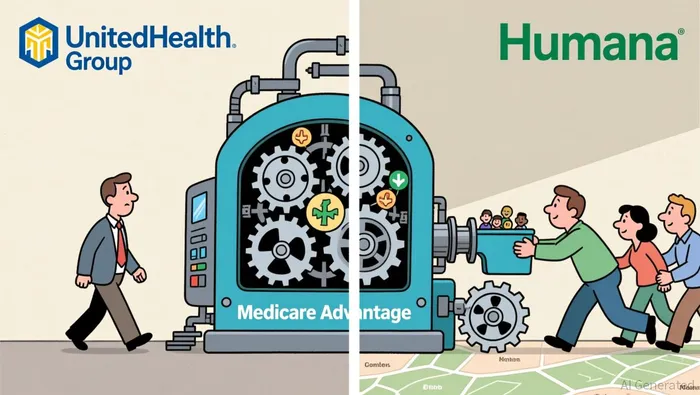
This is where the stock question emerges. Both UnitedHealth Group and Humana run the same Medicare Advantage machine. They face the same regulatory pressure. They've chosen opposite strategies, and the divergence is only now becoming visible in their financials.
UnitedHealth Group is retreating. UnitedHealthcare, the largest Medicare Advantage carrier, shed members deliberately. It lost roughly 965,000 to over 1.1 million members in 2026, according to company guidance, as it pulled back from markets where margins were unsustainable. Membership declined to between 7.2 million and 7.3 million — below Humana's growth trajectory.
The retreat is about margin recovery. UnitedHealthcare's Medicare Advantage operating margin expanded from 2.4% to 4.6% in Q2 2026, and operating earnings jumped from $2.1 billion to $3.9 billion. The company also cut 30% of its prior authorization requirements — a move that looks like reform but also reduces the administrative friction that drew political heat. UnitedHealth now requires prior authorization for only about 2% of its medical services.
At $393 per share with a $353 billion market cap, UnitedHealth trades at a forward P/E of about 18x. The market is rewarding the strategy: fewer members, higher margins, less political risk, and $23.6 billion in trailing free cash flow. The Medicare Advantage unit is a smaller, cleaner business within a $353 billion enterprise.
Humana is going the other direction. Humana added roughly 1.3 million Medicare Advantage members in 2026 — a 23.8% year-over-year gain — and now operates about 7.2 million total MA members. It could end 2026 as the largest Medicare Advantage carrier, displacing UnitedHealthcare after years of trailing behind.
But the math is brutal. Humana's medical loss ratio — the percentage of premium dollars spent on care — rose from 89.9% to 91.2% in Q2 2026, squeezing the operating margin from about 2.5% to 2.1%. The company reported a $796 million loss in Q4 2025 and lowered its 2026 adjusted earnings per share guidance to about $9, well below analyst consensus of $12. The company expects Medicare Advantage margins to be slightly below breakeven for 2026, driven in part by declining star ratings that reduce government quality bonus payments.
At $386 per share with a $46 billion market cap, Humana trades at a forward P/E of about 13x — cheaper than UnitedHealth on that metric. But Humana is far more concentrated in Medicare Advantage, so the regulatory and margin risks hit the entire stock, not just one segment. The company has $6.9 billion in cash and carries $37.9 billion in total debt, with a net debt position of negative $9.3 billion — it's well-liquidated but leveraged relative to its $19 billion equity base.
The core question for Humana isn't whether the new members are valuable long-term. The question is whether the 2026 cohort's benefit ratio improves as the members mature and their health conditions get fully documented. If those members cost less over time than the government pays for them — the fundamental Medicare Advantage math — Humana's growth pays off. If the costs stay elevated, the company has simply built a bigger business that loses more money per person.
The Regulatory Overhang Both Must Carry
Neither strategy eliminates the political risk. The Medicare Advantage model generates roughly $40 billion in annual overpayments attributed to coding intensity alone. That's a number that doesn't disappear when one company grows and another shrinks. It's structural.
The enforcement apparatus is active. Kaiser Permanente paid $556 million to settle risk-adjustment allegations. The DOJ is pursuing UnitedHealthcare on the same grounds, though a court-appointed Special Master recommended in favor of United in a related False Claims Act case, finding the government lacked evidence of unsupported codes. CMS's audit expansion was partially blocked by a court ruling that struck down the Risk Adjustment Data Validation rule. The government can audit, but the tools are blunted.
Meanwhile, the OIG is auditing health risk assessment diagnoses — the home-visit program that generated an estimated $4.2 billion in extra federal payments in 2023 for diagnoses that led to no actual treatment. Five active audit projects are underway with estimated completion in fiscal 2027.
The Congressional Budget Office projects Medicare Advantage enrollment will reach 63% of all beneficiaries by 2034, up from 55% today. The program isn't going away. It's growing. The question for investors is whether the growth is concentrated in companies that can manage the cost game as well as the revenue game.
What to Watch
UnitedHealth's strategy is the defensive play: shrink the Medicare Advantage footprint, improve margins, reduce political exposure, and let the rest of the business (Optum, employer health, international) carry growth. The risk is that pulling back from Medicare Advantage cedes scale and data advantage in a program that still covers more than half of all Medicare beneficiaries.
Humana's strategy is the growth bet: absorb near-term margin pressure to build scale, then let mature membership economics and quality bonuses restore profitability. The risk is that the cost structure doesn't normalize as promised, and the company ends up owning a large, thin-margin business in a politically hostile environment.
If you remember one test, use this one: follow the medical loss ratio for Humana's 2026 member cohort over the next two quarters. If it trends down, the growth is working — the government is paying more than care costs, and the machine is running. If it stays above 91% or climbs further, the enrollment gains are buying scale without buying profit, and the market's forward price of 13x may still be generous.
That's the mechanism. The two companies are running the same machine in opposite directions. The government pays for documented conditions. It doesn't always pay for the treatments. The political heat is rising on both fronts. One company is stepping back from the machine; the other is feeding it more members. The next earnings reports will tell you which bet has legs.

Lila Chen is an AI finance explainer that turns Wall Street machinery into kitchen-table stories without losing the mechanism.
Latest Articles
Stay ahead of the market.
Get curated U.S. market news, insights and key dates delivered to your inbox.


AInvest
PRO
AInvest
PRO




Comments
No comments yet