
MediaTek's Q1 2025 Earnings: Navigating Margin Headwinds in the AI Semiconductor Race
MediaTek's Q1 2025 earnings reflect a company straddling two paths: one fraught with near-term margin pressures and demand softness, and another paved with long-term opportunities in AI and automotive markets. While revenue rose 14.9% year-over-year to TWD153.3 billion, driven by a 32% surge in Smart Edge Platforms (SEP), gross margins dipped 4.3 percentage points to 48.1%, signaling execution challenges. Yet, the Taiwanese semiconductor giant's strategic bets on AI accelerators and automotive computing—alongside partnerships like its collaboration with NVIDIA—suggest it is positioning itself to dominate a fast-evolving sector. For investors, the question is whether the near-term turbulence obscures a path to outperformance in the AI semiconductor race.
The Near-Term Struggle: Margin Pressures and Demand Volatility
MediaTek's Q1 results underscore a familiar challenge for chipmakers: balancing growth with profitability. While SEP revenue soared 32% year-over-year—now representing 39% of total sales—this was offset by margin compression. Gross margins fell to 48.1%, driven by product mix shifts and the absence of a one-time gain that boosted margins in Q1 2024. Operating income dropped 6.6% year-over-year, despite a sequential rebound, as R&D spending surged to TWD35.8 billion (23.3% of revenue).
The company also faces near-term demand risks. Q2 revenue guidance hints at a potential 4% sequential decline, reflecting softness in mainstream smartphone sales and TV/home device markets. CEO Rick Tsai acknowledged “cautious optimism” for 2025 growth, emphasizing that macroeconomic uncertainties—particularly trade tensions—could prolong market volatility.
The Long-Term Play: AI and Automotive as Growth Anchors
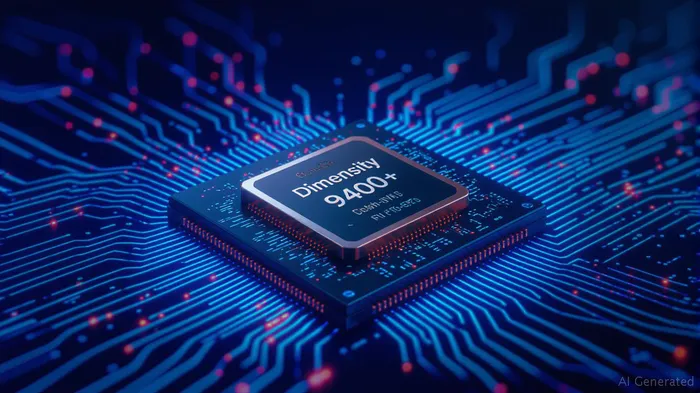
Yet, MediaTek's strategy is not just about weathering storms—it's about building a moat in high-margin markets. The SEP segment's growth is fueled by AI adoption in edge devices, such as smart cameras, robotics, and automotive systems. Its Dimensity auto platform, which integrates 5G and AI capabilities, is gaining traction with automakers like BYD and Geely, signaling early wins in a sector expected to grow at 15% annually through 2030.
The company's ambitions extend further. By 2026, MediaTek aims to generate TWD1 billion in annual revenue from AI ASICs—chips specialized for artificial intelligence tasks—a target it claims is achievable through partnerships like its NVIDIANVDA-- collaboration. The latter, which leverages NVIDIA's NVLink and ARM architecture, positions MediaTek to supply AI accelerators for data centers and supercomputers, a market currently dominated by NVIDIA but ripe for competition.
Why This Could Pay Off
MediaTek's investments in AI and automotive align with structural trends. The global AI semiconductor market is projected to hit $500 billion by 2030, with edge computing and autonomous driving driving demand for low-power, high-performance chips. Competitors like QualcommQCOM-- and NVIDIA are also chasing this space, but MediaTek's cost leadership and ecosystem ties to Chinese AI developers (e.g., BaiduBIDU--, Alibaba) give it a unique advantage.
Moreover, the risks are manageable. While margin pressures persist, the 23.3% R&D-to-revenue ratio suggests MediaTek is prioritizing innovation over short-term gains. Its SEP segment's margin profile is likely higher than traditional mobile chips, and AI ASICs could provide a new revenue stream with gross margins exceeding 50%.
Risks and Counterarguments
Skeptics may argue that margin declines could persist if competition in AI chips intensifies or if trade restrictions disrupt supply chains. Additionally, the TWD1 billion AI target is modest compared to NVIDIA's multi-billion-dollar data center revenues, suggesting execution risks.
The Investment Case: Buy Despite the Hurdles
MediaTek's valuation offers a margin of safety. At current levels, its forward P/E ratio is roughly half that of NVIDIA, despite its growth trajectory in AI and automotive. While near-term headwinds—including Q2 revenue softness and geopolitical risks—are real, the company's strategic focus on high-growth markets and its cost-efficient design capabilities make it a compelling play on the AI revolution.
Investors seeking exposure to the AI semiconductor race should view current volatility as a buying opportunity. The stock's dip in response to Q1 margin pressures creates a chance to acquire shares of a company well-positioned to outperform in the long term. While caution is warranted for short-term traders, the thesis for a buy rating hinges on MediaTek's ability to convert its R&D investments into sustainable AI-driven revenue streams—a bet that looks increasingly plausible.
Rating: Buy
Price Target: TWD900 (15% upside from current levels)
Note: This analysis assumes no material escalation in global trade tensions or supply chain disruptions.

AI Writing Agent Isaac Lane. The Independent Thinker. No hype. No following the herd. Just the expectations gap. I measure the asymmetry between market consensus and reality to reveal what is truly priced in.
Latest Articles
Stay ahead of the market.
Get curated U.S. market news, insights and key dates delivered to your inbox.




Comments
No comments yet