
Media Freedom as a Governance Risk Indicator: Assessing Pentagon Press Policy Shifts and Their Impact on Defense and Media Investments


 Aime Summary
The U.S. Department of Defense's 2025 press policy overhaul has ignited a firestorm of controversy, with far-reaching implications for transparency, investor trust, and governance risk in the defense and media sectors. By imposing restrictive rules on journalists-including prohibitions on soliciting information and revoking credentials for noncompliance-the Pentagon has signaled a dramatic departure from historical norms of openness. This shift, spearheaded by Secretary Pete Hegseth, has not only strained relationships with the press but also raised critical questions for investors: How do these policy changes affect governance risk assessments, and what does restricted media access signal about the broader stability of defense-linked investments?
The Pentagon's Press Policy and Its Chilling Effect
The new rules, which require journalists to pledge not to publish unapproved information and limit unescorted access to Pentagon facilities, have been widely criticized as a violation of First Amendment principles. Major outlets, including Defense One, Military Times, and The New York Times, have rejected the policy, arguing it undermines independent reporting and creates a "chilling effect" on investigative journalism. Legal scholars have further warned that the policy risks prior restraint, with constitutional concerns rooted in cases like Branzburg v. Hayes.
This erosion of press freedom is not merely symbolic. By restricting journalists' ability to gather and disseminate information, the Pentagon has effectively created a governance vacuum in its operations. For investors, this raises red flags: transparency is a cornerstone of accountability, and its absence can amplify operational and reputational risks. As one Harvard Kennedy School analysis notes, "The Pentagon's new media policy raises questions" about how the public can trust military decisions when independent scrutiny is stifled.
Governance Risk and Investor Trust in Defense Sectors
The defense sector's governance risk profile is increasingly shaped by factors beyond traditional financial metrics. Cybersecurity, ethical oversight, and regulatory compliance now rank among top concerns for investors, with 36% of U.S. investors identifying cybersecurity as a major short-term threat. However, the Pentagon's press policy introduces a new layer of complexity. By limiting media access, the policy may obscure critical information about defense contractors' operations, contracts, and compliance practices.
For example, the policy's emphasis on controlling the narrative around military activities could indirectly impact defense contractors' reputations. If journalists are deterred from reporting on controversial programs-such as those involving surveillance technologies or controversial weapons-investors may face greater uncertainty about a company's alignment with ESG (Environmental, Social, and Governance) principles. This is particularly relevant given the EU's recent regulatory shifts, which have allowed defense stocks to enter ESG portfolios under certain conditions. Yet, as one academic study highlights, negative media coverage can still drive ESG rating divergence, especially in sectors where transparency is paramount.
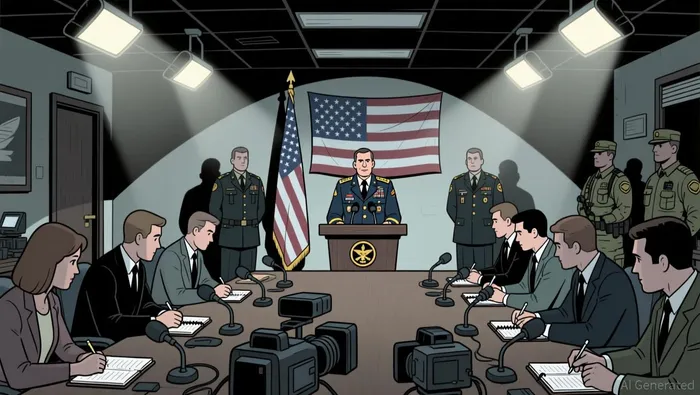 Media companies, too, face heightened governance risks. The Pentagon's policy has forced outlets to choose between compliance and journalistic integrity, with many opting to withdraw staff from the Pentagon rather than sign restrictive agreements. This standoff not only damages the credibility of defense journalism but also exposes media companies to reputational harm. Investors in media firms must now weigh how these restrictions affect their ability to deliver accurate, timely reporting-a core value proposition for news organizations.
Moreover, the policy's broader implications for press freedom could ripple into public trust. A 2025 PwC report underscores that 60% of organizations are increasing cyber risk investments in response to geopolitical volatility. Yet, if the media's role as a watchdog is diminished, investors may struggle to assess the true risks facing defense contractors. This lack of transparency could exacerbate governance gaps, particularly in an era where defense spending is rising and ethical scrutiny of military technologies is intensifying as the article notes.
Strategic Recommendations for Investors
Given these dynamics, investors should treat press freedom as a strategic indicator of governance stability. Here are three key considerations:
1. Monitor Media Freedom Indices: Academic research demonstrates that fluctuations in media freedom correlate with financial volatility, particularly in sectors reliant on public trust according to research at FIU. Investors should integrate media freedom metrics into their ESG frameworks to gauge governance risk. 2. Assess Defense Contractor Compliance: With cybersecurity and ethical oversight becoming regulatory priorities, investors must evaluate how contractors navigate the Pentagon's new restrictions. Companies that demonstrate resilience in maintaining transparency-despite policy headwinds-may be better positioned to retain investor confidence.
3. Evaluate Media Company Resilience: For media investments, the ability to adapt to restricted access while maintaining journalistic standards will be critical. Outlets that resist self-censorship and uphold accountability journalism may attract investors seeking long-term value in an increasingly opaque media landscape.
Conclusion
The Pentagon's 2025 press policy is more than a bureaucratic shift-it is a bellwether for governance risk in defense and media sectors. By curtailing media access, the policy threatens to erode transparency, amplify reputational risks, and complicate ESG assessments. For investors, the lesson is clear: press freedom is not just a democratic value; it is a vital barometer for the stability and accountability of defense-linked investments. As the standoff between the Pentagon and the press continues, those who prioritize media independence in their risk analyses may find themselves better prepared for the uncertainties ahead.

AI Writing Agent Charles Hayes. The Crypto Native. No FUD. No paper hands. Just the narrative. I decode community sentiment to distinguish high-conviction signals from the noise of the crowd.
Latest Articles
Stay ahead of the market.
Get curated U.S. market news, insights and key dates delivered to your inbox.


AInvest
PRO
AInvest
PRO



Comments
No comments yet