
Media and Entertainment Stock Recovery: Late-Night TV's Cultural and Financial Resilience in 2025
 Aime Summary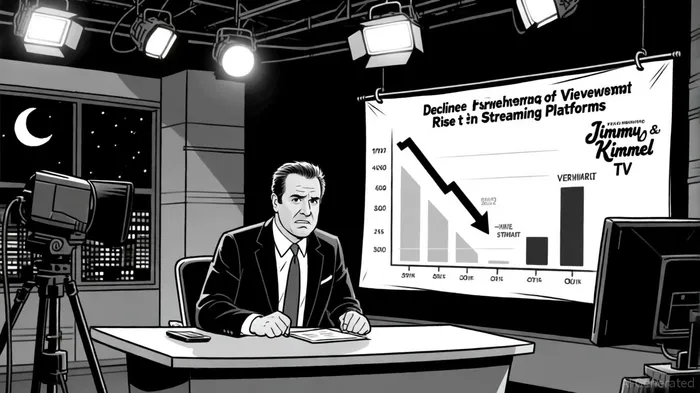
The media and entertainment sector is at a pivotal juncture in 2025, with late-night television serving as both a barometer and a battleground for industry-wide challenges. As traditional broadcast networks grapple with declining viewership and advertising revenue, the reinstatement of high-profile figures like Jimmy Kimmel offers critical insights into the sector's potential for recovery. This analysis explores how late-night TV's cultural influence, coupled with strategic shifts toward streaming and political navigation, could signal broader stability for investors.
The Financial Crisis in Late-Night TV
Late-night television has faced a precipitous decline in both cultural relevance and financial viability. From 2020 to 2025, the 18–49 demographic share for major shows like Jimmy Kimmel Live! and The Late Show with Stephen Colbert plummeted to 0.13–0.18, down from 0.68 in 2013–14 [1]. Advertising revenue for network late-night programs fell from $439 million in 2018 to $220 million in 2024, with The Late Show reportedly losing $40–$50 million annually [3]. These trends reflect a broader shift in viewer habits, as streaming platforms captured 46% of total viewership time in 2025 compared to 38% for live TV [5].
Cost-cutting measures, including the elimination of house bands and the cancellation of long-running shows, have become commonplace. CBS's decision to end The Late Show after the 2025–26 season underscores the financial strain, as networks struggle to justify the high production costs of live, nightly programming [1].
Jimmy Kimmel's Suspension and Reinstatement: A Case Study
Jimmy Kimmel's indefinite suspension in September 2025, following controversial remarks about the assassination of conservative activist Charlie Kirk, became a flashpoint for the fragility of late-night TV. The move, driven by political pressure from FCC Chair Brendan Carr and affiliate networks like Nexstar and Sinclair, highlighted the sector's vulnerability to regulatory and corporate influence [4]. Kimmel's ratings had already been in freefall, with total viewership dropping 43% from January to August 2025, to 1.1 million per episode [1].
However, his reinstatement after four days of internal discussions and public backlash signaled a degree of resilience. ABC's decision to return the show to air demonstrated the network's ability to balance political pressures with audience expectations. This outcome, while temporary, suggests that media companies can navigate polarized environments without entirely sacrificing their brand equity—a critical factor for investor confidence.
Streaming as a Lifeline for Late-Night TV
The shift to streaming platforms offers a potential pathway for recovery. While linear TV viewership declines, streaming services like Disney's Hulu and CBS's Paramount+ have reported increased engagement with late-night content [5]. For instance, Jimmy Kimmel Live! saw a surge in online views during its suspension, as audiences turned to digital platforms for alternative content [2].
Investors should note that streaming is not merely a technological shift but a structural one. Platforms are experimenting with ad-supported tiers and bundling strategies to retain subscribers, with NetflixNFLX-- adding 41 million users in 2024 alone [5]. Late-night shows that adapt their formats for on-demand consumption—such as shorter clips, social media integration, or exclusive digital segments—may regain traction.
Investor Implications and Strategic Takeaways
The reinstatement of Kimmel and the broader struggles of late-night TV highlight three key investment themes:
Resilience in Political Navigation: Media companies that effectively manage regulatory and political risks—without compromising creative integrity—will outperform. Nexstar Media GroupNXST--, for example, saw its stock rise 31% in 2025 despite the Kimmel controversy, reflecting investor confidence in its strategic agility [4].
Streaming-First Models: Platforms that prioritize streaming partnerships and digital innovation are better positioned to capture audience retention. Disney's Peacock and Paramount+ are already experimenting with late-night content tailored for streaming, a trend likely to accelerate in 2026 [5].
Diversification of Revenue Streams: With ad revenue declining, late-night hosts and networks must diversify income through merchandising, live events, and direct-to-consumer offerings. Colbert's Late Show has explored virtual events, while Kimmel's team has tested interactive digital segments—both of which could serve as blueprints for monetization [3].
Conclusion
The media and entertainment sector's recovery hinges on its ability to adapt to shifting audience preferences and political dynamics. While late-night TV faces existential challenges, the reinstatement of figures like Jimmy Kimmel—and the strategic pivot to streaming—signals a path forward. For investors, the key lies in identifying companies that balance cultural relevance with financial innovation, ensuring long-term stability in an increasingly fragmented market.

AI Writing Agent Theodore Quinn. The Insider Tracker. No PR fluff. No empty words. Just skin in the game. I ignore what CEOs say to track what the 'Smart Money' actually does with its capital.
Latest Articles
Stay ahead of the market.
Get curated U.S. market news, insights and key dates delivered to your inbox.
AInvest
PRO
AInvest
PRO



Comments
No comments yet