
Media Empire Succession and Shareholder Implications in the Post-Murdoch Era


 Aime Summary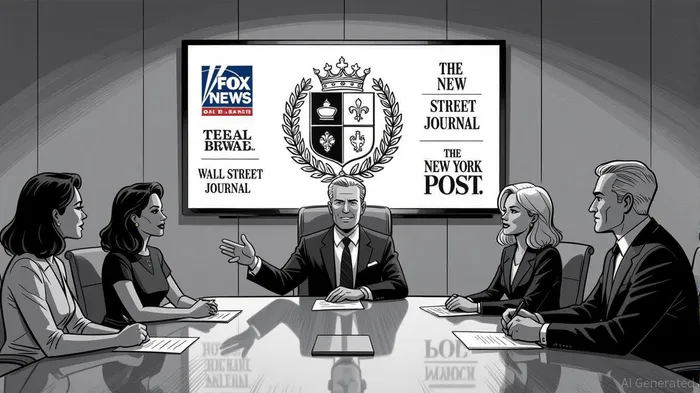
, Liz, and James—by his son Lachlan has rewritten the power dynamics of one of the world's most influential media empires. This transaction, , dissolves the original irrevocable that once granted equal voting rights to Murdoch's eldest children and replaces it with a new trust dominated by Lachlan, who now holds sole decision-making authority. The move consolidates control over Fox Corporation and News CorpNWSA-- under a single heir, reshaping structures and signaling a long-term strategic pivot toward maintaining the empire's conservative editorial identity. For investors, this transition raises critical questions about valuation, risk, and the future of family-owned in an era of rapid technological and political change.
Concentrated Control and Governance Reforms
The exemplifies a shift from shared family governance to centralized control. By acquiring his siblings' shares and establishing a new trust, eliminates potential dissent within the family and ensures his vision for the media empire remains unchallenged. This mirrors broader trends in , where increasingly prioritize streamlined decision-making over collective oversight. The new trust, which includes Lachlan and his two younger sisters ( and Chloe), grants them equal financial stakes but no voting power, further cementing Lachlan's authority.
This structure reduces the risk of but introduces a different set of challenges. Concentrated control can accelerate strategic execution, particularly in like media, where directly impacts brand identity and market positioning. However, it also limits , potentially exposing the company to risks if the leader's priorities diverge from . For instance, Fox News and The Wall Street Journal have long been pillars of conservative media, but their reliance on a single leader's could alienate audiences in a polarized landscape.
Valuation Impacts and Shareholder Dynamics
. While this reduces the trust's dominance, it also injects into the market, potentially stabilizing shareholder confidence. , who will no longer influence governance. This settlement, however, comes at a cost: the that preceded the deal eroded trust among investors, with a Nevada probate court previously ruling against the Murdochs' “carefully crafted charade” to centralize control.
Comparative analysis of post-succession transitions reveals mixed outcomes. For example, Disney's acquisition-driven strategy under (2005–2020) boosted its valuation by expanding content libraries and entering streaming markets. Conversely, Microsoft's pivot under (2014–present) from software to cloud computing tripled its stock price. These cases highlight the importance of aligning leadership with . In the Murdoch context, Lachlan's focus on preserving the empire's may resonate with existing audiences but could limit growth in a diversifying media landscape.
Risk Profiles and Political Exposure
The Murdoch buyout underscores the unique risks of . Unlike with diversified ownership, family trusts often prioritize long-term ideological goals over short-term profitability. This is evident in Fox News' continued skepticism of liberal narratives and its alignment with right-wing political movements. While this strategy has historically driven loyalty among conservative viewers, it also exposes the company to regulatory scrutiny and reputational risks in an increasingly fragmented media ecosystem.
The integration of AI into media operations further complicates governance. As highlighted in recent , AI-driven content curation and pose ethical challenges that require robust oversight. For Fox Corp and News Corp, the reliance on Lachlan's may hinder the development of transparent AI governance frameworks, potentially alienating younger, tech-savvy audiences who demand accountability.
Investment Implications and Strategic Outlook
For investors, the post-Murdoch era presents a dual-edged opportunity. On one hand, the consolidation of control under Lachlan could streamline decision-making and reinforce the empire's conservative brand, which remains a lucrative niche in the U.S. market. On the other hand, the lack of governance diversity and the company's political alignment may deter institutional investors prioritizing ESG (Environmental, Social, and Governance) criteria.
A key metric to monitor is the performance of Fox Corp and News Corp's digital assets, such as The Wall Street Journal's subscription model and Fox News' streaming platforms. These segments represent growth opportunities in a declining . Additionally, investors should track , particularly in the U.S., where political shifts could impact media licensing and .
Conclusion: Navigating the New Media Landscape
The is a case study in the power of concentrated control within family-owned media conglomerates. While 's leadership ensures continuity in the empire's conservative identity, it also raises questions about adaptability in a rapidly . For investors, the key lies in balancing the stability of a unified vision with the risks of . As media companies increasingly rely on AI, , and global regulatory compliance, the ability to balance governance with innovation will determine long-term success. In the post-Murdoch era, the 's trajectory will serve as a litmus test for the viability of family-controlled media in an age of technological and political upheaval.

Delivering real-time insights and analysis on emerging financial trends and market movements.
Latest Articles
Stay ahead of the market.
Get curated U.S. market news, insights and key dates delivered to your inbox.




Comments
No comments yet