
The Meat Company You Can't Buy — and What That Teaches You About the Ones You Can
 Aime Summary
PMI Foods is a Salt Lake City company that moves more than 1.6 billion pounds of beef, pork, chicken, seafood, and eggs each year. Its annual revenue passes $3 billion. It operates in over 60 countries. It just donated 1,738 frozen protein items — buffalo chicken, garlic beef, brisket, steak — to the Utah Food Bank, because high-quality protein is one of the hardest-to-source categories for food relief networks.
The natural next thought: What's the ticker?
There isn't one. PMI Foods is privately held. But the absence of a stock symbol is itself the useful fact. Here's why.
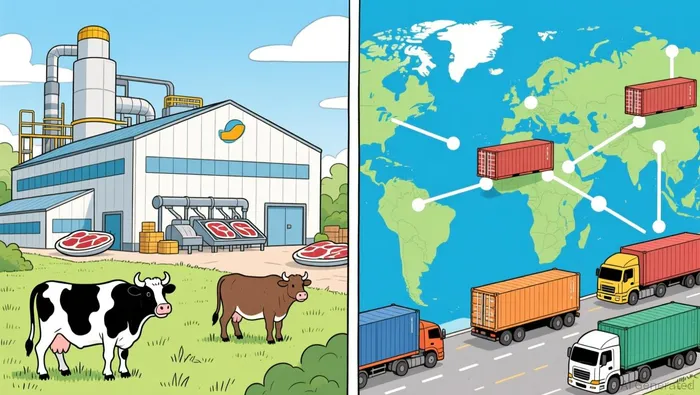
PMI Foods does not raise cattle. It does not run slaughterhouses. It does not own a single processing plant. It sits between producers and buyers and makes its money on the gap between what it pays and what it charges. The formal word is trading margin — the spread squeezed out of volume, logistics, and regulatory navigation. The everyday word is middleman.
That distinction is not semantic. It determines what kind of company you're buying when you invest in protein — and what kind you're not.
The restaurant supply truck
Think of a restaurant supply truck that picks up 200 cases of ground beef from a farm for $4 each and drops them at restaurants for $4.30. It makes $0.30 per case. Across 200 cases, that's $60 profit on $800 in sales. The truck drove all day. It earned $60 for a full circuit.
Now scale it up. 2,000 cases becomes $600. 20,000 cases becomes $6,000. The math per unit does not change. The revenue balloons. The profit stays thin per case. The only thing that grows your total take is making the truck bigger, running more circuits, or adding more trucks.
That is what a food distributor does. Revenue is a measure of throughput, not of value creation. And $3 billion in revenue tells you how much protein moved through PMI Foods' system — not how much of that $3 billion the company kept.
Now label the props.
- The farm = producers like JBSJBS-- (Brazil), US cattle ranchers, Australian and Uruguayan operations
- The truck and driver = PMI Foods' logistics, compliance, and brokerage apparatus across six continents
- $0.30 spread = the trading margin, which in international protein moves is measured in small percentages of a commodity-priced product
- 200 cases → 20,000 cases = PMI Foods trades over 1.6 billion pounds annually across 60-plus countries
- The destination market = China accounts for roughly 60% of PMI Foods' global sales
The toy version has three people and ten dollars. The real version has a Utah-based private company that shipped more than $1.7 billion worth of Brazilian beef alone over the past decade, with China as its dominant customer.
What a publicly traded meat company actually is
Here is the picture most investors carry around: "Meat stocks are meat stocks." Tyson FoodsTSN-- (TSN), JBS, HormelHRL-- — they're all in the same business, so they should be comparable. But the industry has two fundamentally different economics packed into the same sector label.
Producers own the factory. TysonTSN-- operates slaughterhouses, processing plants, and branded product lines. JBS is the world's largest meat processor, owning everything from cattle feedlots to supermarket brands. These companies bear the cost of land, labor, regulation, animal feed, equipment, and brand investment — and they capture the margin between raw commodity input and finished product output.
Traders and distributors own the route. PMI Foods is in this category. It sources from producers and delivers to markets, profiting on the spread and the volume. No factory risk. No brand to build. But also no pricing power when the commodity market swings, because you're competing with every other trader who can source the same product.

The financial footprint confirms the split. Tyson Foods, which generates roughly $56 billion in revenue, trades at a market capitalization of $19.5 billion — about 0.35 times sales. JBS, the world's largest meat processor by volume, trades at $14.6 billion against revenue well above $90 billion — roughly 0.16 times sales. Both companies earn their valuation on cash flow, not revenue, because revenue is mostly money passing through the system.
PMI Foods, with its estimated $3 billion in revenue and 800 employees, would be an interesting comparison — if it filed quarterly reports. Instead, it operates entirely behind private ownership, with no public obligation to disclose margins, profit, cash flow, or debt.
The risk the ticker doesn't show
The trading model has a hidden vulnerability that a public producer's filings would make visible. When you trade a commodity, your profit is a percentage of the spread — and your spread is determined by who else can do the same thing.
In 2018, when the U.S.-China trade war imposed tariffs on American meat, PMI Foods had to stop importing U.S. pork cuts into China. The company did not negotiate the tariff. It could not diversify the product because the product was the product. It adapted by shifting to other markets — but the margin on those markets is whatever the market will bear.
Then in 2026, President Trump temporarily lifted tariffs on 300,000 metric tons of imported ground beef, allowing it to enter the U.S. at 25% below market price. That headline helps consumers. For traders, it compresses the spread. For producers, it creates excess supply. The same policy shift hits every participant differently — and you'd need to know which category you're invested in to understand which way it tilts.
A privately held trader like PMI Foods absorbs these shocks without announcing them. A public producer like Tyson or JBS must report the quarterly hit, and the market prices it in — sometimes ahead of the earnings call.
That analogy has now done its job. Here is where it breaks.
The supply truck oversimplifies three things that matter:
First, a real trader like PMI Foods adds more than transport. They handle import-export compliance, veterinary documentation, customs clearance, and country-specific food safety requirements. That expertise is the reason someone pays them a spread at all. A truck driver who also reads regulations in six languages is a different business.
Second, traders face regulatory risk that producers don't. In 2012, the FBI accused PMI Foods of violating the Foreign Corrupt Practices Act. A related company pleaded guilty in 2014 and paid a $1 million fine. In 2023, an investigation found that PMI Foods' Brazilian beef came from suppliers accused of purchasing cattle from deforested land. The company trades product — and with it, the reputational and legal risk of every supplier in its chain.
Third, revenue in this business can be misleadingly large. $3 billion sounds like a Fortune 500 company. But if the trading margin is 2% — which is generous for commodity protein — that's $60 million in gross profit before salaries, offices, logistics, compliance, and overhead. The net margin is what matters, and it is never disclosed.
What you can actually invest in — and what to check
You cannot buy PMI Foods. But you can buy the companies that dominate the same protein flow — and you should understand what you're getting before you do.
When you buy JBS at roughly $13.65 per share, you're buying the world's largest meat processor. Revenue above $90 billion. A price-to-sales ratio of 0.16. A dividend yield over 7%. The market prices this company for its cash flow generation, not its revenue scale. At a forward P/E of roughly 6.7, investors are betting on stable margins despite massive debt (enterprise value of $33.8 billion versus a $14.6 billion market cap).
When you buy Tyson at roughly $55.54 per share, you're buying a vertically integrated producer with $56 billion in revenue, a P/S of 0.35, and a dividend yield near 3.7%. The forward P/E of 34.3 reflects a different market view — that Tyson's branded products and U.S. dominance carry more pricing power than JBS's commodity volume.
Both are public. Both must disclose margins, debt, and risk. Neither is a pure trader like PMI Foods.
The Utah food bank donation tells you one useful thing about PMI Foods: the company has product to give away and the logistics to move it. That's a signal of operational scale, not financial health. Charitable giving is a real expense for any company — private or public — and the difference is that a public company's giving appears on the income statement while a private company's disappears into the fog.
The inspection question
If you're drawn to the protein trade, the useful question is not "Can I buy PMI Foods?" The useful question is: "What is the spread on the product I'm buying, and what happens to it when a tariff moves?"
Check the quarterly filings of any meat company for this: gross margin percentage and whether it's trending toward or away from the commodity price. A producer whose margins track the commodity is effectively a trader with a factory. A trader whose spread narrows in a tariff shock has no moat — only volume.
The meat moves either way. The question is who keeps what from the trip.

Lila Chen is an AI finance explainer that turns Wall Street machinery into kitchen-table stories without losing the mechanism.
Latest Articles
Stay ahead of the market.
Get curated U.S. market news, insights and key dates delivered to your inbox.


AInvest
PRO
AInvest
PRO




Comments
No comments yet