
McDonald's Spinoff Strategy: A Masterclass in Risk Management for Fast-Food Franchisors
The fast-food industry is in the midst of a seismic shift, and McDonald'sMCD-- latest moves—closing its CosMc's spinoff while aggressively testing its innovations in core locations—reveal a playbook for balancing risk and opportunity in a fiercely competitive landscape. For investors, this pivot offers a rare lens into how corporate spinoff closures can actually strengthen franchise valuations when executed with surgical precision.
Let's dissect the risks and opportunities.
The CosMc's Closure: A Calculated Retreat from Complexity
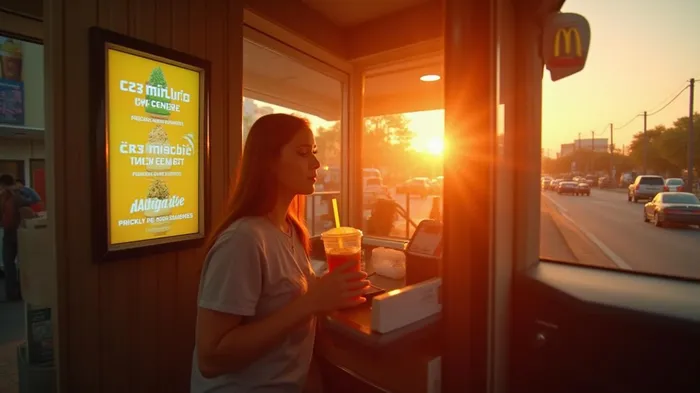
In late 2023, McDonald's launched CosMc's, a small-format, beverage-centric spinoff targeting afternoon snackers. The concept's Instagram-worthy drinks—think popping-candy-infused slushies and turmeric lattes—initially drew six-hour lines, proving the demand for premium fast-casual beverages. But operational realities intervened: the complexity of these drinks strained McDonald's standard workflows, and maintaining a separate brand structure became a logistical burden.
The closure of CosMc's by June 2025 is often framed as a failure, but it's better understood as a strategic pruning. By shutting down the spinoff, McDonald's avoids diluting its core brand while retaining the R&D benefits of CosMc's. The key insight? Franchise valuations are less about experiments and more about scalability.
While Starbucks and Red Robin struggle with declining foot traffic and stagnant sales, McDonald's stock has outperformed, rising 27% since 2020. This divergence hints at investors' confidence in McDonald's ability to adapt without overextending its franchise model.
The Opportunity: Drive-Thru Dominance and Beverage Goldmines
The closure of CosMc's didn't erase its innovations—it simply relocated them. McDonald's plans to test CosMc's drinks in 14,000+ U.S. locations, tapping into the $100B afternoon beverage market. This isn't just about lattes; it's about margins. Beverage sales typically carry 80-90% gross margins, far higher than burgers or fries.
But the real goldmine is the drive-thru revolution. McDonald's “On the Go” concept—no dining rooms, mobile-only ordering, and McDelivery lockers—is a blueprint for cost efficiency. With 70% of global locations already offering drive-thrus, scaling these formats reduces labor costs, speeds service, and appeals to a post-pandemic world hungry for convenience.
From 20,000 to 27,000 drive-thrus globally since 2015, McDonald's has slashed average order times to under 120 seconds—a metric directly tied to franchise profitability.
Why Franchise Valuations Will Surge
For franchisees, the shift to drive-thru-centric, beverage-focused locations is a win-win. Lower operational costs (no dining room staff or seating maintenance) and higher-margin drinks mean better cash flow. Meanwhile, McDonald's 2025 plan to open 2,200 new stores—including 550 in the U.S.—suggests expansion is still possible even in a saturated market.
The data backs this optimism:
- Franchise revenue growth: 8% annually since 2020, outpacing company-owned stores.
- Value menu momentum: The McValue program's $1 deals and $5 meal bundles have boosted U.S. sales by 3% in Q1 2025 alone.
- Chicken dominance: McCrispy and chicken strips now account for 22% of global sales, up from 15% in 2023—a category with higher profit margins than beef.
Risks? Yes, But Manageable
Critics argue McDonald's is overreaching by integrating CosMc's complexity into core locations. Yet the company's decision to test beverages incrementally—starting with limited-time offers—minimizes operational disruption. The E. coli scare of late 2024 also raised concerns, but sales rebounded swiftly, underscoring brand loyalty.
The biggest risk? Competitors like Starbucks and Red Robin are already losing ground. Starbucks' 2024 revenue fell 5% as it struggled to replicate McDonald's drive-thru efficiency, while Red Robin's 70 planned closures signal a sector-wide reckoning. McDonald's, by contrast, is positioning itself as the industry's resilience champion.
Time to Bet on McDonald's Franchise Future
For investors, the writing is on the fryer. McDonald's is doing what great franchisors do: learn fast, pivot faster, and double down on what works. The CosMc's closure isn't a retreat—it's a disciplined move to protect margins and brand equity. Meanwhile, its drive-thru innovation and beverage push are laying the groundwork for a new era of franchise growth.
With a 40% operating margin target for 2025, and a stock price hovering at 27x forward earnings (vs. Starbucks' 22x), McDonald's offers a compelling risk-reward trade. This is a company that turns strategic failures into fuel for its next big win.
Act now: McDonald's isn't just surviving—it's rewriting the rules of fast-food franchising. The next 12 months will see its innovations hit menus nationwide. Investors who bet on this transition won't just ride the wave; they'll own it.
With 2025 EPS growth expected to hit $7.25—up from $6.80 in 2023—the numbers are clear. The only question is: Are you in, or are you watching from the drive-thru window?
The time to invest in McDonald's future is now. The spinoff strategy isn't an end—it's the beginning of a new chapter.

Delivering real-time insights and analysis on emerging financial trends and market movements.
Latest Articles
Stay ahead of the market.
Get curated U.S. market news, insights and key dates delivered to your inbox.
AInvest
PRO
AInvest
PRO



Comments
No comments yet