
McDonald's Revenue Resilience Amid Inflation and Consumer Shifts: A Blueprint for Sustainable Growth
 Aime Summary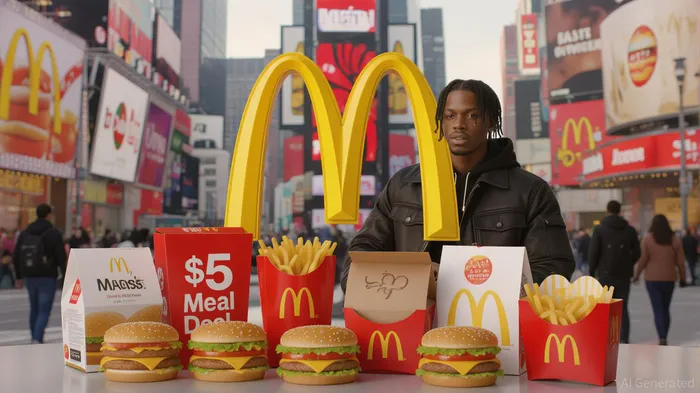
In an era marked by inflationary pressures and shifting consumer priorities, McDonald'sMCD-- has emerged as a standout performer in the consumer discretionary sector. By strategically leveraging brand collaborations and value-menu innovations, the fast-food giant has not only stabilized its revenue but also redefined its relevance in a competitive market. This article examines how McDonald's is navigating economic headwinds and explores whether its playbook offers a scalable model for other consumer discretionary stocks.
Strategic Brand Collaborations: Tapping into Pop Culture and Global Fandom
McDonald's has mastered the art of aligning with cultural touchstones to drive engagement and sales. The Travis Scott Meal and BTS Meal campaigns exemplify this approach. The Travis Scott collaboration, which included co-branded merchandise and high-impact social media campaigns, generated a 250% surge in McNuggets sales in South Korea and a 12% increase in U.S. restaurant visits. Similarly, the BTS Meal leveraged the K-pop group's massive global fanbase to boost international sales, demonstrating the power of celebrity partnerships in transcending geographic and demographic boundaries.
These collaborations are not one-off promotions but part of a broader strategy to create emotional resonance with consumers. By aligning with influencers and cultural icons, McDonald's taps into existing communities of loyal fans, turning them into brand advocates. This approach has proven particularly effective in attracting younger demographics, who prioritize experiences and social media engagement over traditional advertising.
Value-Menu Innovations: Balancing Affordability and Profitability
While brand collaborations drive short-term traffic, McDonald's value-menu innovations ensure long-term revenue resilience. The $5 Meal Deal and McValue platform have become cornerstones of its strategy, offering affordable options that cater to price-sensitive consumers without compromising margins. For instance, the “Buy One, Add One for $1” promotion allows customers to pair a McDouble with a McChicken sandwich or breakfast items, encouraging upselling while maintaining a perception of value.
The financial impact of these initiatives is evident. Despite a 3% revenue decline in Q1 2025, McDonald's reported a 0.3% rise in U.S. sales in Q2 2024, driven by value promotions. Internationally, localized value menus like the McSmart platform in Australia and Germany have mirrored the U.S. success, enabling the company to expand its footprint in high-growth markets. These strategies are supported by robust digital integration, including app-exclusive deals and loyalty programs, which enhance customer retention and drive repeat visits.
Scalability and Sector-Wide Implications
McDonald's model is not an isolated success. Other consumer discretionary brands are adopting similar strategies to navigate economic challenges. Starbucks, for example, has streamlined its menu and reintroduced handwritten notes to enhance the “third place” experience, while Taco Bell has leveraged digital sales and beverage innovation to boost margins. Chick-fil-A and Dunkin' have also prioritized value-driven promotions and operational efficiency to maintain market share.
The key to scalability lies in digital infrastructure and data-driven marketing. McDonald's investment in AI-driven kitchens, mobile ordering, and loyalty programs has enabled it to optimize costs and personalize customer experiences. For other brands, replicating this model requires a balance between affordability and innovation—offering products that resonate with evolving consumer preferences while maintaining profitability.
Investment Considerations: Is McDonald's a Buy?
McDonald's financials underscore its resilience. In 2024, the company reported $25.92 billion in revenue, with operating income of $11.71 billion and a 45.19% operating margin. Its free cash flow of $6.67 billion supports shareholder returns, with a 2.3% dividend yield. Analysts project a 5.1% revenue increase in 2025, driven by value initiatives and global expansion.
However, risks persist. Declining customer satisfaction scores (71/100 in 2024) and margin pressures from value promotions could temper growth. Investors should monitor Q2 2025 earnings, particularly the impact of the Big Arch burger rollout and new breakfast items like the Spicy Sausage McMuffin.
Conclusion: A Blueprint for Consumer Discretionary Growth
McDonald's has demonstrated that strategic brand collaborations and value-menu innovations can drive sustainable growth even in a high-inflation environment. By combining pop cultureCPOP-- relevance with affordability, the company has created a formula that resonates with diverse demographics. For investors, this model offers a compelling case study in balancing short-term revenue gains with long-term brand equity. As other consumer discretionary brands follow suit, the sector's future may hinge on the ability to adapt McDonald's playbook—leveraging digital tools, cultural trends, and value-driven offerings to outperform in a cautious-consumer landscape.

Stay ahead of the market.
Get curated U.S. market news, insights and key dates delivered to your inbox.
AInvest
PRO
AInvest
PRO



Comments
No comments yet