
McDonald's Menu Alchemy: How Strategic Innovation Brews Shareholder Success
In an era where fast-food giants compete not just on taste but on relevance, McDonald'sMCD-- has doubled down on a formula that's as American as the Big Mac itself: value, adaptability, and customer obsession. Over the past year, the company's relentless focus on menu innovation—driven by data-backed regional customization, loyalty program expansion, and crisis management—has not only stabilized its sales but positioned it as a leader in an increasingly fragmented market. Let's dissect how these strategies are fueling both brand loyalty and stock performance.
The $5 Meal Revolution: A Foundation of Value
At the heart of McDonald's recent success is its McValue program, a suite of promotions designed to counter inflation-driven price sensitivity. The crown jewel is the $5 Meal Deal, which combines a main item (e.g., Sausage McMuffin or Double Cheeseburger) with a “Buy One, Add One for $1” option. This model isn't just a pricing gimmick—it's a masterclass in behavioral economics. By anchoring purchases to a perceived “steal,” McDonald's has reignited traffic, particularly among budget-conscious diners.
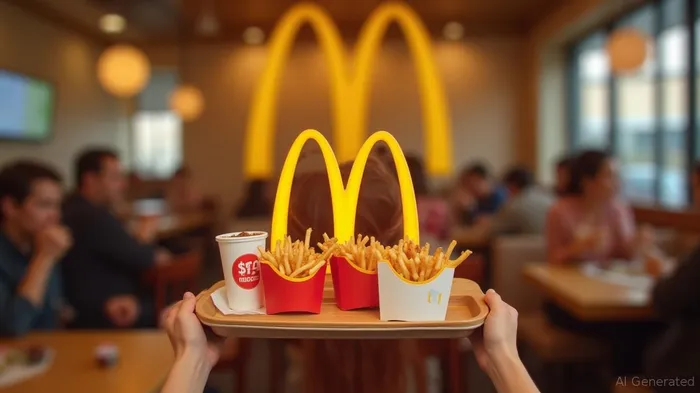
The results? In Q4 2024, global systemwide sales grew 2% (2% in constant currency), driven by holiday demand and the sustained popularity of the $5 promotion. Notably, the program's extension into December 2024—after its summer 2024 launch—showed the brand's agility in responding to market feedback.
Regional Customization: The Globalization of “Local Love”
While the $5 meal is a universal draw, McDonald's has also leaned into local preferences to deepen brand resonance. The McValue program includes region-specific deals like discounted chicken McNuggets in the U.S. and app-exclusive offers such as free fries with a $1 purchase. Beyond pricing, the menu now features culturally tailored items: Teriyaki burgers in Japan, McAloo Tikki in India, and even the McCrispy Chicken Sandwich (a 2025 launch expected to boost sales by 2–2.5%).
This strategy isn't just about differentiation—it's about owning cultural moments. For instance, the 2025 Minecraft promotion, which tied in-game collectibles to real-world purchases, drove a 12.2% surge in visits on its launch day. Such campaigns blur the lines between physical and digital engagement, keeping McDonald's top-of-mind for both kids and parents.
Loyalty as a Growth Engine: The $30 Billion Bet
The MyMcDonald's Rewards program is the unsung hero of this turnaround. With 175 million active users (up 15% YoY) and $30 billion in annual sales tied to loyalty members, this app-centric initiative has become a profit machine. Members not only visit more frequently but also spend more per transaction, driven by perks like free fries on Fridays or instant discounts for app users.
The program's AI-driven personalization—such as geofencing for “Ready on Arrival” orders—adds a layer of convenience that rivals tech-native brands. By 2027, McDonald's aims to grow loyalty-linked sales to $45 billion and add 250 million active users. This scale suggests the program could soon rival AmazonAMZN-- Prime in its impact on customer retention.
Navigating Storms: Crisis Management as a Competitive Edge
No strategy is flawless. The late-2024 E. coli outbreak linked to Quarter Pounder onions briefly dented U.S. sales, but McDonald's swift response—allocating $100 million to support affected stores—showed operational resilience. This transparency likely mitigated long-term reputational damage, a critical factor for a brand reliant on trust.
The Stock's Story: Value Meets Momentum
While McDonald's stock has averaged an 8.22% gain during its critical October-to-December sales quarters, its true power lies in consistency. Despite macroeconomic headwinds, the stock remains stable at $288.70, buoyed by steady sales growth and a dividend yield of 1.1%.
Investors should note two catalysts for future upside:
1. Global expansion: Plans to hit 50,000 stores by 2027 (up from ~43,000 today) will capitalize on underpenetrated markets.
2. Digital dominance: With 31% of orders now app-based, the company is primed to monetize data-driven targeting and personalized offers.
The Bottom Line: A Recipe for Long-Term Gains
McDonald's isn't just surviving—it's evolving. By blending value-driven pricing, cultural relevance, and tech-enabled loyalty, it's creating a moat against competitors like Subway and ChipotleCMG--. While short-term hiccups (e.g., supply chain issues with Krispy KremeDNUT-- partnerships) may cause minor dips, the brand's fundamentals suggest long-term outperformance.
For investors, MCDMCD-- offers a rare blend of defensiveness (stable cash flows) and growth (expansion and innovation). With a P/E ratio of 28.5—moderate for a growth stock—and a track record of adapting to crises, this is a name to hold through market cycles. As the fast-food wars intensify, remember: the Golden Arches still know how to cook up shareholder value.
Investment recommendation: Consider a medium-term position in MCD, targeting $320–$350 by 2026, with stops below $260.

Delivering real-time insights and analysis on emerging financial trends and market movements.
Latest Articles
Stay ahead of the market.
Get curated U.S. market news, insights and key dates delivered to your inbox.




Comments
No comments yet