
McDonald's Value Gambit: A Strategic Bet on a Two-Tier Economy and Fast-Food Stock Resilience


 Aime Summary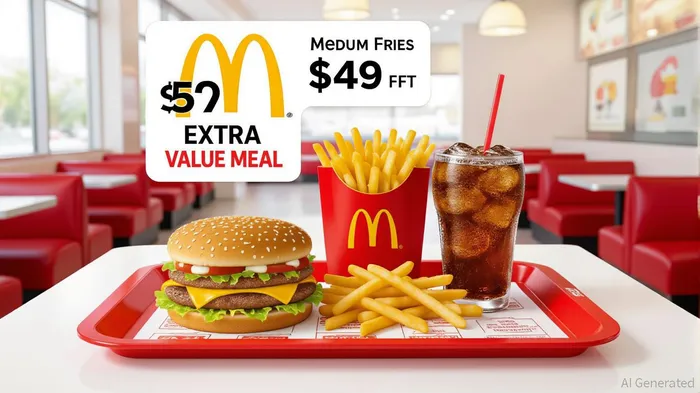
The fast-food industry in 2025 is navigating a fractured consumer landscape. Inflation, , and shifting demographics have created a two-tier economy: one where price-sensitive diners prioritize affordability, and another where discretionary spending on premium experiences remains resilient. McDonald'sMCD-- recent reintroduction of Extra Value Meals. For investors, the move underscores a critical question: Can fast-food chains like McDonald's sustain their value-driven strategies while maintaining profitability in a cost-conscious market?
The Value Meal as a Strategic Anchor
McDonald's has long understood the power of pricing psychology. , the company is directly targeting the $10 for affordability. , down from much higher levels a decade ago. . However, the broader industry context reveals a more complex picture.
The fast-food sector is in a value war, with competitors like Checkers and Rally's offering $4 combo meals and Wendy'sWEN-- experimenting with aggressive discounts. Yet, McDonald's has a structural advantage: its global scale, , and menu innovation pipeline (e.g., McCrispy Chicken Strips). These factors position it to absorb margin pressures better than smaller chains. For instance, , , reflecting investor skepticism toward premium QSRs but confidence in the Golden Arches' resilience.
A Two-Tier Economy and Demographic Shifts
The success of McDonald's value strategy hinges on its ability to attract low-income consumers, who visit QSRs more frequently than higher-income groups. CEO noted that these customers had reduced visits by “nearly double digits” in recent quarters—a trend exacerbated by inflation and rising food costs. By offering meals like the $5 Sausage McMuffin with Egg, McDonald's is not just selling food; it's selling accessibility .
This demographic shift has broader implications for fast-food stock valuations. Chains that fail to adapt to price sensitivity—like CavaCAVA-- and Sweetgreen—face declining traffic and bloated valuations. Conversely, McDonald's and Domino's, which have maintained strong value positioning, are outperforming peers. The key differentiator is operational flexibility: McDonald's franchisees control local pricing, allowing them to adjust discounts based on market conditions while maintaining brand consistency.
Long-Term Investment Potential: Balancing Value and Margins
For investors, the challenge lies in balancing McDonald's value-driven strategy with its margin health. , , . This suggests that volume growth can offset price concessions—a dynamic that is critical for long-term sustainability. However, the risk lies in . If competitors like Burger King or Wendy's respond with deeper discounts, McDonald's margins could face downward pressure.
The broader fast-food sector also faces structural challenges. Unlike casual dining chains, which can upsell with alcoholic beverages or desserts, QSRs rely on food-only margins. This limits their ability to offset value-driven pricing. McDonald's mitigates this risk through (e.g., McCrispy Chicken Strips) and (e.g., the Minecraft Movie Meal), which drive traffic without eroding margins as severely.
Conclusion: A Value Leader in a Fractured Market
McDonald's Extra Value Meals are more than a tactical response to inflation—they are a strategic repositioning for a two-tier economy. By anchoring its brand as a value leader, . traffic. For investors, . However, the long-term success of this strategy will depend on McDonald's ability to innovate without sacrificing margins and to outmaneuver competitors in a pricing-driven market.
In a world where affordability is king, McDonald's has positioned itself as the reigning champion. The question for investors is not whether the company can survive the current environment—but whether it can dominate it.

Delivering real-time insights and analysis on emerging financial trends and market movements.
Latest Articles
Stay ahead of the market.
Get curated U.S. market news, insights and key dates delivered to your inbox.
AInvest
PRO
AInvest
PRO



Comments
No comments yet