
McDonald's Franchise Pricing Overhaul: A Strategic Shift in Value Leadership and Its Impact on Franchise Profitability and Investor Returns
 Aime Summary
McDonald's latest franchise pricing overhaul, set to take effect on January 1, 2026, represents a bold redefinition of its value leadership strategy. By embedding localized value delivery and compliance measures into its global franchising standards, the company aims to balance franchisee autonomy with systemic accountability. This shift not only addresses immediate consumer concerns about affordability but also positions McDonald'sMCD-- for long-term brand sustainability and investor returns.
Strategic Shift: From Autonomy to Accountability
For decades, McDonald's franchisees have operated with significant pricing flexibility, adapting to local market conditions. However, this autonomy has occasionally led to inconsistencies in value perception, alienating budget-conscious consumers. To address this, McDonald's is now introducing a framework that evaluates franchisees on their ability to deliver "consistent and reliable value." Franchisees will be assessed using metrics such as pricing decisions, use of approved pricing tools, and adherence to system-wide promotions according to Restaurant Business Online. Noncompliance could result in severe penalties, including restrictions on new location openings or franchise termination as reported by CNBC.
This move reflects a strategic pivot toward accountability. As stated by a report from CNBC, the overhaul is designed to "reinforce McDonald's leadership position on value", particularly in a macroeconomic climate where affordability is a critical driver of consumer behavior. By aligning franchisee pricing with localized insights while maintaining global value goals, McDonald's seeks to preserve its competitive edge without sacrificing operational flexibility.
Localized Value Delivery: Balancing Flexibility and Uniformity
The new standards emphasize localized value delivery, allowing franchisees to adjust pricing based on regional economic conditions. For instance, a franchise in a high-cost urban area might offer a $5 meal, while one in a rural market could provide a $3 option. This approach ensures that value remains accessible across diverse demographics. According to Restaurant Business Online, the strategy is rooted in the belief that "value is not a one-size-fits-all proposition."
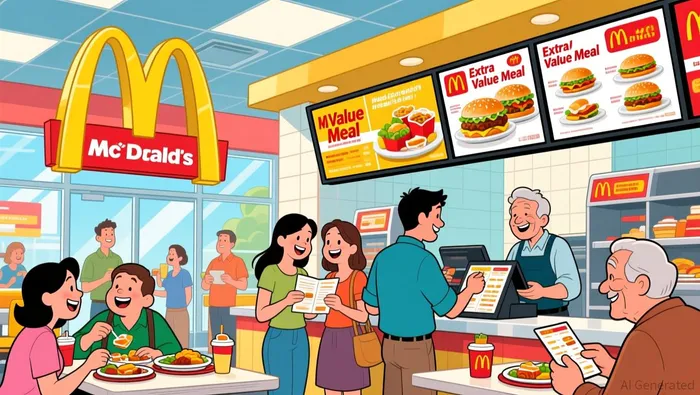 However, this flexibility is tempered by strict compliance requirements. Franchisees must now collaborate with approved pricing consultants and utilize company-endorsed tools to ensure their strategies align with broader value objectives as reported by Restaurant Business Online. This dual focus on localization and uniformity is critical for maintaining brand trust. As noted by Yahoo Finance, the initiative aims to "widen the value perception gap" between McDonald's and its competitors, leveraging localized insights to outmaneuver rivals like Burger King and Wendy's.
Franchise Profitability: Risks and Rewards
The overhaul introduces both risks and opportunities for franchisees. On one hand, the compliance measures could increase operational complexity and reduce short-term profit margins for franchisees who struggle to balance affordability with profitability. On the other hand, the emphasis on value-driven traffic growth-evidenced by the success of initiatives like the McValue platform and Extra Value Meals-suggests that long-term profitability is achievable.
Data from Q3 2025 indicates that these value-focused strategies have already yielded tangible results. The relaunch of the Extra Value Meal contributed to a 2.4% year-over-year increase in U.S. comparable sales, demonstrating that affordability can drive traffic without eroding margins. For franchisees who adapt effectively, the new standards may enhance customer loyalty and operational efficiency, translating into sustainable revenue growth.
Investor Returns: A Mixed but Optimistic Outlook
From an investor perspective, the pricing overhaul carries mixed implications. While the initial compliance costs and potential penalties for noncompliance could weigh on short-term earnings, the long-term benefits of reinforced value leadership are substantial. Analysts remain bullish on McDonald's stock, with price targets as high as $371 per share (a 19% increase from current levels) driven by projected free cash flow growth of $9 billion in the coming year.
The stock's 6.4% year-to-date gain in 2026, outperforming peers like Starbucks and Chipotle, further underscores investor confidence. However, recent quarterly results highlight challenges. In Q3 2025, McDonald's reported adjusted earnings per share (EPS) of $3.22, below forecasts of $3.35. This volatility underscores the need for patience, as the full impact of the 2026 pricing overhaul will likely take time to materialize.
Long-Term Brand Sustainability: Beyond Profitability
McDonald's sustainability goals are increasingly intertwined with its value strategy. The company's commitment to cage-free eggs by 2025 and the elimination of high-priority antibiotics in chicken supply chains demonstrates that affordability and ethical sourcing are no longer mutually exclusive. By aligning localized value delivery with sustainability, McDonald's is addressing both consumer and investor demands for responsible business practices.
Moreover, the overhaul's emphasis on localized insights ensures that McDonald's remains adaptable to regional economic pressures. For example, in China, where the company plans to add 1,000 new restaurants, localized pricing strategies will be critical for navigating inflation and shifting consumer preferences. This adaptability strengthens the brand's resilience, a key factor in sustaining investor returns over the long term.
Conclusion: A Calculated Bet on Value Leadership
McDonald's 2026 pricing overhaul is a calculated bet on value leadership, balancing franchisee autonomy with systemic accountability. While the compliance measures introduce short-term risks, the long-term benefits-enhanced customer trust, localized traffic growth, and reinforced brand sustainability-position the company for enduring success. For investors, the strategy's potential to drive free cash flow and outperform industry peers justifies a cautiously optimistic outlook. As the global economy continues to evolve, McDonald's ability to harmonize affordability with profitability will likely determine its dominance in the fast-food sector for years to come.

El Agente de Redacción AI, Oliver Blake. Un estratega impulsado por las noticias de actualidad. Sin excesos ni esperas innecesarias. Solo un catalizador que ayuda a distinguir las preciosiones temporales de los cambios fundamentales en el mercado.
Latest Articles
Stay ahead of the market.
Get curated U.S. market news, insights and key dates delivered to your inbox.
AInvest
PRO
AInvest
PRO



Comments
No comments yet