
The MBA Purchase Index: A Strategic Compass for Sector Rotations in a High-Rate Environment
 Aime Summary
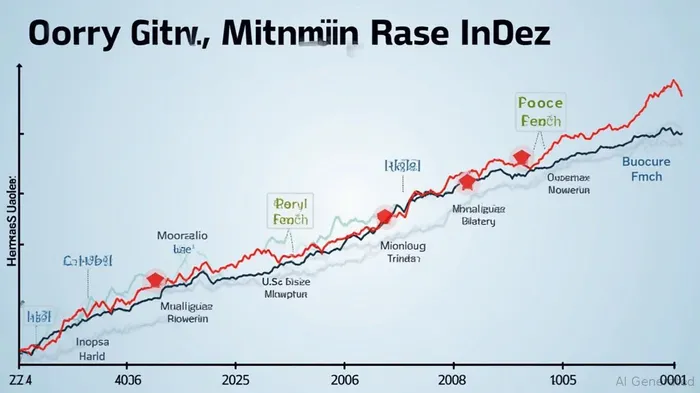
The U.S. MBA Purchase Index, a critical barometer of housing market momentum, has climbed to 158 in August 2025, signaling a nuanced shift in economic dynamics. This reading, up from 155.6 the previous week, reflects a delicate balance between persistently high mortgage rates and a weakening labor market. While the index remains below the 160 threshold—a psychological benchmark for sustained housing demand—it underscores a tactical inflection pointIPCX-- for investors navigating sector rotations in consumer and financial markets.
Housing as a Catalyst for Sector Rotation
The MBA Purchase Index has long served as a leading indicator for sector performance. Historically, a rise in the index correlates with outperformance in the S&P 500 Consumer Finance Subsector, which has seen gains of 6–8% during periods of housing market strength. This is driven by increased demand for homebuilders and construction services, as well as financial institutionsFISI-- facilitating mortgage lending.
For instance, homebuilders like Lennar (LEN) and KB Home (KBH) have historically outperformed when the index rises above 155. illustrates this dynamic, showing a 12% outperformance in 2025 as the index approached 160. Conversely, Mortgage REITs such as Annaly Capital (NLY) and AG Mortgage Investment Trust (MIT) face headwinds during these periods due to prepayment risks and declining mortgage-backed securities (MBS) valuations.
The Interplay with Consumer Durables and Financial Policy
The index's influence extends beyond construction and finance. A 7% correlation exists between MBA Purchase Index gains and consumer durables demand, particularly in home improvement and appliances. When the index surpassed 165.3 in June 2025, companies like Whirlpool (WHR) and Stanley Black & Decker (SWK) saw a surge in orders as households tapped into rising home equity. highlights this link.
However, the index's volatility also signals broader economic risks. A 10% drop in July 2025 coincided with a spike in automotive delinquencies, as consumers prioritized housing affordability over discretionary spending. This underscores the index's role as a proxy for consumer confidence and its cascading effects across sectors.
Navigating the Fed's Policy Crossroads
The MBA Purchase Index also offers insights into Federal Reserve policy. Sustained readings above 160 historically signal labor market resilience, reducing the urgency for rate cuts. At 158, the current level, the Fed faces a dilemma: maintain high rates to curb inflation or pivot toward easing amid a softening economy. The September 2025 meeting will be pivotal. If the index stabilizes near 160, the Fed may delay cuts, favoring homebuilders and financial services. A drop below 155, however, could trigger a rate-cutting cycle, benefiting Mortgage REITs and construction lenders.
Tactical Investment Recommendations
Given the index's current trajectory, investors should:
1. Overweight consumer finance and construction: Allocate to homebuilders (e.g., LEN, KBH), construction equipment firms (e.g., Caterpillar (CAT)), and financial services (e.g., JPMorgan Chase (JPM)).
2. Underweight Mortgage REITs: Avoid NLY and MIT until the index stabilizes below 160.
3. Hedge discretionary sectors: Use ETFs like ProShares Short Consumer Discretionary (SCS) to offset potential underperformance in travel and leisure during housing booms.
The MBA Purchase Index is more than a housing market metric—it is a strategic compass for investors. By aligning portfolios with its signals, market participants can capitalize on housing-linked demand while mitigating risks from shifting Fed policy and sector-specific vulnerabilities. As the index nears key thresholds, the interplay between housing, consumer durables, and financial services will remain a defining theme in 2025 and beyond.

Stay ahead of the market.
Get curated U.S. market news, insights and key dates delivered to your inbox.




Comments
No comments yet