
How the U.S. MBA 30-Year Mortgage Rate Shapes Construction and Utilities Stocks in a Low-Rate World
 Aime Summary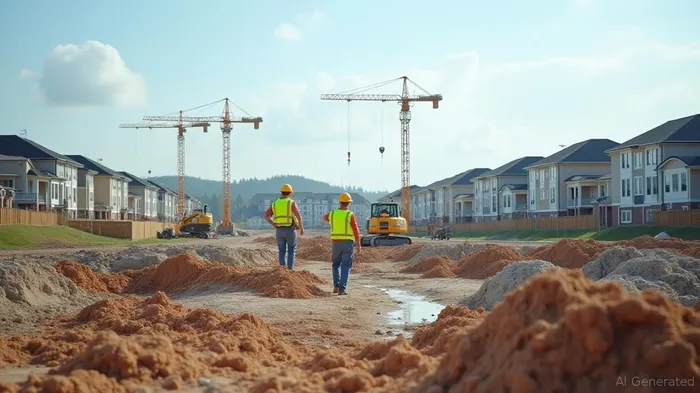
The U.S. MBA 30-Year Mortgage Rate, currently at 6.82% as of July 11, 2025, has long been a barometer for economic health and investor sentiment. While recent volatility—driven by Treasury yield fluctuations and trade policy uncertainty—has kept the rate elevated compared to the 2.85% lows of 2020, historical patterns suggest that even small dips in this metric can trigger significant shifts in sector performance. For investors, understanding how construction and utilities stocks react to low-rate environments is critical to navigating the next phase of market cycles.
Construction: A Sensitive Gauge of Rate Changes
The construction sector, particularly building materials and construction-tech firms, has historically thrived when mortgage rates fall. Data from 2000 to 2025 shows a clear inverse relationship: when the U.S. MBA 30-Year Mortgage Rate drops unexpectedly, the construction materials sector gains an average of +7% over 28 days. This is no accident. Lower borrowing costs spur homebuyer demand, driving up housing starts and, by extension, the need for lumber, steel, and digital tools to streamline construction.
For example, during the post-2020 rate plunge, housing starts surged, and construction-tech firms like Autodesk (ADSK) and Trimble (TRMB) saw robust demand for their software solutions. These companies, which optimize project management and reduce labor costs, outperformed traditional homebuilders by leveraging technology to offset margin pressures from material tariffs and labor shortages.
Investors should note that construction materials firms—such as Lowe's (LOW) or USG (USG)—are particularly sensitive to rate-driven demand swings. A return to low-rate conditions (e.g., a hypothetical drop to 5.5% in 2026) could reignite activity in this sector, especially if infrastructure policies like the Inflation Reduction Act continue to incentivize modernization.
Utilities: A Tale of Two Sectors
The utilities sector, however, tells a more nuanced story. While the broader S&P Utility Index has outperformed the S&P 500 in three of the past four years (including a 4.9% gain in Q1 2025), sub-sector performance diverges sharply. Gas utilities have historically underperformed during low-rate periods, averaging a -5% decline over 42 days after unexpected rate drops. This is tied to shifting consumer behavior: as mortgage rates fall and home construction accelerates, new homes tend to be smaller and more energy-efficient, reducing per-unit gas consumption.
Conversely, electric utilities and renewable infrastructure have shown resilience. The electrification of transportation, data centers, and home appliances creates a structural tailwind for companies like NextEra Energy (NEE) and Dominion Energy (D). These firms benefit from regulated demand and long-term contracts, insulating them from short-term rate volatility.
A key driver here is policy. The Infrastructure Investment and Jobs Act, combined with state-level clean energy mandates, has locked in growth for electric utilities. Meanwhile, gas utilities face existential risks as households and businesses transition to cleaner alternatives.
Strategic Implications for Investors
Given the projected decline in mortgage rates to 6.30% by 2026 and 6.00% by 2027, investors should prepare for a rebalancing of sector weights:
1. Overweight construction-tech innovators: Firms like AutodeskADSK-- and TrimbleTRMB-- offer exposure to housing demand without the volatility of raw material prices.
2. Underweight traditional gas utilities: The sector's long-term viability is increasingly uncertain, especially in a low-rate environment that accelerates electrification.
3. Favor electric utilities with infrastructure exposure: Companies positioned to benefit from grid modernization and renewable integration will likely outperform.
The U.S. MBA 30-Year Mortgage Rate remains a powerful lens through which to view sectoral dynamics. While construction stands to gain from rate-driven housing booms, utilities must adapt to a world where affordability and sustainability redefine energy consumption. For investors, the key lies in aligning portfolios with these structural shifts, not just cyclical trends.

Stay ahead of the market.
Get curated U.S. market news, insights and key dates delivered to your inbox.
AInvest
PRO
AInvest
PRO



Comments
No comments yet