
Mazda's Strategic Shift and Market Challenges: Navigating Supply Chain Risks and the EV Transition


 Aime Summary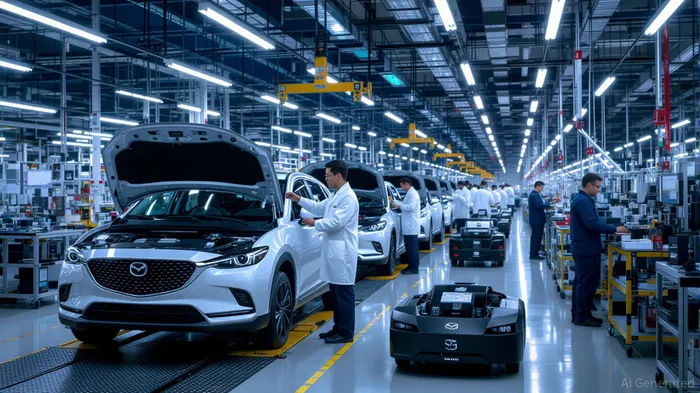
The global automotive industry is undergoing a seismic shift as automakers grapple with the dual pressures of electrification and supply chain volatility. Mazda, a brand long celebrated for its engineering finesse and driving dynamics, finds itself at a crossroads. Its strategic pivot toward a "Lean Asset Strategy" and multi-solution electrification approach has drawn both praise and scrutiny. For investors, the question is whether Mazda's balancing act between cost efficiency, supply chain resilience, and product diversification can sustain its valuation in a market increasingly dominated by EV-first competitors.
Supply Chain Vulnerabilities and the Tariff Threat
Mazda's supply chain structure remains a double-edged sword. While its 2025 "Lean Asset Strategy" has reduced reliance on just-in-time (JIT) manufacturing by optimizing component diversity and relocating assembly closer to production hubs, the automaker's heavy dependence on imported vehicles—only 19% of its U.S. sales are domestically produced—leaves it exposed to geopolitical risks. The looming 25% U.S. tariffs on imported vehicles, for instance, could erode margins and force price hikes that alienate cost-sensitive consumers.
This vulnerability contrasts sharply with rivals like FordF-- (78% domestic production) and ToyotaTM-- (50% domestic production), whose localized manufacturing buffers them against tariff shocks. Mazda's limited U.S. production footprint, despite the U.S. being its largest market (424,382 vehicles sold in 2024), underscores a strategic gap. While the company has begun producing the CX-50 and its hybrid variant in Alabama through a joint venture with Toyota, this effort remains a drop in the bucket compared to the scale needed to offset import costs.
Product Diversification: A Multi-Pathway Approach
Mazda's EV roadmap, unveiled in March 2025, emphasizes a "multi-solution strategy" that blends internal combustion engines (ICEs), hybrids, and battery electric vehicles (BEVs). This approach diverges from the all-in EV bets of companies like TeslaRACE-- and GMGM--, instead prioritizing flexibility to adapt to regional regulations and consumer preferences. The SKYACTIV-Z hybrid system, set to debut in the 2027 CX-5, exemplifies this strategy, offering high fuel efficiency and emissions compliance without sacrificing driving pleasure.
The automaker's in-house BEV platform, developed in collaboration with Panasonic Energy, further underscores its commitment to electrification. However, Mazda's reluctance to abandon ICEs entirely has raised questions about its long-term competitiveness. While this strategy may preserve short-term profitability, it risks alienating investors who view EVs as the sole future of mobility.
Investor Sentiment and Valuation Implications
Mazda's strategic choices have had a nuanced impact on investor sentiment. On one hand, its cost-conscious "Lean Asset Strategy"—which reduced electrification investment from ¥2 trillion to ¥1.5 trillion through partnerships—has been lauded for mitigating financial risk. The company's ability to produce both BEVs and ICEs on the same lines, cutting capital expenditures by 85%, has also been seen as a smart use of existing assets. These efficiencies, combined with record 2024 sales (420,000 units, up 16% year-on-year), suggest a resilient business model.
On the other hand, Mazda's slower EV adoption lags behind peers like Toyota and Hyundai, which have more aggressive EV roadmaps. While Toyota's hybrid-centric strategy has similarly drawn criticism for being "behind the curve," Mazda's smaller scale and limited U.S. production make it more vulnerable to market shifts. Investors must weigh whether Mazda's balanced approach will sustain its premium valuation or if it will be outpaced by EV-first competitors.
Strategic Recommendations for Investors
For investors, Mazda presents a compelling case of a nimble automaker navigating a turbulent transition. Its supply chain innovations and cost discipline offer a buffer against industry-wide disruptions, while its multi-solution strategy ensures relevance in markets where ICEs remain dominant. However, the company's limited U.S. production and reliance on imported vehicles pose a significant risk, particularly if tariffs escalate.
- Monitor Tariff Developments: The U.S. market accounts for 42% of Mazda's sales. Any escalation in import tariffs could force price hikes or margin compression. Investors should track U.S. trade policy and Mazda's domestic production expansion plans.
- Assess EV Adoption Rates: While Mazda's hybrid and ICE offerings have driven recent success, the long-term viability of its strategy depends on EV adoption in key markets. The 2027 launch of its in-house BEV will be a critical test.
- Evaluate Partnership Synergies: Mazda's collaborations with Toyota and Panasonic are vital to its cost efficiency. Investors should analyze the financial and technological benefits of these alliances.
In conclusion, Mazda's strategic shift reflects a pragmatic approach to the EV transition—one that prioritizes flexibility and cost control over aggressive bets. While this may not align with the high-growth narratives of EV-first automakers, it offers a more sustainable path in a market where consumer demand and regulatory landscapes remain fluid. For investors seeking a balanced, risk-mitigated play in the automotive sector, Mazda's stock warrants close attention—but not without vigilance on its supply chain and production challenges.

Delivering real-time insights and analysis on emerging financial trends and market movements.
Latest Articles
Stay ahead of the market.
Get curated U.S. market news, insights and key dates delivered to your inbox.




Comments
No comments yet