
Mazda's Strategic Shift and Market Challenges: Navigating Import Dependency and the EV Transition


 Aime Summary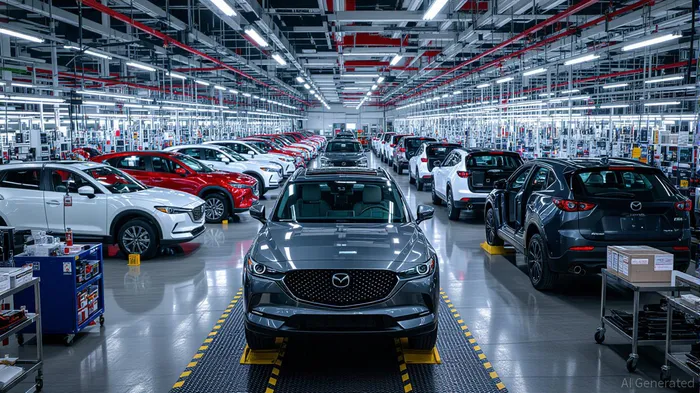
The global automotive industry is at a crossroads, with trade policies and the electrification revolution reshaping risk profiles for automakers. Mazda, a nimble but underdog player, finds itself at the intersection of these forces. Its heavy reliance on imports—particularly in the U.S.—and its cautious approach to electrification present both vulnerabilities and opportunities. For investors, understanding how Mazda navigates these challenges could determine whether it becomes a resilient long-term bet or a cautionary tale.
The Tariff Tightrope: Import Dependency as a Double-Edged Sword
Mazda's U.S. business is a textbook case of exposure to trade policy. In 2025, 81% of its U.S. sales are imported, primarily from Japan and Mexico. With the Trump administration's 25% tariffs on non-USMCA-compliant imports set to take effect, the automaker faces a projected operating loss of ¥145.2 billion ($987 million) for fiscal 2025. This is no small number—it's a stark reminder of how import dependency can amplify financial risks.
The solution? Localized production. Mazda is ramping up domestic output of the CX-50 at its Alabama joint venture with ToyotaTM--. This move is critical: the CX-50, a rugged crossover, aligns with U.S. consumer demand for SUVs (which now account for over 50% of global sales). However, even with this pivot, Mazda's U.S. domestic production remains a fraction of competitors like FordF-- (78% domestic) and Toyota (50%). The gapGAP-- is glaring.
Investors should watch how effectively Mazda scales its Alabama operations. A 19% domestic production rate in the U.S. is a liability in a high-tariff environment. If the CX-50 fails to gain traction, or if production bottlenecks persist, the automaker's margins could erode further.
Global Supply Chain Strains: Europe and Asia in the Crosshairs
Mazda's import dependency isn't confined to the U.S. In Europe, the automaker relies heavily on Japanese and Mexican production for models like the CX-5 and CX-30. July 2025 data shows a 16% year-on-year decline in European exports, signaling waning demand or logistical hurdles. Meanwhile, in Asia—particularly China—Mazda's sales dropped 15.8% in July 2025, despite plans to launch the all-electric EZ-60 by 2025.
The problem? Mazda's production strategy is still anchored to Japan. Domestic production in Japan fell 5.3% year-to-date in 2025, while overseas production declined 3.7%. This contraction underscores a lack of flexibility in a world where supply chains are increasingly fragmented. Competitors like Toyota and Hyundai have diversified their production hubs, but Mazda's reliance on a single country for core manufacturing leaves it exposed to geopolitical and economic shocks.
The EV Transition: A Race Against Time
Mazda's electrification strategy is a mixed bag. On one hand, its partnership with Toyota and DENSO has slashed battery costs by 85%, a lifeline in an industry where EV margins are notoriously thin. On the other, its roadmap lags behind peers. The automaker plans to launch a battery electric vehicle (BEV) in 2027, but its current focus remains on hybrids and plug-in hybrids—a pragmatic approach given its limited scale.
This hybrid-first strategy could be a double-edged sword. While it allows Mazda to avoid the upfront costs of full electrification, it also risks alienating markets with aggressive EV mandates, such as the EU and China. For example, the EU's 2035 ban on internal combustion engines (ICEs) could force Mazda to pivot faster than its current timeline allows.
Investment Implications: Risks and Rewards
Mazda's story is one of resilience and reinvention. Its partnerships with Toyota and DENSO provide a financial cushion, and its localized production efforts in Alabama are a step in the right direction. However, the automaker's import dependency and slow EV transition remain red flags.
For investors, the key is to balance optimism with caution. Mazda's stock has underperformed peers like Toyota and Ford in recent years, but its strategic shifts could unlock value if executed well. The CX-50's success, the rollout of the 2027 BEV, and the effectiveness of its cost-sharing collaborations will be critical metrics.
In the short term, Mazda's stock is a high-risk, high-reward proposition. The automaker's operating loss in 2025 and its exposure to tariffs make it a volatile play. However, for those with a longer time horizon, Mazda's agility and partnerships could position it as a niche player in a post-ICE world.
Final Verdict
Mazda is at a pivotal moment. Its ability to reduce import dependency through localized production and accelerate its EV transition will determine its survival in a rapidly evolving industry. While the path is fraught with challenges, the automaker's strategic partnerships and focus on cost efficiency offer a glimmer of hope. For investors, the lesson is clear: bet on execution, not just ambition. If Mazda can turn its plans into results, it might just prove that even the underdog can win the race.

Delivering real-time insights and analysis on emerging financial trends and market movements.
Latest Articles
Stay ahead of the market.
Get curated U.S. market news, insights and key dates delivered to your inbox.




Comments
No comments yet