
Mazda's Strategic Shift to Crossovers and EV Readiness: A Calculated Gamble in a Turbulent Era


 Aime Summary
The global automotive industry is undergoing a seismic transformation, driven by the convergence of electrification, shifting consumer preferences, and geopolitical volatility. For import-dependent automakers like Mazda, the stakes have never been higher. As the company navigates the dual pressures of U.S. tariffs and the race to electrify, its strategic pivot to premium crossovers and hybrid-electric vehicles offers a compelling case study in resilience—and a cautionary tale for investors.
The Tariff Quagmire and Production Rebalancing
Mazda's financial performance from 2023 to 2025 reveals a company caught in a crossfire of external headwinds. U.S. import tariffs, which impose 15% on Japanese imports and 25% on Mexican ones, have eroded operating profits by an estimated ¥145.2 billion ($987 million) for the fiscal year ending March 2026. With 81% of its U.S. sales reliant on imported vehicles, Mazda is among the most vulnerable automakers to these levies. Its debt-to-equity ratio of 1.42, well above the industry average of 1.0, further amplifies liquidity risks.
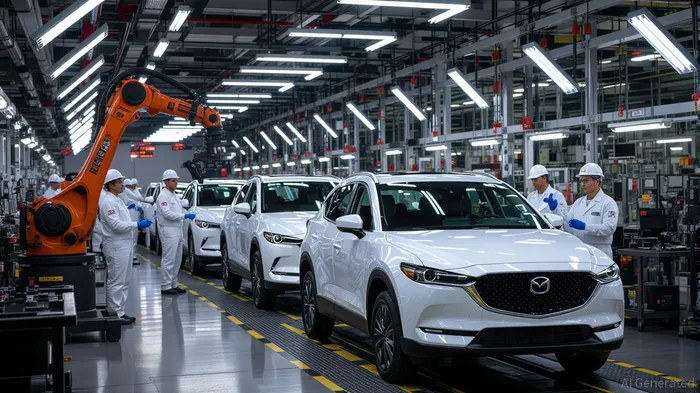
To mitigate these pressures, Mazda has recalibrated its production strategy. The Alabama plant, part of its joint venture with ToyotaTM-- (Mazda Toyota Manufacturing), is now a linchpin for U.S. production, particularly for the CX-50 and its hybrid variant. This model, which accounts for 19% of U.S. sales, has driven a 4% year-on-year sales increase in the first half of 2025. Meanwhile, the company has frozen investments in its Mexican plant, pending clarity on Trump-era tariffs that could escalate costs by 25%.
The Crossover Gambit: Premiumization and Hybrid Dominance
Mazda's pivot to premium crossovers is a calculated response to market dynamics. The CX-90 and CX-70, offered in hybrid and plug-in hybrid configurations, have achieved 24–25 mpg, blending efficiency with the brand's signature driving dynamics. These models cater to a growing segment of consumers seeking luxury without compromising fuel economy. The CX-50 Hybrid, set to launch in 2025, leverages Toyota's hybrid technology to compete directly with the RAV4 Hybrid and CR-V Hybrid.
However, the company's reliance on partnerships raises questions about long-term profitability. While collaborations with Toyota and Panasonic reduce R&D costs, they also limit Mazda's control over critical technologies. The MX-30, its first all-electric model, uses a plug-in hybrid rotary engine—a novel solution but one that may not align with the pure EV trajectories of competitors like TeslaTSLA-- or BYD.
Electrification: A Gradual, Cost-Conscious Transition
Mazda's electrification strategy is defined by caution. The company plans to introduce a dedicated Skyactiv EV platform by 2025, aiming for 25% EV sales by 2030—a target significantly lower than the 50%+ goals of peers like Volkswagen or General MotorsGM--. This conservative approach reflects both market uncertainty and a focus on profitability. Mazda's “Lean Asset Strategy” prioritizes cost efficiency, reducing electrification investments from ¥2 trillion to ¥1.5 trillion by 2030 through shared development and production lines.
The SKYACTIV-Z engine, set to debut in the next-generation CX-5 by 2027, underscores Mazda's hybrid-first philosophy. This engine, paired with proprietary hybrid systems, aims to bridge the gap between internal combustion and full electrification while meeting stringent emissions standards. For investors, this dual-track strategy balances innovation with fiscal prudence but may leave Mazda lagging in the EV race.
Risks and Opportunities in a Volatile Market
Mazda's long-term profitability hinges on its ability to navigate three key challenges:
1. Tariff Uncertainty: The potential for 25% U.S. tariffs on Mexican imports could force further production shifts, straining margins.
2. EV Adoption Rates: If consumer demand for EVs accelerates faster than anticipated, Mazda's conservative targets may leave it playing catch-up.
3. Brand Positioning: The premium crossover segment is crowded, with competitors like BMW and Mercedes-Benz offering superior tech and charging infrastructure.
Yet, Mazda's strengths are undeniable. Its “joy of driving” ethos differentiates it in a market saturated with bland EVs. The company's lean production methods and strategic partnerships offer a buffer against capital-intensive missteps. Moreover, its focus on profitability over volume aligns with a market increasingly skeptical of tech-driven hype.
Investment Implications
For investors, Mazda represents a high-conviction, medium-risk opportunity. The company's ability to adapt to tariffs and its hybrid-centric strategy provide near-term stability, while its EV roadmap offers long-term upside. However, the risks of regulatory shifts and EV market saturation cannot be ignored.
A diversified portfolio might pair Mazda with more aggressive EV players like Tesla or BYD, balancing innovation with Mazda's cost-conscious approach. Investors should monitor key metrics: the success of the CX-50 Hybrid, the impact of Trump-era tariffs on Mexican production, and the adoption rate of the Skyactiv EV platform.
Conclusion
Mazda's strategic shift to crossovers and EV readiness is a masterclass in incrementalism. By prioritizing profitability, leveraging partnerships, and preserving its brand identity, the company is navigating a volatile landscape with measured precision. For investors, the question is not whether Mazda will succeed, but whether its cautious approach can outpace the bold bets of its rivals. In a world of uncertainty, Mazda's blend of tradition and innovation may yet prove to be its greatest asset.

Delivering real-time insights and analysis on emerging financial trends and market movements.
Latest Articles
Stay ahead of the market.
Get curated U.S. market news, insights and key dates delivered to your inbox.




Comments
No comments yet