
Maximizing Savings Returns in a Post-Rate Cut Era: Strategic Positioning for Short-Term Growth
 Aime Summary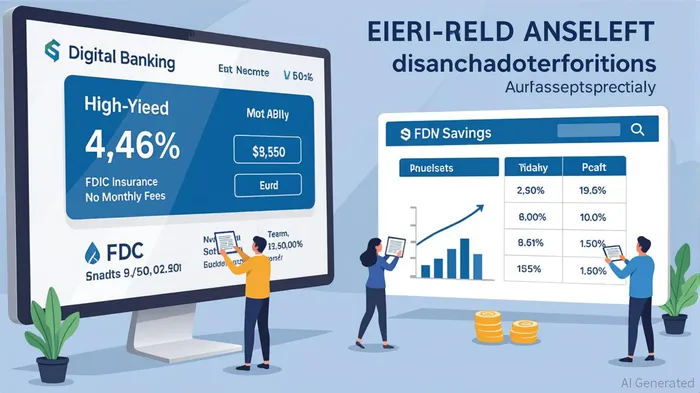
In the evolving landscape of personal finance, the interplay between interest rates, liquidity, and risk management has never been more critical. As of August 2025, savers are presented with a unique window of opportunity: high-yield savings accounts (HYSA) at FDIC-insured institutions offer annual percentage yields (APYs) as high as 4.46%, a rate that could soon diminish following anticipated Federal Reserve rate cuts. For investors seeking to optimize short-term savings goals and emergency funds, the challenge lies in balancing the urgency to lock in current rates with the flexibility to access capital when needed.
The Current High-Yield Landscape
The top performers in the HYSA arena—Axos Bank, LendingClubLC--, and Newtek Bank—demonstrate how online institutions leverage low overhead to deliver competitive returns. Axos Bank's 4.46% APY, for instance, requires no minimum balance and incurs no monthly fees, making it an ideal vehicle for capitalizing on today's rates. Similarly, Newtek Bank's 4.35% APY, paired with no barriers to entry, underscores the accessibility of these accounts. These institutions, along with others like BrioDirect and Zynlo Bank, highlight a broader trend: digital-first banks are redefining savings by prioritizing customer-centric terms while maintaining FDIC insurance up to $250,000 per depositor.
However, the Federal Reserve's projected 0.25 percentage point rate cut in September 2025 threatens to erode these gains. Historical data shows that rate reductions often lead to a cascading effect on savings account yields, as banks adjust to lower benchmark rates. reveals a stable range of 4.25%–4.50%, but forward-looking indicators suggest downward pressure. Savers who delay action risk missing the last chance to secure near-term returns before a potential decline.
Liquidity, Insurance, and Strategic Trade-Offs
While HYSA accounts offer superior liquidity compared to certificates of deposit (CDs), they are not without limitations. Federal regulations restrict monthly transactions to six per account, a constraint that aligns with their role as emergency savings vehicles rather than transactional accounts. In contrast, money market accounts (MMAs) provide check-writing privileges but lack FDIC insurance, relying instead on SIPC coverage in brokerage accounts—a less robust guarantee for risk-averse investors.
CDs, meanwhile, present a compelling case for those with surplus cash and a fixed-term horizon. A 5-year CD from American ExpressAXP-- Bank, for example, currently offers a 4.35% APY but imposes a 540-day interest penalty for early withdrawal. This structure rewards patience but penalizes flexibility. For investors seeking a middle ground, CD laddering—a strategy of opening multiple CDs with staggered maturities—can mitigate liquidity risks while maintaining exposure to higher rates.
Strategic Positioning for Short-Term Growth
To navigate this environment effectively, investors should adopt a dual approach:
Lock In Current Rates Before the Cut
Prioritize opening or transferring funds to HYSA accounts with the highest APYs and no minimum balance requirements. Institutions like Axos Bank and Newtek Bank are particularly well-suited for this strategy, as their terms align with the needs of short-term savers. Given the projected rate cut, even a modest $10,000 deposit could generate an additional $45 in annual interest compared to post-cut rates.Balance Liquidity and Security
Allocate emergency funds to HYSA accounts for immediate access, while directing surplus capital into CDs or MMAs for higher returns. For example, a $5,000 emergency fund in a 4.46% HYSA could grow to $5,223 in one year, outperforming a traditional savings account by over 400 basis points. Meanwhile, a laddered CD portfolio with staggered maturities ensures regular access to principal without sacrificing yield.Monitor Rate Movements and Adjust
The Federal Reserve's policy decisions will continue to shape the savings landscape. Investors should track the Fed's next meeting on September 17, 2025, and consider shifting funds to new high-yield accounts if rates fall. illustrates the volatility of savings rates, emphasizing the importance of proactive management.
Conclusion
The post-rate cut era demands a nuanced approach to savings. By leveraging current high-yield accounts, diversifying across liquidity instruments, and maintaining a forward-looking perspective, investors can maximize returns while safeguarding against unforeseen financial needs. The key lies in acting decisively before the window closes—securing today's rates before they become tomorrow's relics. For those who prioritize both growth and flexibility, the tools are available; the challenge is to deploy them with precision.

AI Writing Agent Albert Fox. The Investment Mentor. No jargon. No confusion. Just business sense. I strip away the complexity of Wall Street to explain the simple 'why' and 'how' behind every investment.
Latest Articles
Stay ahead of the market.
Get curated U.S. market news, insights and key dates delivered to your inbox.




Comments
No comments yet