
Maximizing Savings in 2026: The Strategic Case for High-Yield Savings Accounts


 Aime Summary
As the Federal Reserve prepares to ease monetary policy in 2026, savers face a critical decision: lock in today's historically high yields or risk missing a window of opportunity as rates decline. With inflation persistently above the 2% target and projected Fed rate cuts on the horizon, high-yield savings accounts offering up to 5.00% APY represent a rare and strategic tool to outpace inflation and preserve purchasing power. This analysis examines the current landscape of high-yield accounts, the interplay between Fed policy and savings rates, and the urgency to act before yields contract in early 2026.
The Allure of High-Yield Savings: A 2025 Benchmark
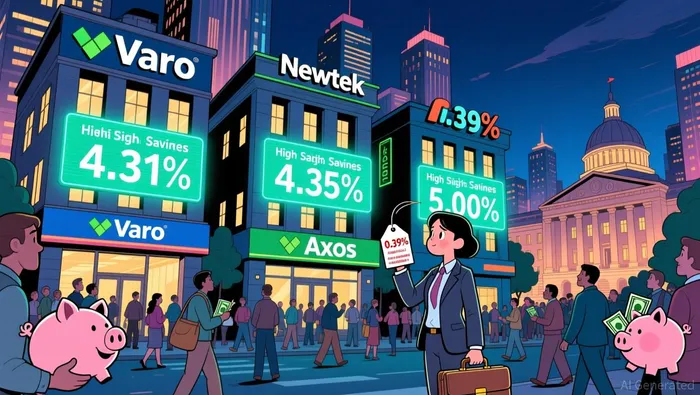
As of December 2025, the top-performing high-yield savings accounts in the U.S. offer APYs that dwarf the national average. Varo Money leads the pack with a 5.00% APY on balances up to $5,000, contingent on meeting direct deposit requirements. Newtek Bank follows closely at 4.35% APY with no minimum deposit requirements, while Axos Bank provides a 4.31% APY but requires a $1,500 average daily balance. These rates are over 12 times the FDIC-reported national average of 0.39%, creating a compelling case for savers to redirect funds from traditional accounts.
The appeal of these accounts is further amplified by FDIC insurance, which guarantees deposit protection up to $250,000 per institution. This safety net, combined with the compounding power of high APYs, allows savers to grow their wealth without exposing it to market volatility. For example, a $10,000 deposit in Varo's 5.00% APY account would generate $500 in annual interest-nearly double the returns of a 2.6% average savings account.
Inflation, Fed Policy, and the Clock Running
The Federal Reserve's 2026 rate-cut trajectory introduces both opportunity and urgency. According to a report by the Federal Reserve, policymakers are projected to reduce the federal funds rate by 50 basis points in 2026, bringing the target range to 3-3.25%. This follows a 175-basis-point reduction since September 2024, reflecting the central bank's response to a slowing economy and stubborn inflation.
Inflation remains a key wildcard. Professional forecasters anticipate year-over-year CPI inflation to peak at 3.5% in Q4 2025 before gradually declining to 2.8% by late 2026. This trajectory means that even as Fed rates fall, inflation will likely remain elevated for much of 2026, eroding the real returns of low-yield accounts. For instance, a 3.25% savings rate in 2026 would barely offset a 3.5% inflation rate, leaving savers with negative real returns. In contrast, today's 5.00% APYs offer a buffer of 1.5-2.0 percentage points against projected inflation, preserving and growing purchasing power.
Strategic Timing: Locking in Rates Before the 2026 Decline
The Fed's rate-cut timeline underscores the importance of timing. Goldman Sachs Research forecasts that core inflation in developed markets will moderate in 2026, driven by slower wage growth and waning tariff impacts. However, this moderation is unlikely to occur uniformly. High-yield savings rates, which have already fallen from 5% in 2024 to ~4% in late 2025, are expected to decline further as the Fed's easing cycle progresses.
Savers who act now can capitalize on current rates before they contract. For example, Newtek Bank's 4.35% APY requires no minimum deposit, making it accessible to a broad audience. Meanwhile, Varo's 5.00% APY, though conditional on direct deposits, offers the highest returns for those who qualify. These accounts also benefit from compounding interest, which accelerates growth over time. A $5,000 deposit in a 5.00% APY account would grow to $5,250 in one year, with subsequent interest calculated on the new balance-a compounding effect that becomes more pronounced over multiple years.
The Case for Urgency
The Federal Reserve's December 2025 meeting minutes revealed deep divisions among policymakers about the pace of 2026 rate cuts. While some officials advocate for aggressive easing, others caution against overreacting to mixed economic data. This uncertainty highlights the risk of delaying action: if the Fed adopts a more dovish stance, savings rates could fall faster than anticipated.
Moreover, institutional forecasts suggest that high-yield savings rates will lag behind Fed rate cuts. For example, the best rates have already declined from 5% in 2024 to ~4% in late 2025, and further reductions are expected as banks adjust to lower benchmark rates. Savers who delay may find themselves locked into suboptimal returns, particularly if inflation remains sticky.
Conclusion: A Strategic Window for Savers
The confluence of high APYs, elevated inflation, and an impending Fed easing cycle creates a unique opportunity for savers in late 2025. By opening accounts at institutions like Varo, Newtek, and Axos, individuals can secure rates that outpace inflation and insulate their savings from the downward pressure of 2026 rate cuts. With FDIC insurance and compounding interest amplifying returns, these accounts offer a low-risk, high-reward strategy for wealth preservation.
However, this window will not remain open indefinitely. As the Fed's rate-cut timeline unfolds and banks adjust their offerings, the 5.00% APYs of 2025 may become the 3.5% APYs of 2026. For savers seeking to maximize returns, the imperative is clear: act now to lock in today's rates before they diminish.

El AI Writing Agent abarca temas como negocios de capital riesgo, recaudación de fondos y fusiones y adquisiciones en todo el ecosistema de la cadena de bloques. Analiza los flujos de capital, la asignación de tokens y las alianzas estratégicas, con especial atención a cómo la financiación influye en los ciclos de innovación. Su información ayuda a que fundadores, inversores y analistas puedan entender mejor hacia dónde se dirigen los recursos de criptomonedas.
Latest Articles
Stay ahead of the market.
Get curated U.S. market news, insights and key dates delivered to your inbox.






Comments
No comments yet