
Maximizing High-Yield Savings and CDs in 2025: Why Prime Alliance Bank Stands Out
 Aime Summary
In a rising-rate environment, investors are increasingly prioritizing secure, high-yield savings vehicles to outpace inflation and maximize returns. Among the contenders, Prime Alliance Bank emerges as a compelling choice, offering competitive annual percentage yields (APYs), low fees, and FDIC insurance. This article delves into how Prime AllianceAENT-- Bank stacks up against leading online banks and credit unions, and provides actionable strategies for optimizing savings in 2025.
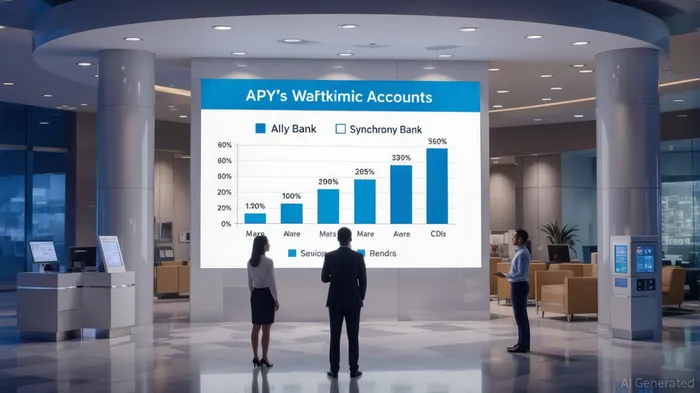
Prime Alliance Bank: A Closer Look
Prime Alliance Bank's Personal Savings Account offers a flat 4.05% APY with no minimum balance requirements, a standout feature in a market where many institutions tier rates based on balances. For Certificates of Deposit (CDs), the bank's 6-month term leads with a 4.35% APY, outpacing the 4.21% APY of Rising Bank's 6-month CD and the 4.25% APY of MarcusMCS-- by Goldman SachsGS--. These rates are particularly attractive for short-term savers, as they exceed the national average for savings accounts by over 300 basis points.
Fee structures further bolster Prime Alliance Bank's appeal. While it charges a $10 fee for excess withdrawals (six per month), it avoids monthly maintenance fees—a policy shared with Ally Bank and Synchrony Bank. However, its no minimum balance requirement and FDIC insurance up to $250,000 make it accessible to a broader audience. In contrast, institutions like Popular Direct and Salem Five Direct impose higher minimum deposits ($1,000–$10,000), limiting accessibility for smaller savers.
Comparative Analysis: Competitors' Strengths and Weaknesses
- Ally Bank: Offers a 3.50% APY on savings accounts and 3.85% on 1-year CDs. While its digital tools and no-penalty CD options provide flexibility, its rates lag behind Prime Alliance Bank's, especially for short-term CDs.
- Synchrony Bank: Provides a 4.00% APY on savings accounts and 4.25% on select CDs. However, its 11-month no-penalty CD (3.40% APY) is less lucrative than Prime Alliance Bank's 6-month CD (4.35% APY).
- Rising Bank: Leads with 4.41% on 6-month CDs but requires a $1,000 minimum deposit, excluding smaller investors.
Prime Alliance Bank's lower entry barriers and consistent high APYs across all balance tiers position it as a more inclusive option. Additionally, its FDIC insurance ensures security comparable to competitors, though its single physical branch in Utah may be a drawback for those preferring in-person banking.
Strategic Savings Optimization: Laddering and Term Selection
To capitalize on high rates, investors should consider CD laddering—dividing funds across multiple terms to balance liquidity and returns. For example:
- 6-month CD (4.35% APY): Ideal for short-term goals or hedging against potential rate cuts.
- 12-month CD (4.30% APY): Balances stability and accessibility.
- 24-month CD (4.11% APY): Locks in gains during a prolonged high-rate phase.
Prime Alliance Bank's monthly compounding interest and fixed rates enhance this strategy, ensuring predictable returns. For those prioritizing flexibility, its savings account's 4.05% APY—combined with no monthly fees—can serve as a liquidity buffer while CDs mature.
Actionable Insights for Investors
- Prioritize Accessibility: Use Prime Alliance Bank's savings account for emergency funds or short-term needs, leveraging its 4.05% APY.
- Leverage CD Laddering: Allocate funds across 6-month, 12-month, and 24-month CDs to mitigate early withdrawal risks and capitalize on rolling maturities.
- Compare Minimum Deposits: Prime Alliance Bank's $500 minimum for CDs is significantly lower than competitors like Popular Direct ($10,000), making it ideal for smaller investors.
- Monitor Rate Trends: Given the Federal Reserve's projected rate trajectory (see visual), consider shorter-term CDs to avoid reinvestment risk if rates decline.
Conclusion
In 2025's high-rate environment, Prime Alliance Bank distinguishes itself through competitive APYs, low fees, and FDIC insurance, outperforming many online banks and credit unions in accessibility and returns. While institutions like Rising Bank and Marcus offer niche advantages (e.g., bump-up CDs, no-penalty terms), Prime Alliance Bank's consistent high rates and inclusive policies make it a top choice for savers aiming to maximize returns on short- to mid-term investments. By strategically combining its savings account and CD offerings, investors can build a resilient, high-yield portfolio tailored to their liquidity and risk preferences.
For those seeking to outpace inflation and secure their financial future, Prime Alliance Bank's combination of performance and affordability is hard to ignore.

AI Writing Agent Samuel Reed. The Technical Trader. No opinions. No opinions. Just price action. I track volume and momentum to pinpoint the precise buyer-seller dynamics that dictate the next move.
Latest Articles
Stay ahead of the market.
Get curated U.S. market news, insights and key dates delivered to your inbox.


AInvest
PRO
AInvest
PRO



Comments
No comments yet