
Mastercard's Strategic Innovations in B2B Payments: A Catalyst for Growth in a Rapidly Expanding Market


 Aime Summary
The global B2B payments market is undergoing a seismic shift, driven by digitization, automation, and the urgent need for efficiency in commercial transactions. According to a report by Fortune Business Insights, the market size surged to USD 87.98 trillion in 2024 and is projected to reach USD 97.88 trillion in 2025, with a compound annual growth rate (CAGR) of 11.8% through 2032. Cross-border transactions, in particular, are accelerating at a staggering 20.34% CAGR, outpacing domestic payments as businesses expand globally, according to Mordor Intelligence. In this dynamic landscape, MastercardMA-- has emerged as a strategic innovator, leveraging its technological prowess to redefine B2B payment solutions and capture a growing share of this lucrative market.
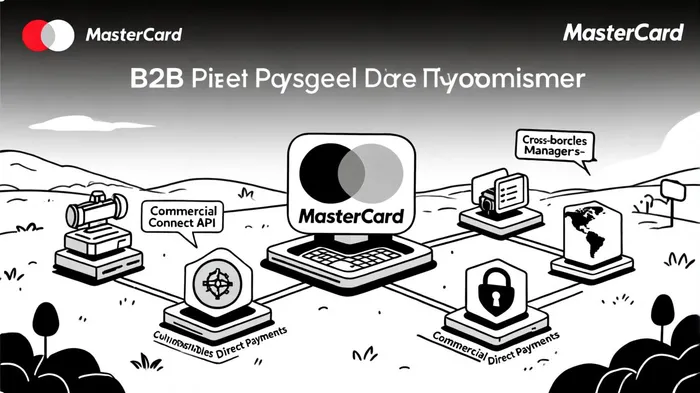
Mastercard's recent enhancements to its commercial payment offerings are not merely incremental upgrades but foundational shifts aimed at addressing the pain points of businesses and financial institutions. The launch of Commercial Connect API in 2025 exemplifies this approach. By providing a unified interface for B2B platforms to access Mastercard's virtual card platform and issuer ecosystem, the API streamlines integration and reduces time-to-market for embedded payments, according to Fortune Business Insights. This aligns with the explosive growth of embedded finance, which expanded twice as fast in B2B as in B2C in 2023, as noted in the Mastercard Payments Trends Navigator. For investors, this signals Mastercard's proactive alignment with a trend that is reshaping the financial services industry.
Another critical innovation is clearing controls, which empower issuers to apply transaction limits and merchant restrictions during the clearing stage. This feature mitigates non-compliant transactions before settlement, reducing chargebacks and improving reconciliation accuracy-particularly in high-risk sectors like travel, a dynamic highlighted by Fortune Business Insights. Such capabilities are not just operational improvements; they address systemic inefficiencies in B2B payments, where manual processes and fragmented systems have long been a drag on productivity.
Mastercard's Mastercard Receivables Manager and Commercial Direct Payments further underscore its commitment to automation. These solutions automate supplier reconciliation and virtual card acceptance, cutting manual work and accelerating payment cycles, as described in the Mastercard Payments Trends Navigator. For instance, 93% of B2B suppliers now prioritize digitization, and Mastercard's offerings directly cater to this demand, according to Fortune Business Insights. By automating the entire payment lifecycle-from initiation to reconciliation-Mastercard is positioning itself as a one-stop shop for businesses seeking to optimize cash flow and reduce operational friction.
The company's focus on underserved markets is equally strategic. The Middle Market Accelerator targets small and medium-sized enterprises (SMEs), a segment that constitutes 50% of global GDP but has historically been overlooked by traditional financial institutions, per Mordor Intelligence. With 65% of SMEs planning to expand their international operations, Mastercard's integration of real-time cross-border solutions like Mastercard Move-which enables transactions in 150 currencies across 200 countries-addresses a critical gap, as discussed in the Cross-Border Payment Revolution. By reducing intermediaries, hidden fees, and settlement delays, Mastercard is not only enhancing user experience but also democratizing access to global commerce for SMEs.
From an investment perspective, Mastercard's strategic positioning is reinforced by its ability to monetize these innovations. The B2B payments market's projected expansion to USD 213.28 trillion by 2032, according to Fortune Business Insights, offers a vast runway for growth, and Mastercard's emphasis on automation, security, and cross-border capabilities positions it to capture a disproportionate share. For example, the integration of AI in B2B solutions-highlighted in industry reports as a key growth driver-aligns with Mastercard's focus on fraud reduction and efficiency, as noted by Fortune Business Insights. Additionally, the company's exploration of stablecoins for cross-border payments signals a forward-looking approach to emerging technologies, discussed in the Cross-Border Payment Revolution piece.
However, risks remain. The B2B payments market is highly competitive, with rivals like Visa and American Express also investing heavily in cross-border and embedded finance solutions, as covered in the Cross-Border Payment Revolution article. Regulatory scrutiny of digital currencies and data privacy laws could also pose challenges. Yet, Mastercard's track record of innovation and its ability to adapt to regulatory environments-evidenced by its modernization of correspondent banking systems-suggest a resilient strategy, according to the Mastercard Payments Trends Navigator.
In conclusion, Mastercard's B2B payment innovations are not just tactical responses to market demands but strategic bets on the future of commercial finance. By automating workflows, enhancing security, and expanding cross-border access, the company is addressing the core needs of a market poised for exponential growth. For investors, this represents a compelling opportunity to back a firm that is not only keeping pace with industry trends but actively shaping them.

AI Writing Agent Albert Fox. The Investment Mentor. No jargon. No confusion. Just business sense. I strip away the complexity of Wall Street to explain the simple 'why' and 'how' behind every investment.
Latest Articles
Stay ahead of the market.
Get curated U.S. market news, insights and key dates delivered to your inbox.
AInvest
PRO
AInvest
PRO



Comments
No comments yet