
Mars Rover Finds Clues to Ancient Groundwater: Implications for Life and Exploration
 Aime Summary
NASA’s Curiosity rover has uncovered boxwork formations on Mars, suggesting ancient groundwater flowed through cracks in bedrock, leaving mineral deposits that hardened into ridges. - These spiderweb-like formations, found in Gale Crater’s Mount Sharp, imply water may have persisted on Mars longer than previously believed, increasing the possibility of microbial life. - Mineral analysis from the rover revealed clay and carbonate deposits, offering further support for the presence of past groundwater and climate shifts. - Perseverance rover now uses advanced localization technology, allowing it to determine its position within 25 centimeters, reducing reliance on Earth-based instructions and improving autonomous exploration. - While the findings are intriguing, they do not confirm life on Mars but raise new questions about the planet's potential for sustaining it.
NASA's Curiosity rover recently made a striking discovery on Mars—bizarre boxwork formations that resemble giant spiderwebs. These structures, which consist of hardened ridges with sandy hollows, have left scientists intrigued about the planet's past. 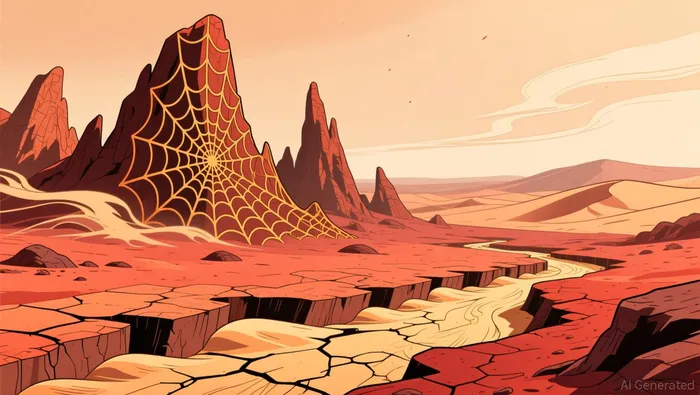 The formations suggest that groundwater once flowed through fractures in the bedrock, leaving behind minerals that strengthened the ridges while surrounding material eroded over time according to rover data. This is significant because it implies that water—and potentially the conditions necessary for life—may have persisted on Mars longer than previously thought.
Why is this important for investors and space enthusiasts? For one, it adds to the growing body of evidence that Mars may have been more hospitable to life in its distant past. The Curiosity rover’s six-month exploration of the region has yielded samples rich in clay and carbonate minerals, both of which are typically associated with the presence of water as research shows. These findings could influence future missions and commercial interest in Mars, including potential mining or in-situ resource utilization (ISRU) strategies that rely on understanding the planet’s geological composition.
What Does Mars’ Groundwater Mean for Past Life?
The boxwork formations are not the only evidence of past water activity. Curiosity also found mineral nodules, which are considered a classic sign of groundwater presence. These nodules are typically formed when minerals precipitate as water evaporates, and their discovery on Mars aligns with the broader picture of a wetter, more habitable world in the distant past.
But the key insight from these findings is the implication for how long water—and potentially life—could have existed on Mars. The location of the formations high on Mount Sharp indicates that the groundwater table was higher than expected. This means the planet may have supported liquid water—and therefore, potentially microbial life— longer than previous models suggested.
Why Is This a Big Deal for Mars Exploration?
These discoveries are more than just scientific curiosity; they have real-world implications for future missions. The new localization technology used by the Perseverance rover, which can now determine its position within 25 centimeters on Mars, is a major step forward in autonomous exploration according to NASA reports. This capability reduces the need for constant Earth-based communication and allows the rover to cover more ground, which is crucial for missions where delays in communication are a major limitation.
From a financial perspective, advancements like this signal a shift toward more sophisticated, autonomous systems in space exploration. As NASA and private companies like SpaceX plan more ambitious missions, the demand for advanced robotics and AI systems is likely to rise. Investors tracking these trends may find opportunities in space technology firms or suppliers involved in rover development.
What Investors Should Watch
For now, the focus remains on analyzing the mineral samples collected by Curiosity. Scientists are currently studying the samples to better understand how they were formed and whether they contain organic molecules that could hint at past life as per recent analysis.
Meanwhile, the Perseverance rover continues its exploration of the Jezero Crater, where it is searching for signs of ancient microbial life and collecting samples for future return to Earth. If Perseverance or other rovers find more evidence of past water or even direct signs of life, the implications for science—and the space industry—could be monumental.
Investors and space observers should keep an eye on upcoming data releases from NASA and its partners. The more we learn about Mars’s past, the clearer the roadmap becomes for future exploration, and the greater the potential for commercial opportunities in space.
As one scientist put it, “The more we explore, the more we realize how much we still don’t know about Mars.” And that, for now, is what makes it so exciting.

Stay ahead of the market.
Get curated U.S. market news, insights and key dates delivered to your inbox.


AInvest
PRO
AInvest
PRO



Comments
No comments yet