
Mars Inc.'s Natural Dyes Transition: A Strategic Bet on Consumer Trends and Regulatory Shifts
 Aime Summary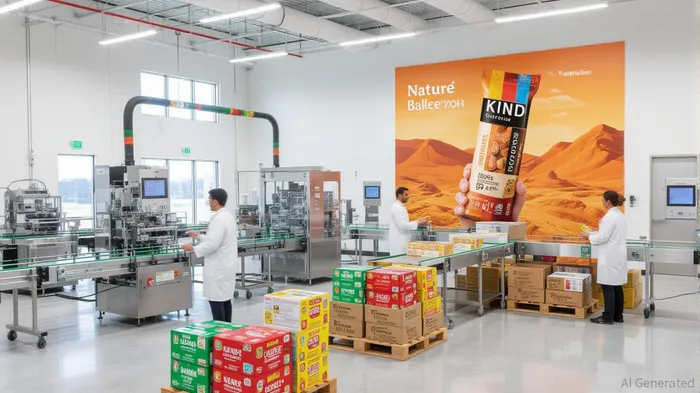
The snack industry is undergoing a seismic shift as consumers increasingly demand transparency, health benefits, and sustainability. At the forefront of this transformation is Mars Inc., a global leader in confectionery and snacks, which has committed $2 billion to U.S. manufacturing by 2026. This investment, including a new $240 million facility for Nature's Bakery, underscores the company's pivot toward natural ingredients and clean-label products. However, Mars' approach to synthetic dyes—retaining them in U.S. markets while phasing them out in Europe—raises critical questions for investors about its alignment with regulatory trends and consumer expectations.
The Market for Natural Ingredients: A $15.94 Billion Opportunity
The global organic snack market is projected to grow at a compound annual growth rate (CAGR) of 6.6%, reaching $15.94 billion by 2029. This expansion is driven by rising obesity rates, regulatory pressures (e.g., synthetic dye phase-outs in the U.S. and EU by 2026–2027), and a cultural shift toward wellness. Mars' $2 billion U.S. manufacturing push, which includes 230 new jobs at the Nature's Bakery facility, positions the company to capitalize on this growth. Yet, its selective reformulation strategy—retaining synthetic dyes in popular U.S. brands like M&Ms and Skittles—could expose it to reputational and regulatory risks.
Mars' Strategic Dilemma: Innovation vs. Consumer Preferences
Mars' 2016 pledge to remove artificial colors globally was met with skepticism when the company delayed action in the U.S. While it has successfully rebranded its European portfolio with natural dyes (e.g., using paprika for Spanish rice dishes), U.S. consumers have shown a preference for vibrant, synthetic colors in confectionery. This divergence highlights a broader challenge: balancing innovation with market-specific demands. Mars' recent investments in R&D for natural dyes, such as beet juice and turmeric, are promising, but the lack of a 2025 deadline for U.S. reformulation contrasts with competitors like Nestlé and HersheyHSY--, which have committed to full phase-outs.
Competitive Positioning and Regulatory Risks
Mars' market-specific approach has drawn scrutiny, particularly from Texas Attorney General Ken Paxton, who is investigating the company's alleged failure to honor its 2016 pledge. This legal exposure, combined with the impending FDA deadlines for synthetic dye reformulation, could force Mars to accelerate its U.S. transition. Meanwhile, competitors like MondelezMDLZ-- (gluten-free Oreos) and PepsiCoPEP-- (plant-based snacks) are leveraging clean-label trends to capture market share. Mars' acquisition of KellanovaK--, which includes RXBAR and NutriGrain, provides a buffer, but its reliance on legacy brands like Snickers and Twix remains a double-edged sword.
Investment Implications: Balancing Growth and Risk
For investors, Mars' strategy presents both opportunities and risks. The company's $2 billion U.S. manufacturing investment and expansion of Nature's Bakery align with long-term growth in the organic snack sector. However, its delayed action on synthetic dyes could lead to regulatory fines, loss of consumer trust, or market share erosion. Key metrics to monitor include:
1. R&D spending on natural dyes (e.g., Mars' 2025 R&D budget as a percentage of revenue).
2. Consumer sentiment shifts (e.g., surveys tracking U.S. demand for clean-label confectionery).
3. Regulatory timelines (e.g., FDA enforcement of synthetic dye phase-outs).
Conclusion: A Calculated Bet on the Future
Mars Inc. is navigating a complex landscape where consumer preferences, regulatory pressures, and competitive dynamics intersect. While its investments in organic snacks and localized innovation (e.g., vegetarian Snickers in India) demonstrate agility, its hesitancy to fully commit to natural dyes in the U.S. could hinder its long-term growth. For investors, the key is to assess whether Mars' current strategy can adapt to the accelerating clean-label trend. If the company fails to align with regulatory and consumer expectations by 2026, it risks ceding ground to more agile competitors. Conversely, successful execution of its $2 billion U.S. manufacturing plan—and a timely pivot to natural dyes—could solidify Mars' position as a leader in the $15.94 billion organic snack market.
Investment Advice: Investors should closely monitor Mars' 2025–2026 reformulation progress and regulatory compliance. A short-term bearish stance may be warranted if the company delays U.S. synthetic dye phase-outs, but a long-term bullish outlook is justified if Mars leverages its manufacturing and R&D investments to dominate the clean-label segment. Diversifying exposure to competitors like Nestlé and Mondelez could also mitigate risks in this evolving sector.

Stay ahead of the market.
Get curated U.S. market news, insights and key dates delivered to your inbox.
AInvest
PRO
AInvest
PRO



Comments
No comments yet