
Mars' Boxwork Patterns: A Catalyst for Aerospace Innovation and Investment Opportunities
The discovery of boxwork patterns by NASA's Curiosity rover on Mars has reignited excitement about the planet's geological history—and its potential as a resource-rich frontier. These intricate mineral ridges, formed by ancient groundwater activity, not only hint at Mars' past habitability but also signal a new era of commercial opportunity in aerospace robotics, data analytics, and extraterrestrial resource extraction. For investors, this is a golden moment to position in firms at the forefront of these breakthroughs.
The Science Behind the Boxwork: Why It Matters
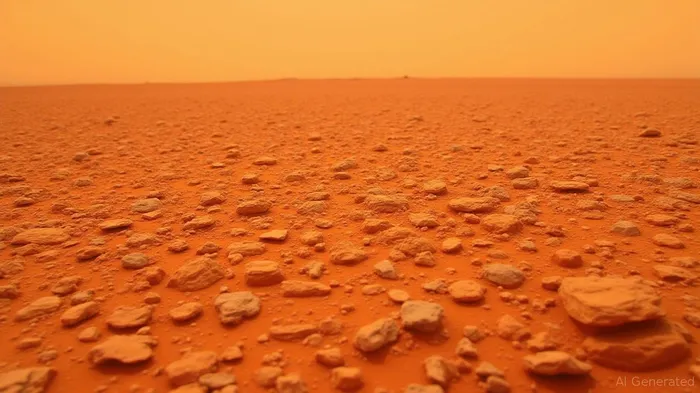
The boxwork patterns, found on Mount Sharp in Gale Crater, are networks of mineralized ridges composed of magnesium sulfates and calcium sulfates. These compounds suggest Mars transitioned from a wetter environment to a drier one, with subsurface water persisting long after surface water vanished. The presence of sulfates is particularly intriguing: on Earth, such minerals often form in saline environments that can sustain microbial life. This raises the possibility of preserved biosignatures—and the potential for Mars to host valuable minerals like rare earth elements or water ice, which could fuel future exploration.
Technological Breakthroughs: The Private Sector's Playbook
The boxwork findings have spurred innovation across three key sectors, each ripe for investment:
1. Robotics: Building Smarter, Stronger Machines
The need to explore Mars' rugged terrain and analyze its minerals has driven advancements in robotics. Firms like Lockheed Martin (LMT) are developing autonomous systems capable of navigating complex Martian landscapes, while Astrobotic (a CLPSCLPS-- partner) is refining lunar landers for payload delivery—technology easily adaptable to Mars missions.
Startups like Redwire Space are pushing boundaries with in-situ resource utilization (ISRU) technologies, such as 3D printing habitats from Martian regolith. Meanwhile, Blue Origin and SpaceX are tackling communication challenges with next-gen relay systems, critical for real-time data transmission between Mars and Earth.
2. Data Analytics: Turning Martian Data into Dollars
Curiosity's discoveries generate terabytes of data daily, requiring advanced analytics to map mineral deposits and optimize exploration routes. Companies like Planet Labs and Orbital Insight are already leveraging satellite imagery to identify resource-rich zones, while NASA's partnerships with IBM highlight AI's role in processing geological data.
The $9.15 billion global space mining market (projected to grow at a 20.68% CAGR to ontvang 2032) underscores the demand for data-driven insights. Investors should watch firms like AstroForge, which uses AI to pinpoint asteroid mineral content, and IMENSUS, whose seismic imaging tools map lunar subsurface resources.
3. Extraterrestrial Resource Extraction: The Next Gold Rush
The boxwork's sulfates and calcium deposits signal Mars' mineral wealth, from water ice (vital for fuel and hydration) to rare metals like platinum. Terra Luna (Canada) is pioneering lunar water refineries, while Aganitha Space (India) develops methane-based energy systems for sustainable missions.
Even more ambitious is Outer Rim Exploration (ORE), which uses muon-detection technology to probe asteroids for subsurface minerals. These firms are laying the groundwork for a future where space resources fuel Earth's industries—think lithium for batteries sourced from asteroids, or lunar ice supporting Mars colonies.
Investment Opportunities: Where to Look Now
The Mars boom is no longer a distant dream. Investors should prioritize firms with proven tech and strategic partnerships:
- Lockheed Martin (LMT): A leader in NASA's Mars relay programs and autonomous robotics.
- Redwire Space: Innovating in ISRU and 3D printing for in-space manufacturing.
- AstroForge: Pioneering asteroid mining with FCC-licensed deep-space operations.
- SpaceX (via ARKQ ETF): Benefiting from Starship's potential as a Mars transport workhorse.
For risk-tolerant investors, consider venture capital funds focused on space startups, such as Space Capital, which backs firms like Ethos Space (lunar regolith processing).
Risks and Considerations
Regulatory hurdles remain, particularly around space resource ownership. While the U.S. Commercial Space Launch Competitiveness Act allows private ownership of extracted resources, international treaties like the Moon Agreement (1979) remain unresolved. Investors must also weigh technological risks, such as the high cost of Mars landings and the unpredictability of extraterrestrial environments.
Conclusion: The Red Planet's Green Opportunities
Mars' boxwork patterns are more than a geological curiosity—they're a roadmap to commercialization. As firms like Blue Origin, Redwire, and Terra Luna translate discoveries into technologies, the space economy is primed for explosive growth. For investors, this is the time to allocate capital to robotics innovators, data analytics pioneers, and resource extraction visionaries. The next gold rush isn't on Earth—it's on Mars.
Investment Takeaway: Prioritize firms with scalable tech, strategic partnerships, and a focus on ISRU. The Red Planet's secrets could be the blue-chip investments of the next decade.

Delivering real-time insights and analysis on emerging financial trends and market movements.
Latest Articles
Stay ahead of the market.
Get curated U.S. market news, insights and key dates delivered to your inbox.




Comments
No comments yet