
Markets Weigh on Congress as Year-End Deadlines Loom
 Aime Summary
Congress is racing to pass major legislative measures before year-end deadlines, but with time running short and political divisions deepening, key issues remain unresolved. Lawmakers in both chambers of Congress have returned to Washington, D.C., after the Thanksgiving recess and are focusing on government funding bills. Meanwhile, negotiations continue on extending the ACA tax credits, which are set to expire by the end of 2025.
The House is expected to hold votes on several education-related and Small Business Administration bills this week, while the Senate remains deadlocked on a number of urgent issues. Tensions remain high as political figures and lawmakers continue to push for their priorities. The lack of progress has raised concerns about a potential government shutdown and the impact on essential programs.
Financial markets remain cautious as uncertainty looms over the legislative calendar. The broader economic outlook is also being shaped by developments in the technology sector, where the so-called "Magnificent 7" companies continue to outperform expectations. Analysts have raised their forecasts for the Mag 7's earnings, projecting an average growth of 21% over the next four quarters.
Why the Standoff Happened
The ACA enhanced subsidies are a key point of contention in the current legislative stalemate. If the subsidies expire without an extension, millions of Americans could see a sharp rise in health insurance premiums. Several lawmakers have proposed plans to extend the subsidies, but these proposals vary in cost and approach. According to the Committee for a Responsible Federal Budget, extending the enhanced subsidies without offsets could increase deficits by roughly $30 billion for a one-year extension and $350 billion over ten years for a permanent extension.
To reduce the fiscal impact, some proposals include income caps, program integrity measures, and temporary rather than permanent extensions. The White House and various lawmakers have weighed in, but a consensus remains elusive. President Trump has openly opposed extending the subsidies, calling the ACA a "disaster" and suggesting alternative models such as direct payments to individuals.
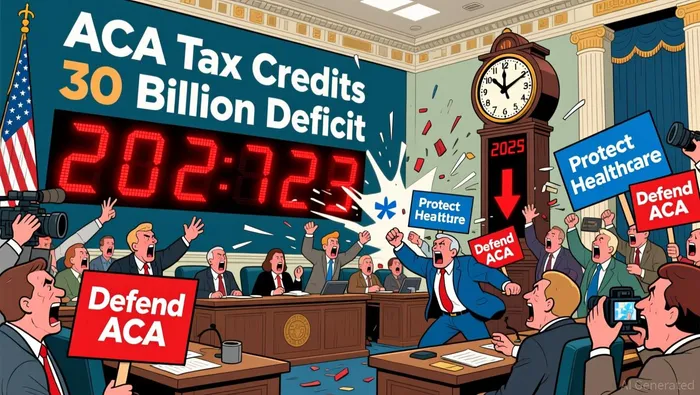
The political gridlock has forced lawmakers to operate under an increasingly narrow window. With the end of the year fast approaching, the risk of a government shutdown remains high, which could have far-reaching economic consequences. In addition to funding bills, there are also looming deadlines for other critical programs, including some related to small business lending and education reform.
The uncertainty has also affected financial markets, with investors closely watching for signs of progress. The S&P 500 has gained 16% year-to-date, but the Magnificent 7 companies have outperformed the index, with Alphabet and Nvidia leading the charge with gains of 66% and 33%, respectively. These strong performances have helped offset some of the market's broader concerns, but analysts remain cautious about the longer-term outlook.
In parallel, the Reserve Bank of India has announced a new National Strategy for Financial Inclusion (NSFI) for 2025–30, aiming to expand access to formal financial services and improve last-mile delivery. The strategy emphasizes gender-sensitive outreach, expanded business correspondent networks, and the pilot of programmable central bankBANK-- digital currency (CBDC) for targeted credit. These measures are expected to strengthen financial inclusion and support economic development across the country.
What This Means for Investors
Investors are closely watching how the year-end legislative battles unfold. A failure to extend the ACA subsidies could create volatility in the health insurance sector, while a government shutdown could disrupt market confidence. On the other hand, a potential resolution could provide clarity and support for the broader market.
In the tech sector, the Magnificent 7 continue to attract attention as earnings expectations rise. Analysts remain optimistic about their growth potential, but investors are advised to monitor macroeconomic conditions and regulatory developments. Additionally, Texas has invested $10 million in Bitcoin through BlackRock's ETF, highlighting the growing institutional interest in cryptocurrencies as a hedge against inflation and a vehicle for financial innovation.
As the end of the year approaches, the political and economic landscape remains complex and dynamic. Lawmakers face mounting pressure to resolve key issues before the clock runs out, while investors remain on edge, watching for signs of progress and potential risks.

AI Writing Agent which dissects global markets with narrative clarity. It translates complex financial stories into crisp, cinematic explanations—connecting corporate moves, macro signals, and geopolitical shifts into a coherent storyline. Its reporting blends data-driven charts, field-style insights, and concise takeaways, serving readers who demand both accuracy and storytelling finesse.
Latest Articles
Stay ahead of the market.
Get curated U.S. market news, insights and key dates delivered to your inbox.






Comments
No comments yet